Murderer
Murderer is a social deduction game in which players move freely around a space while one secretly designated player eliminates others by winking at them. When a player receives a wink, they count silently to five and then perform a dramatic death. Surviving players attempt to identify the murderer before everyone is eliminated. If a player suspects the murderer's identity, they may make an accusation. A wrong accusation eliminates the accuser. The game sharpens observational awareness, rewards bold physical commitment in the death scenes, and builds ensemble energy through the combination of tension, deception, and theatrical dying.
Structure
All players close their eyes. The facilitator taps one player on the shoulder, designating them as the murderer. Players open their eyes and begin moving freely around the space, making eye contact and interacting naturally.
The murderer eliminates players by making eye contact and winking. The wink must be discrete enough that other players do not see it. When a player receives a wink, they continue moving normally for a silent count of five and then perform a dramatic death: falling, staggering, gasping, and collapsing in the most theatrical manner possible.
Surviving players observe the deaths and try to identify the murderer. At any point, a player may raise a hand and declare an accusation. The game pauses. If a second player confirms the accusation, the accused reveals whether they are the murderer. If the accusation is correct, the game ends. If the accusation is wrong, both the accuser and the confirming player are eliminated.
The game continues until the murderer is correctly identified, until the murderer eliminates all other players, or until the facilitator calls the game at a natural peak.
Variations include multiple murderers, a detective role (one player can investigate by asking yes-or-no questions), and themed murder (the facilitator specifies a style for the deaths: slow motion, operatic, soap opera).
How to Teach It
How to Explain It
"One of you is the murderer. Only you know who you are. Your weapon is eye contact: when you catch someone's eye and wink, that person dies dramatically. The detective must identify the murderer before everyone is dead."
Murderer is an effective warm-up for building group energy, physical commitment, and observational awareness. The game requires no improv knowledge and works equally well with experienced performers and complete beginners.
Coach the death scenes for variety and commitment. Players who die the same way every round limit the game's entertainment value. Encourage creativity: die of shock, die of heartbreak, die while delivering a dramatic final speech to an imagined loved one. The death scenes are an opportunity for physical performance practice in a low-stakes context.
The game teaches deception and detection skills that transfer to scene work. A murderer who can maintain a neutral demeanor while eliminating targets is practicing the same composure that allows a character to hold a secret in a scene. A player who can read subtle behavioral shifts to identify the murderer is practicing the same observational acuity that makes a responsive scene partner.
The accusation mechanism teaches the cost of acting on insufficient evidence. Players who accuse too quickly, based on hunches rather than observation, learn that carelessness eliminates not just themselves but their confirming partner. This lesson in measured response transfers to scene work, where jumping to conclusions can derail a scene.
How to Perform It
The death scenes are the game's entertainment peak. Players who commit to dramatic, theatrical deaths create the energy and laughter that drive the game. A player who simply says "the character is dead" and sits down wastes the opportunity. Coach for maximum theatrical commitment: stagger across the room, deliver a final soliloquy, reach dramatically toward the light.
The murderer's skill is subtlety. A wink that is too obvious gives the game away too quickly. A wink that is too subtle may be missed by the target. The ideal wink is visible only to the target, requiring the murderer to manage eye contact and timing with precision.
The game's tension increases as the player count decreases. Late-game moments, when only three or four players remain and the murderer could be any of them, produce the most intense observational focus and the most dramatic accusations.
The game rewards attentiveness. Players who watch the room carefully, track who was looking at whom before each death, and notice behavioral patterns in the surviving players develop the observational skills the game is designed to train.
Audience Intro
"Someone in this game is the murderer. Watch for who is dying and try to identify the killer before everyone is dead. The detective will need your help."
Worth Reading
See all books →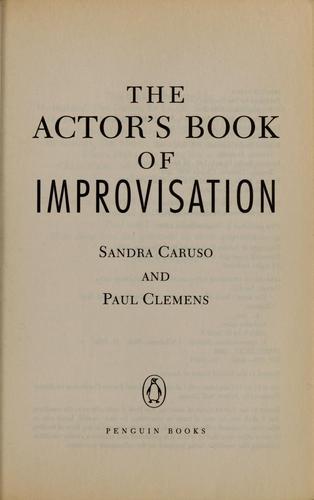
The Actor's Book of Improvisation
Sandra Caruso; Paul Clemens

Theatrical Improvisation
Short Form, Long Form, and Sketch-Based Improv
Jeanne Leep

The Improv Handbook
The Ultimate Guide to Improvising in Comedy, Theatre, and Beyond
Tom Salinsky; Deborah Frances-White

Acting Through Improv
Improv Through Theatresports
Lynda Belt; Rebecca Stockley

Improve
How I Discovered Improv Comedy and Conquered Social Anxiety
Alex Graudins

The Applied Improvisation Mindset
Tools for Transforming Individuals, Organizations, and Communities
Theresa Robbins Dudeck; Caitlin McClure
Related Games
Assassin
Assassin is a sustained social game in which each player is secretly assigned a target to "eliminate" through a discreet signal such as a wink, a specific word, or a light tap. Players circulate through the space or go about their normal activities while simultaneously hunting their assigned target and watching for signs that someone is hunting them. The game unfolds over an extended period, ranging from a single workshop session to an entire day or retreat. Assassin builds observational awareness, peripheral attention, and the ability to function on multiple levels of awareness simultaneously. The game is distinct from the exercise Assassins (a separate entry in the archive), which involves physical tag-style elimination in a defined space.
Mafia
Mafia is a social deduction game in which players are secretly assigned roles as either mafia members or innocent townspeople. During night rounds, the mafia silently selects a player to eliminate. During day rounds, the surviving group debates and votes to remove a suspected mafia member. The game develops skills in reading group dynamics, persuasion, deception detection, and the ability to maintain a role under pressure. Mafia is widely used as a social warm-up and trust-building exercise in improv training and applied improvisation contexts.
Murder Mystery
Murder Mystery is a long-form or short-form game in which the ensemble improvises a classic whodunit scenario, complete with a victim, suspects, clues, red herrings, and a dramatic reveal. The audience often suggests the victim, the setting, and the murder weapon, providing the raw material from which the ensemble constructs the mystery. The game demands careful narrative tracking, ensemble coordination, and the ability to plant information early that pays off in the final act. It rewards performers who can maintain the balance between genre fidelity and comedic invention.
Detective
Detective is a guessing game in which one player takes the role of an investigator while the remaining performers hold secret information about a crime, event, or scenario. The detective pieces together the story through questioning, observation, and deduction while the other performers communicate information indirectly through behavior, dialogue, and scene work rather than stating the answer directly. The game trains deductive reasoning, indirect communication, and the ability to convey information through subtext and physicality. Detective rewards both the guessing player's analytical skill and the ensemble's ability to provide clear, playable clues without giving the answer away.
The Lineage
Explore the schools and structures that influenced or evolved from Murderer.
112 Acting Games (Levy)
How to Reference This Page
The Improv Archive. (2026). Murderer. Retrieved September 28, 2026, from https://improvarchive.org/games/murderer
The Improv Archive. "Murderer." The Improv Archive, 2026. https://improvarchive.org/games/murderer.
The Improv Archive. "Murderer." The Improv Archive, 2026, https://improvarchive.org/games/murderer. Accessed September 28, 2026.
The Improv Archive is a systemically maintained repository. The archive itself acts as the corporate author.