Ali Farahnakian
Ali Farahnakian is a New York-based improv performer, teacher, and founder of The People's Improv Theater (The PIT), which he established in New York City on December 6, 2002, as a tribute to his mentor Del Close. A founding member of the Upright Citizens Brigade ensemble in Chicago, a writer on Saturday Night Live's 25th anniversary season, and a graduate of ImprovOlympic under Del Close, Farahnakian built The PIT into one of New York's significant independent improv training institutions, with notable alumni including Ellie Kemper, Kristen Schaal, and Hannibal Buress.
Career
After arriving in Chicago in late 1990, Farahnakian trained at The Second City and at ImprovOlympic under Del Close and Charna Halpern, becoming a house team member at ImprovOlympic in the early 1990s. At The Second City he studied sketch writing under Michael McCarthy and appeared in the Second City e.t.c. production 'The Revelation Will Not Be Televised,' directed by Jeff Richmond, for which he received a Jeff Award nomination for Best Actor in a Revue.
In fall 1991 Farahnakian joined the Upright Citizens Brigade ensemble as a founding member, alongside Matt Besser, Amy Poehler, Ian Roberts, and others. He co-created the UCB sketch show 'Virtual Reality' and toured nationally with UCB ensembles through the mid-1990s as the group developed the format and following that would eventually support their New York theatre.
In 1999, Farahnakian was hired as a writer for Saturday Night Live's 25th anniversary season. The writing team received a Writers Guild of America Award nomination in the Comedy/Variety category.
In 2001, he wrote and performed the one-man show 'Word of Mouth,' developed in one week in New York. While the show was running at the Second City e.t.c. in Chicago, it was selected for the U.S. Comedy Arts Festival in Aspen, where it premiered in the comedy arts competition context. He also appeared in the Steppenwolf Theatre Company's Mainstage production of Tony Kushner's 'Homebody/Kabul' during the 2002-2003 season, as well as at Brooklyn Academy of Music and Playwrights Horizons.
On December 6, 2002, Farahnakian founded The People's Improv Theater (The PIT) at 154 West 29th Street in Manhattan, in a 50-seat black-box venue in a building that had previously served as a synagogue and later a church. He named the theatre in honor of Del Close. The PIT offered long-form improvisation training and performance programming as an alternative to UCB's increasingly structured and competitive environment.
On December 31, 2010, The PIT expanded to 123 East 24th Street in the Flatiron district, opening the 99-seat PIT Striker and the 20-seat PIT Underground. In 2015, the original 29th Street location was formally designated the PIT Loft, giving the institution three operating venues. In 2018, Farahnakian opened a second PIT location at 462 West Franklin Street in Chapel Hill, North Carolina, in the space formerly occupied by DSI Comedy Theater. The Chapel Hill location closed permanently during the COVID-19 pandemic. In February 2021, the 24th Street Flatiron location also closed. The PIT Loft at 29th Street reopened in June 2021 and has continued to operate.
Film credits include 'Edge of Darkness' (2010), 'Arthur' (2011), and 'The Bourne Legacy' (2012). Television credits include recurring appearances in '30 Rock' and co-starring roles in 'Law and Order: Criminal Intent,' 'Law and Order: Special Victims Unit,' 'Louie,' 'Inside Amy Schumer,' and 'Unbreakable Kimmy Schmidt.' Three of his films screened at the Sundance Film Festival; one screened at Cannes.
Farahnakian launched the podcast 'Improv Your Life with Ali Farahnakian' in 2019 and 'Is This A Bad Time To Talk?' in 2021. He has taught SNL writing workshops at Philadelphia Improv Theater (2009) and appeared as a featured teacher at the North Carolina Comedy Arts Festival (2016), and has been an ongoing teacher at The PIT throughout its history.
Historical Context
The founding of The People's Improv Theater in 2002 responded to specific conditions in New York improv at the turn of the century. UCB Theater had established itself as the dominant New York improv institution after its founding in 1999, but its Harold team program was competitive and selective, leaving a gap in accessible long-form training for improvisers who were not selected for UCB house teams or who found the institutional environment restrictive.
Farahnakian's decision to name The PIT explicitly after Del Close was a statement of lineage: the theatre positioned itself in the tradition of Close's long-form work at ImprovOlympic rather than in the UCB theatrical tradition, even though Farahnakian himself had been a founding UCB member. The gesture acknowledged a divergence in approach between the Harold-focused Chicago pedagogy that Close represented and the character-driven sketch aesthetic that UCB had developed in New York.
The PIT's model of open-enrollment classes, accessible jams, and affordably priced programming created a different kind of institutional culture from UCB's audition-based house teams. The theatre's subsequent growth into three venues before the COVID contraction of 2021 documents the demand for that kind of open-access improv training in New York's highly competitive comedy market.
Teaching Philosophy
Farahnakian's pedagogical orientation traces directly to Del Close and the ImprovOlympic tradition of long-form ensemble work grounded in listening, commitment, and the Harold structure. His decision to name The PIT after Close was not merely honorific but programmatic: the theatre was built to transmit the Chicago long-form tradition rather than the more theatricalized UCB approach. His SNL writing workshops and North Carolina Comedy Arts Festival teaching expanded his pedagogical reach into professional comedy writing contexts beyond improv training specifically.
Legacy
Farahnakian's most consequential contribution to improv's institutional landscape is The PIT, which he built from a single 50-seat room in 2002 into a three-venue institution before the pandemic contractions of 2021 and which continues to operate at the PIT Loft. The theatre's alumni include Ellie Kemper, whose work in 'The Office' and 'Unbreakable Kimmy Schmidt' brought her to wide public recognition; Kristen Schaal, one of the most distinctive comic voices of her generation; and Hannibal Buress, one of the most influential comedians of the 2010s.
For the archive, Farahnakian represents the second generation of Chicago-trained improvisers who carried the Del Close tradition into new institutional contexts. His trajectory from ImprovOlympic house team member to UCB founding member to independent theatre founder in New York documents how the Chicago improv diaspora of the 1990s diversified the New York comedy ecosystem. His naming of The PIT after Del Close placed that inheritance explicitly in the public record.
Early Life and Training
Farahnakian was born on October 26, 1967, in Tehran, Iran. His family emigrated during his early childhood, settling first in Connecticut before relocating to North Carolina, where he grew up in the Winston-Salem area. He studied psychology and English at the University of North Carolina at Chapel Hill, graduating in 1990. In November 1990 he relocated to Chicago to pursue comedy.
Personal Life
Farahnakian was born in Tehran, Iran, and grew up in North Carolina after his family emigrated. He has been based in New York City since the early 1990s. He married Beth Saunders in September 2004.
Companies and Organizations
Associated venues and institutional relationships currently documented in the archive.
Recommended Reading
Books are ordered from the strongest direct connection outward to broader relevance.

Whose Improv Is It Anyway?
Beyond Second City
Amy E. Seham

The Second City Unscripted
Revolution and Revelation at the World-Famous Comedy Theater
Mike Thomas

Long Form Improvisation and American Comedy
The Harold
Matt Fotis
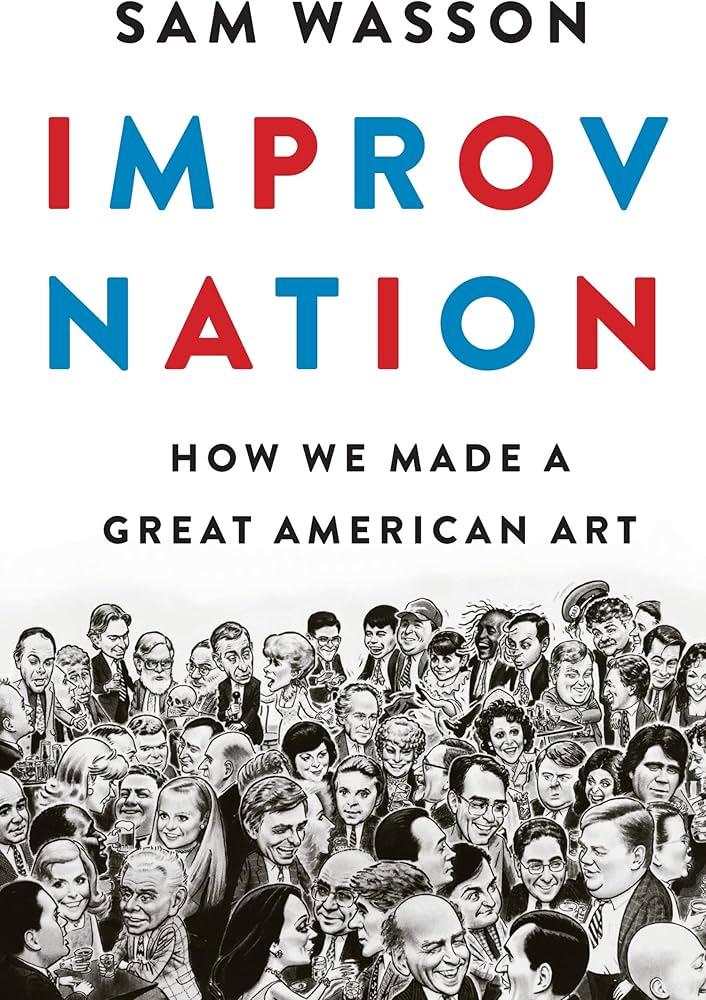
Improv Nation
How We Made a Great American Art
Sam Wasson

The Art of Chicago Improv
Short Cuts to Long-Form Improvisation
Rob Kozlowski

Truth in Comedy
The Manual of Improvisation
Charna Halpern; Del Close; Kim Howard Johnson
References
In the Archive
How to Reference This Page
The Improv Archive. (2026). Ali Farahnakian. Retrieved September 28, 2026, from https://improvarchive.org/people/ali-farahnakian
The Improv Archive. "Ali Farahnakian." The Improv Archive, 2026. https://improvarchive.org/people/ali-farahnakian.
The Improv Archive. "Ali Farahnakian." The Improv Archive, 2026, https://improvarchive.org/people/ali-farahnakian. Accessed September 28, 2026.
The Improv Archive is a systemically maintained repository. The archive itself acts as the corporate author.