David Pasquesi is a Chicago actor and improviser who trained with Del Close at iO Theater for fifteen years, performed four revues at The Second City Mainstage, and co-created the long-form improvisational duo TJ and Dave with T.J. Jagodowski beginning in 2002. His sustained commitment to the Harold form and his unscripted long-form practice with Jagodowski have established him as one of the most respected improvisers in the Chicago tradition. The New York Times described TJ and Dave as 'Second City-seasoned masters of long form improv,' and their monthly residency at Barrow Street Theatre in New York placed the Chicago-developed long form before Off-Broadway audiences for more than a decade.
Career
David Pasquesi was born on December 22, 1960, in Chicago, Illinois, and grew up in Lake Bluff, Illinois, in Lake County on Chicago's North Shore, residing on West Terrace Drive and later West Hawthorne Street through age nineteen. His mother Nancy immigrated from Italy; the family had ties to the Gonnella Baking Company. He attended Lake Forest High School, graduating in 1978, and subsequently enrolled at Loyola University Chicago, where he studied philosophy and earned his degree.
Pasquesi's introduction to improvisational performance came through his Loyola University roommate Joel Murray, who introduced him to improv classes in 1981. That initial exposure proved decisive. By 1984 Pasquesi had left office work entirely to pursue performance full-time.
His formal training began at iO Chicago (then ImprovOlympic) under Del Close, whose approach to the Harold form as a sustained, musiclike structure governed by group mind principles shaped Pasquesi's entire practice. Pasquesi studied with Close for fifteen years, until Close's death in 1999, one of the longest continuous student-teacher relationships in the Chicago improv tradition. During the early years of that training Pasquesi performed on Baron's Barracudas, one of the first Harold teams at iO, alongside Chris Farley and Joel Murray.
Pasquesi also joined The Second City, performing in four Mainstage revues over the course of his association with the theater. His work in 'The Gods Must Be Lazy' earned him a Jeff Award for Best Actor in a Revue in 1989. He also performed in 'It Was Thirty Years Ago Today' and 'Flag Smoking Permitted in Lobby Only,' among other productions.
On screen Pasquesi appeared in Light of Day (1987) and played the psychiatrist in Harold Ramis's Groundhog Day (1993), a role that became widely cited among fans of that film. His feature credits also include Claudio Vincenzi in Ron Howard's Angels and Demons (2009). His television work spans more than two decades: recurring appearances in Strangers with Candy, Curb Your Enthusiasm, and Lodge 49, and the role of Andrew Meyer across seven seasons of HBO's Veep (2012-2019), for which he received particular recognition for his work opposite Julia Louis-Dreyfus. He later appeared in She-Hulk: Attorney at Law (Disney+).
In 2002 Pasquesi began performing TJ and Dave with T.J. Jagodowski, a long-form improvisational duo format in which two performers create a complete, unscripted full-length show with no pre-established premise, character, or structure. The duo's performances at iO Chicago became one of the most-discussed ongoing improvisational events in the American comedy community. From 2006 onward TJ and Dave performed a monthly residency at Barrow Street Theatre in New York City, bringing their Chicago-rooted long-form practice to Off-Broadway audiences and establishing the pairing as one of the most sustained and critically regarded improvisational partnerships in American performance.
In 2015 Pasquesi co-authored Improvisation at the Speed of Life: The TJ and Dave Book with Jagodowski and Pam Victor, with a foreword by Amy Sedaris, published by Solo Roma. The book articulates the philosophical and practical approach underlying TJ and Dave's performances. Pasquesi has received the Chicago Improv Festival's Improviser of the Year honor. He holds dual United States and Italian citizenship and divides his time between Chicago and Bologna, Italy.
Historical Context
David Pasquesi's career documents the sustained development of the Harold form's long-form potential within the Chicago improv tradition over more than four decades. His fifteen-year training relationship with Del Close placed him among the practitioners closest to Close's evolving conception of the Harold as a structure governed by emergence rather than prescribed scenes, in which the group mind's shared attention generates connections and patterns that no individual performer plans in advance.
The Baron's Barracudas team on which Pasquesi performed in the early 1980s was among the first organized Harold ensembles at ImprovOlympic, a period when Close and Charna Halpern were still establishing the institutional framework that would eventually codify the Harold as the central form of the Chicago long-form tradition. Performing on that team alongside Chris Farley and Joel Murray placed Pasquesi at the generative moment of the Harold's development as a teachable and repeatable form.
His Second City Mainstage work ran concurrently with the iO relationship, meaning Pasquesi was simultaneously engaged in both the sketch-oriented revue tradition and the unscripted long-form tradition during the late 1980s and 1990s. The Jeff Award for Best Actor in a Revue in 1989 confirmed his standing within the Chicago theater community's formal recognition structures at a time when Second City and iO represented distinct, and to some practitioners competing, visions of what comedy performance could mean.
The formation of TJ and Dave in 2002 represented Pasquesi's most concentrated investment in the philosophical premises underlying long-form improv: that two sufficiently trained performers, attending fully to each other and to the emerging material, could sustain a full-length performance of genuine theatrical interest with no preparation beyond their shared practice. The duo's Barrow Street Theatre residency beginning in 2006 extended this argument to New York audiences, where the absence of games, premises, or visible structure made TJ and Dave's performances a sustained demonstration of what Harold-lineage long-form could produce at its most refined expression.
Teaching Philosophy
David Pasquesi's approach to long-form improvisation, as articulated in Improvisation at the Speed of Life and observable in his TJ and Dave performances, centers on present-moment attention as the sole reliable source of material in unscripted performance. The TJ and Dave method explicitly rejects premise, predetermined character, and audience suggestion as starting points, relying instead on the accumulated attention and responsiveness of two performers who have practiced listening to each other closely enough to recognize and develop what emerges organically in the first moments of a performance.
This approach places Pasquesi's teaching lineage firmly within the Del Close tradition, which held that the group mind, operating through full group attention rather than individual planning, generates more interesting and more surprising material than any performer could conceive in advance. Close's influence on Pasquesi's understanding of what improv is for is traceable throughout TJ and Dave's public discussions of their practice: the emphasis on serving the emerging material rather than performing for laughs, the commitment to character over joke, and the willingness to let scenes develop at whatever pace the material requires rather than accelerating toward resolution.
Pasquesi has described the fifteen years of study with Close as a sustained exposure to the possibility that improv could function as genuine theatrical performance rather than as a vehicle for comedy skill display. This distinction, between performance that pursues truth and performance that pursues laughter, is the philosophical axis around which TJ and Dave's approach revolves, and it grounds Pasquesi's teaching and his ongoing practice in the most consequential premises of the Chicago long-form tradition.
Legacy
David Pasquesi's position in the American improv tradition rests on three parallel contributions: his early participation in the Harold's institutional formation at ImprovOlympic, his sustained Second City Mainstage work during a pivotal decade in that theater's history, and his long-form partnership with T.J. Jagodowski, which has been cited by practitioners and critics as among the most rigorous ongoing realizations of the Harold form's philosophical premises.
TJ and Dave's work has influenced a generation of long-form practitioners who have studied their performances, their Barrow Street Theatre residency, and their book as primary texts for understanding what committed long-form performance looks like without the scaffolding of games, premises, or audience suggestion. The New York Times description of the duo as 'Second City-seasoned masters of long form improv' placed their practice within critical discourse at a level rarely achieved by improvisational partnerships operating outside mainstream entertainment contexts.
Pasquesi's film and television work, particularly Groundhog Day and seven seasons of Veep, has made him known to broad audiences who encounter his performance outside the improv community's frame of reference. His role as Andrew Meyer in Veep demonstrated that an actor trained primarily in the Harold and long-form traditions could sustain a complex recurring character across a full dramatic arc in prestige television.
Improvisation at the Speed of Life articulated the TJ and Dave approach in written form, contributing to the pedagogical literature of long-form improv alongside Keith Johnstone's Impro, Viola Spolin's Improvisation for the Theater, and the handful of other texts that practitioners treat as foundational. As the Chicago tradition's long-form practices continue to spread through international training programs, Pasquesi's name recurs as one of the practitioners whose work most directly embodies the form's aspirations at the highest level of execution.
Early Life and Training
David Pasquesi was born on December 22, 1960, in Chicago, Illinois. He grew up in Lake Bluff, Illinois, in Lake County north of Chicago, and attended Lake Forest High School, graduating in 1978. His mother Nancy was an immigrant from Italy; the family had connections to the Gonnella Baking Company in Chicago. He studied philosophy at Loyola University Chicago, where a friendship with roommate Joel Murray introduced him to improvisational performance around 1981.
Personal Life
David Pasquesi holds dual United States and Italian citizenship through his Italian family heritage. He divides his time between Chicago and Bologna, Italy.
Companies and Organizations
Associated venues and institutional relationships currently documented in the archive.
Recommended Reading
Books are ordered from the strongest direct connection outward to broader relevance.
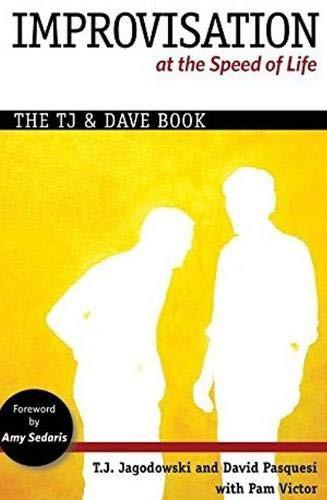
Improvisation at the Speed of Life
The TJ & Dave Book
T.J. Jagodowski; David Pasquesi; Pam Victor

Truth in Comedy
The Manual of Improvisation
Charna Halpern; Del Close; Kim Howard Johnson

Whose Improv Is It Anyway?
Beyond Second City
Amy E. Seham

The Funniest One in the Room
The Lives and Legends of Del Close
Kim Howard Johnson

The Second City Unscripted
Revolution and Revelation at the World-Famous Comedy Theater
Mike Thomas
Improv Nation
How We Made a Great American Art
Sam Wasson
References
In the Archive
How to Reference This Page
The Improv Archive. (2026). David Pasquesi. Retrieved September 28, 2026, from https://improvarchive.org/people/david-pasquesi
The Improv Archive. "David Pasquesi." The Improv Archive, 2026. https://improvarchive.org/people/david-pasquesi.
The Improv Archive. "David Pasquesi." The Improv Archive, 2026, https://improvarchive.org/people/david-pasquesi. Accessed September 28, 2026.
The Improv Archive is a systemically maintained repository. The archive itself acts as the corporate author.