Problem Solving
Problem Solving is an applied improvisation exercise from Business Improv in which teams tackle challenges using "Yes, And" principles and other improvisational techniques. Rather than following traditional analytical frameworks, participants generate solutions through rapid ideation, collaborative building, and the willingness to explore unconventional approaches.
Structure
Setup
Teams of four to six receive a problem statement. This can be a real organizational challenge brought by a participant or a fictional scenario provided by the facilitator. The facilitator establishes ground rules: all ideas are valid in the generation phase, building on others' contributions is required, and evaluation comes only after the ideation phase is complete.
Progression
In the first phase, the group brainstorms solutions using strict "Yes, And" rules. Every contribution must begin by accepting the previous idea and adding to it. No evaluation, no critique, no filtering. A timer runs for five to ten minutes.
In the second phase, the group reviews their generated ideas and identifies the three most promising solutions. The selection process itself uses improvisational principles: participants advocate for ideas by building on them further rather than by arguing against alternatives.
In the third phase, each selected solution receives a rapid prototype treatment. The team improvises a short scene or presentation showing the solution in action, making the abstract idea concrete and revealing practical considerations that pure discussion would miss.
Variations
A constraint version adds increasing limitations as the exercise progresses, forcing more creative thinking. A reversal version begins by solving the opposite problem (how to make this situation worse) before flipping the solutions. A stakeholder version has team members role-play different affected parties while evaluating solutions.
How to Teach It
Objectives
Problem Solving demonstrates that improvisational collaboration generates more diverse and creative solutions than traditional top-down or analytical approaches. The exercise builds the habits of building on others' ideas, deferring judgment during ideation, and making ideas tangible through action.
How to Explain It
"Your team has a problem to solve. For the next ten minutes, generate as many solutions as possible using 'Yes, And.' Every idea is valid. Build on what others offer. We evaluate later."
Scaffolding
Begin with a low-stakes fictional problem to establish the process. Once teams experience the flow of uncritical ideation, introduce real organizational challenges. The third-phase scene work may need encouragement if teams are not accustomed to improvising.
Common Pitfalls
The most common issue is participants who evaluate ideas during the generation phase, saying "Yes, and" while meaning "No, but." Watch for subtle blocking disguised as agreement and redirect to genuine building.
A second pitfall is groups that generate wild ideas without connection to the actual problem. Encourage building that stays tethered to the challenge. Creative does not mean irrelevant.
In Applied Settings
Problem Solving is used in innovation workshops, product development sessions, and organizational change management. The exercise provides teams with a structured alternative to conventional brainstorming that produces more diverse solutions. Facilitators use the scene-work phase to stress-test ideas in simulated real-world conditions, revealing strengths and weaknesses that discussion alone would not surface.
Skills Developed
Worth Reading
See all books →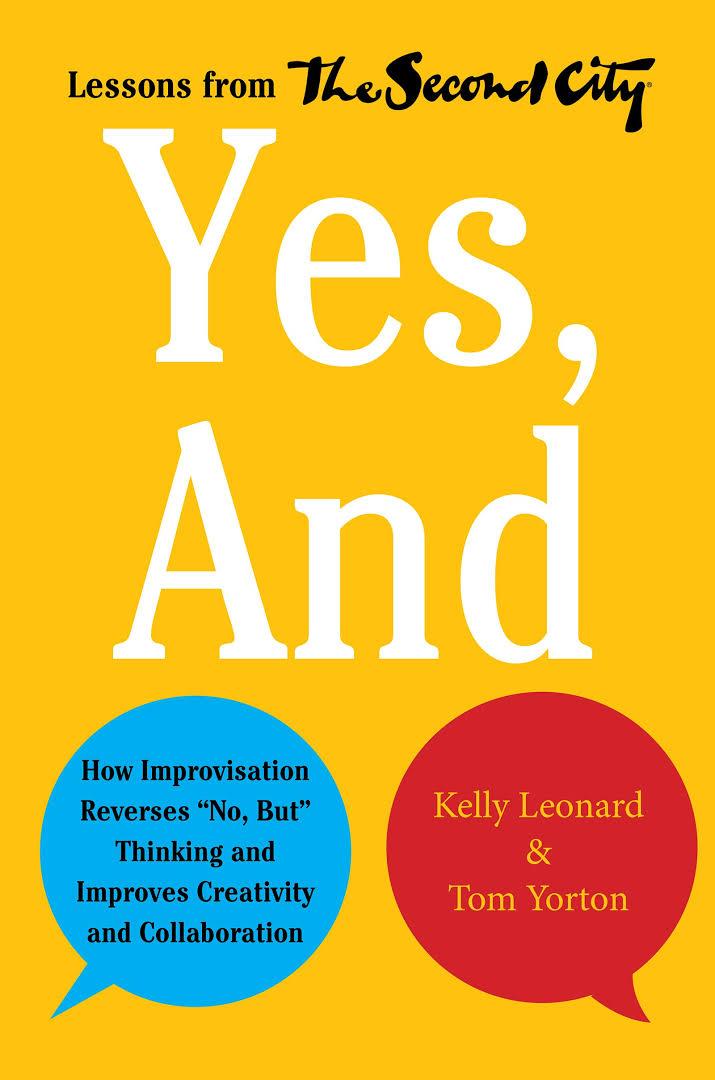
Yes, And
How Improvisation Reverses No, But Thinking and Improves Creativity and Collaboration
Kelly Leonard; Tom Yorton

Business Improv
Experiential Learning Exercises to Train Employees
Val Gee

Theatrical Improvisation
Short Form, Long Form, and Sketch-Based Improv
Jeanne Leep

The Routledge Companion to Improvisation in Organizations
Miguel Pina e Cunha; Dusya Vera; António Cunha Meneses

Improv Yourself
Business Spontaneity at the Speed of Thought
Joseph A. Keefe

Brain Disruption
Radical Innovation in Business Through Improv
Bruce Montgomery; Gail Montgomery
Related Exercises
Creative Solution Building
Creative Solution Building is an applied improvisation exercise in which participants use improvisational principles -- acceptance, building, and collaborative emergence -- to develop solutions to presented problems or scenarios. Rather than analyzing the problem and generating solutions individually, participants build solutions incrementally through a structured ensemble process, with each contribution extending and complying with what has already been offered.
Question Storming
Question Storming is an applied improvisation exercise from Max Dickins' Improvise! in which participants brainstorm questions rather than answers about a challenge. By reframing the creative process away from solutions and toward inquiry, the exercise reveals hidden assumptions, opens new angles of exploration, and demonstrates that asking the right question is often more valuable than generating quick answers.
Prioritizing
Prioritizing is an applied improvisation exercise from Business Improv in which teams practice rapid prioritization and decision-making under time pressure. Using improvisational techniques, participants learn to sort competing demands, make clear choices with incomplete information, and commit to a direction without prolonged deliberation.
Silo-Busting Exercise
Silo-Busting Exercise is an applied improvisation exercise in which a team facing a real challenge invites people from a completely separate department to join their brainstorming session. The outside participants bring fresh perspectives, unfamiliar frameworks, and no institutional assumptions, breaking the echo-chamber dynamic that limits innovation within isolated teams.
Managing Change
Managing Change is an applied improv exercise that uses structured improvisation to help participants navigate and practice the psychological and behavioral responses to unexpected change in organizational contexts. The exercise creates controlled conditions of disruption and adaptation, training the specific skills of remaining present, communicating openly, and collaborating effectively when plans, expectations, or structures are suddenly altered.
Do More with Less
Do More with Less is an applied improvisation exercise inspired by the improvisational principle that constraints generate creativity. Participants identify a real or hypothetical problem they face with limited resources, then use constraint-based thinking to generate solutions that work without the resources they think they need. The exercise challenges the assumption that more resources automatically produce better solutions.
The Lineage
Explore the schools and structures that influenced or evolved from Problem Solving.
Business Improv (Gee & Gee)
How to Reference This Page
The Improv Archive. (2026). Problem Solving. Retrieved September 28, 2026, from https://improvarchive.org/exercises/problem-solving
The Improv Archive. "Problem Solving." The Improv Archive, 2026. https://improvarchive.org/exercises/problem-solving.
The Improv Archive. "Problem Solving." The Improv Archive, 2026, https://improvarchive.org/exercises/problem-solving. Accessed September 28, 2026.
The Improv Archive is a systemically maintained repository. The archive itself acts as the corporate author.