Solo Sevens
Solo Sevens is a rapid-fire brainstorming exercise in which a participant thinks of a category and rapidly names seven things in that category as fast as possible, including made-up answers, to build fluency and overcome the internal censor that blocks creative output.
Structure
Setup
Participants can work individually or in pairs. The facilitator explains the format: choose a category, then name seven items in that category as quickly as possible. Speed matters more than accuracy. Made-up answers are not only acceptable but encouraged.
The Exercise
A participant picks or is given a category: types of fish, things in a garage, reasons to call in sick. They then rattle off seven items as fast as they can. The first three or four answers come easily because they are obvious. The fifth and sixth require more effort. The seventh often produces the most creative or unexpected answer because the obvious options have been exhausted.
The exercise deliberately pushes past the point of easy answers. When the obvious responses run out, the participant must generate something from nothing. This is the moment where creativity happens: not in the comfortable zone of known answers but in the stretch beyond it.
Multiple Rounds
Participants repeat the exercise with new categories. Each round trains the same muscle: overriding the impulse to pause, filter, or evaluate before speaking. The speed requirement bypasses the internal editor that typically suppresses unusual or risky ideas.
Partner Variation
In the partner version, one person calls out categories while the other produces the seven items. The caller can increase the pace by providing new categories immediately after the seventh item, creating a sustained stream of rapid generation.
How to Teach It
Objectives
Solo Sevens develops rapid ideation, tolerance for imperfect answers, and the ability to push past obvious first responses to reach more creative territory. It trains the skill of generating volume before quality, which is fundamental to both improvisation and creative brainstorming.
How to Explain It
"Pick a category. Name seven things in that category as fast as you can. If you run out of real answers, make something up. The point is speed, not accuracy. The best ideas often come after you have used up all the obvious ones."
Scaffolding
Begin with easy categories that have many obvious answers: colors, animals, countries. Progress to narrower categories that exhaust obvious answers faster: types of cheese, things in a dentist's office, reasons to leave a party. The narrower the category, the sooner participants must generate creative responses.
Common Pitfalls
The primary pitfall is participants who slow down to think of "good" answers. The exercise only works at speed. Coach participants to keep talking even when their mind goes blank. Another issue is participants who stop at five or six, satisfied with having gotten most of the list. The seventh item is where the exercise delivers its greatest value.
In Applied Settings
Innovation Training
Solo Sevens translates directly to brainstorming methodology. The exercise demonstrates that the best ideas often come after the obvious ones are exhausted, which supports the innovation principle of generating quantity before evaluating quality.
Meeting Warm-Ups
The exercise works as a brief energizer before ideation sessions. A few rounds of Solo Sevens loosens the group's creative fluency and establishes a norm of rapid, uncensored idea generation that carries into the subsequent discussion.
Facilitation Notes
In professional settings, debrief by asking which answers surprised them and whether any of the "made-up" responses turned out to be more interesting than the obvious ones. This often reveals that the pressure to move fast produces ideas that careful deliberation would never surface.
Skills Developed
Worth Reading
See all books →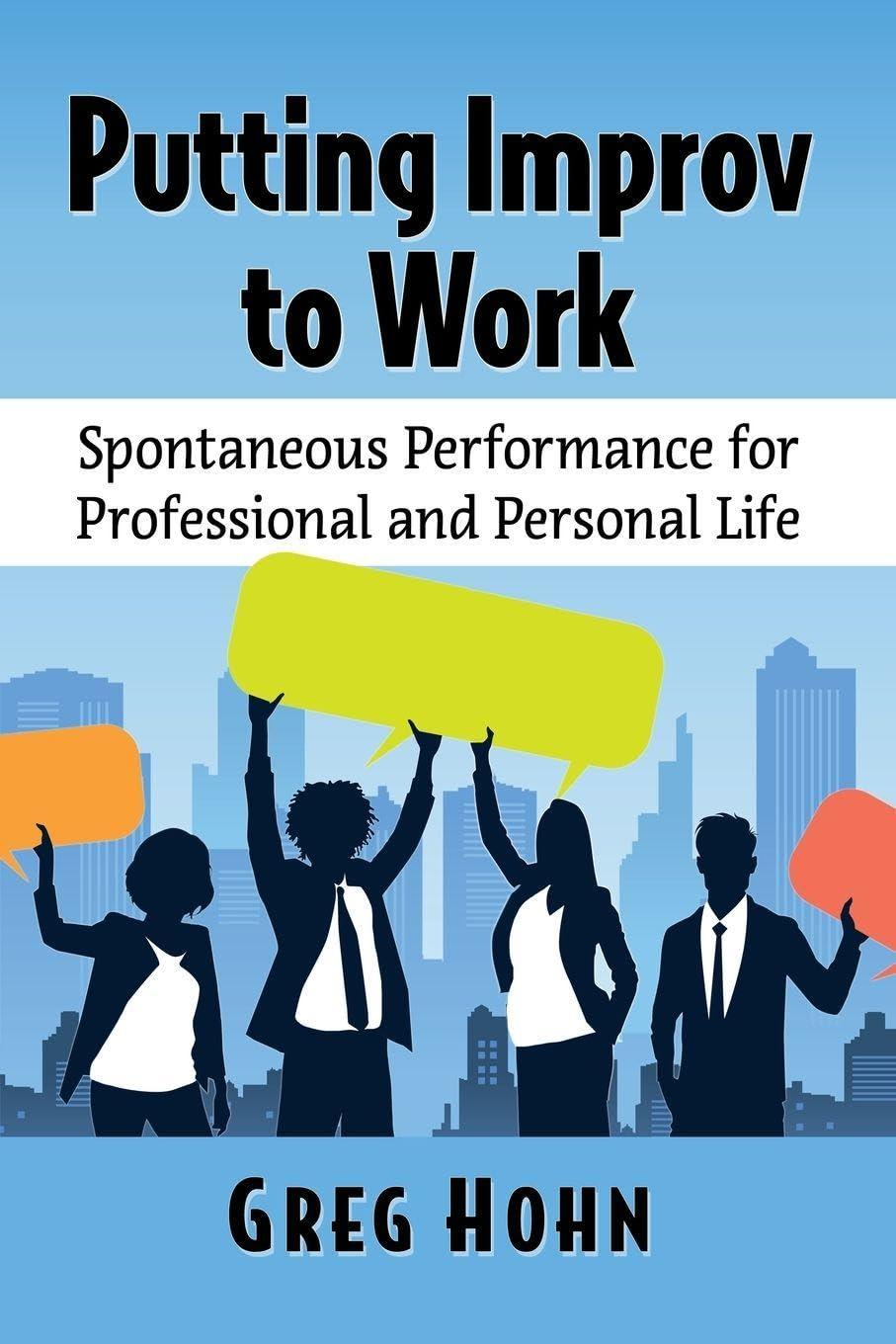
Putting Improv to Work
Spontaneous Performance for Leadership, Learning, and Life
Greg Hohn

The Improv Mindset
How to Make Improvisation Your Superpower for Success
Keith Saltojanes
Theater Games for the Lone Actor
Viola Spolin

Group Improvisation
The Manual of Ensemble Improv Games
Peter Campbell Gwinn; Charna Halpern

The Art of Making Sh!t Up
Using the Principles of Improv to Become an Unstoppable Powerhouse
Norm LaViolette; Bob Melley

Improv Yourself
Business Spontaneity at the Speed of Thought
Joseph A. Keefe
Related Exercises
Just Seven Words
Just Seven Words is an applied improv exercise that constrains each participant to responding with exactly seven words -- no more, no fewer. The constraint forces deliberate word choice, disrupts habitual overexplanation, and trains the ability to communicate precisely and completely within a tight limit. The exercise is used in applied improv to develop conciseness, clarity, and the discipline of editing thought before speaking.
Turbocharged Brainstorm
Turbocharged Brainstorm is an applied exercise in which participants generate ideas at maximum speed for a compressed time period, prioritizing volume and velocity over evaluation. The exercise uses time pressure and competition as catalysts to bypass the inner critic and access the full range of a group's generative capacity.
Out of the Box
Out of the Box is a partnered exercise in which one person leads another around the room, pointing to objects, and the other must immediately name each object as anything other than what it actually is. A chair becomes a volcano, a lamp becomes a saxophone. The exercise breaks habitual thinking patterns and trains participants to override the labeling instinct, building the rapid creative association that underlies strong improvisation and innovative thinking.
Seven Up
Seven Up is a focus exercise in which players count from one to seven in a circle, but the player who lands on seven must perform a designated action, such as sitting down, making a sound, or changing direction. The exercise trains group awareness and concentration through a simple counting pattern with a recurring disruptive element.
Status Shuffle
Status Shuffle is a group ideation exercise that uses playing cards to determine status levels across multiple rounds. Participants experience different status positions within a team brainstorming context, discovering how status affects contribution, idea ownership, and group dynamics.
Silo-Busting Exercise
Silo-Busting Exercise is an applied improvisation exercise in which a team facing a real challenge invites people from a completely separate department to join their brainstorming session. The outside participants bring fresh perspectives, unfamiliar frameworks, and no institutional assumptions, breaking the echo-chamber dynamic that limits innovation within isolated teams.
The Lineage
Explore the schools and structures that influenced or evolved from Solo Sevens.
Putting Improv to Work (Hohn)
How to Reference This Page
The Improv Archive. (2026). Solo Sevens. Retrieved September 28, 2026, from https://improvarchive.org/exercises/solo-sevens
The Improv Archive. "Solo Sevens." The Improv Archive, 2026. https://improvarchive.org/exercises/solo-sevens.
The Improv Archive. "Solo Sevens." The Improv Archive, 2026, https://improvarchive.org/exercises/solo-sevens. Accessed September 28, 2026.
The Improv Archive is a systemically maintained repository. The archive itself acts as the corporate author.