The Party
The Party is an improvisational game in which players take on character identities and interact at a simulated social gathering. In the most widely documented variant, each player is assigned a character they do not know (the identity is written on a card or otherwise concealed) and fellow guests drop subtle conversational hints to help the player deduce who they are. The game develops listening, subtext, and character awareness simultaneously.
Structure
Setup
The facilitator assigns each player a character identity: typically a well-known figure, archetypal role, or recognizable profession. The character is written on a card and attached to the player's back, or whispered to all players except the one being assigned. The player being assigned does not know their own identity. Multiple players can be assigned simultaneously if the group is large enough.
A host is designated. All other players are guests arriving at the party.
Gameplay
Players mingle as if at an actual social gathering. When addressing a player whose identity they know, guests drop subtle hints through casual conversation: references to the character's known traits, domain, history, or associations. The hints should be genuine party conversation, not obvious declarations.
Gavin Levy gives the example: if a player has been assigned Santa Claus, appropriate hints might include remarks about busy seasons, cold weather, or generous spirit, without naming the character directly. Guests should calibrate hint subtlety to the group's skill level.
The assigned player must engage with fellow guests, listen carefully to the hints being dropped, and attempt to identify their character from the accumulating evidence. A player may make a guess when they believe they have enough information. The facilitator confirms or denies the guess.
Conclusion
The round concludes when the player correctly identifies their character, or when the facilitator ends the scene. In multiple-player rounds, all assigned players work simultaneously; the game ends when all have identified themselves or time is called.
Variation
In larger groups or ensemble formats, the game can be run without a host: all players are guests with assigned characters, and the social mingling doubles as mutual revelation. This variant places more weight on sustained character physicality alongside the guessing mechanic.
How to Teach It
Objectives
The Party develops subtext delivery: the skill of conveying meaning indirectly through implication rather than direct statement. Guests must communicate identity information while maintaining the fiction of natural social conversation. This requires players to think about what their character would know about the assigned character and how they would casually reference that knowledge.
Simultaneously, the assigned player practices active listening, pattern recognition across multiple voices, and sustained engagement while uncertain of their own context, a useful analogue for scene work in which a character's situation is revealed incrementally.
How to Explain It
"Everyone except one person knows who that person is. Your job as a guest is to give hints through natural conversation, not riddles. Keep it social. If you were Santa Claus, a guest might say, 'I love your work this time of year.' The player in the middle is trying to figure out who they are based only on what people say to them. Ready? Let's set up the party."
Scaffolding
For groups new to subtext, begin with highly legible characters: major historical figures, iconic pop culture characters. Allow more obvious hints. As players develop facility, tighten the hint requirements so hints feel like genuine party conversation rather than puzzle clues.
For applied improvisation contexts, the character assignments can be thematic to organizational work: professional roles, workplace archetypes, leadership styles. The guessing mechanic becomes a light frame for exploring identity and perception within teams.
Common Notes
"Give a hint that any guest at this party might plausibly say: not a riddle, a remark."
"You do not know who you are, but you know what kind of party this is. Act accordingly."
"Guests: support the player. You are trying to help them figure it out, not stump them."
Common Pitfalls
Guests frequently over-explain, turning hints into obvious clues that undercut the subtext exercise. Coach for implication over declaration.
The assigned player can become passive, waiting for hints rather than engaging as a character. Remind players that they have a role at the party regardless of whether they know who they are.
How to Perform It
On Stage
The Party works well as a demonstration game for audiences unfamiliar with improvisational techniques, because the guessing mechanic gives the audience privileged information (they can see the character card) that the player does not have. This information asymmetry creates a built-in comedic tension as the player struggles to piece together what the audience already knows.
For performance contexts, assigning culturally legible characters (well-known public figures, iconic archetypes) ensures the audience can participate in the hint-recognition game alongside the performing guests. Obscure or highly technical character assignments undermine the audience experience.
Pacing
The assigned player's journey from confusion to recognition provides the dramatic arc. Directors should resist ending the game too quickly: some productive struggle before the breakthrough pays off comedically. A player who guesses on the third hint provides less entertainment than one who works through a dozen increasingly obvious clues before the penny drops.
History
The Party as a character-guessing game is documented by Gavin Levy in 112 Acting Games (2005). Levy frames the game as a way to practice subtext and hint-giving while developing social awareness and listening skills in an ensemble context.
Party scenes as a container for character work and status play appear throughout improvisational traditions independently of the guessing mechanic. Keith Johnstone's status work in Impro (1979) describes social gatherings as natural sites for status transactions, and party scenarios appear as recurring set-ups in ensemble exercise curricula across traditions.
The specific character-assignment-and-guessing format shares structural DNA with parlor games and theatrical party games predating the improvisation tradition. No single originator of this format has been identified within the improv canon.
Worth Reading
See all books →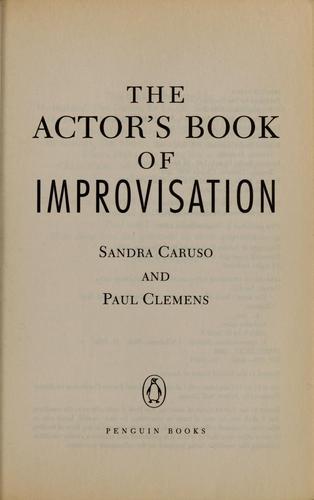
The Actor's Book of Improvisation
Sandra Caruso; Paul Clemens

The Young Actor's Book of Improvisation
Dramatic Situations
Sandra Caruso; Susan Kosoff

The Art of Chicago Improv
Short Cuts to Long-Form Improvisation
Rob Kozlowski

Mask Improvisation for Actor Training and Performance
the compelling image
Sears A. Eldredge

Acting Up!
An Innovative Approach to Creative Drama for Older Adults
Marcie Telander; Flora Quinlan; Karol Verson

Applied Improvisation
Leading, Collaborating, and Creating Beyond the Theatre
Theresa Robbins Dudeck; Caitlin McClure
Related Games
Id
Id is a scene game in which a performer's unfiltered subconscious desires are voiced by a second player, creating a running commentary of primal wants beneath the surface dialogue. The tension between polite conversation and raw impulse generates comedy and dramatic irony. The game highlights the gap between social behavior and inner life.
Cards
Cards is a short-form game in which performers draw playing cards that assign them secret emotions, character traits, or scene constraints they must incorporate into the scene. The random assignment prevents pre-planning and forces genuine in-the-moment adaptation. The game rewards the ability to make any given constraint appear natural.
Bartender
Bartender is a short-form guessing game in which one player tends bar while several patrons, each endowed with a secret character trait, identity, or quirk by the audience, attempt to communicate their assignments through behavior, dialogue, and physical choices. The bartender must identify each patron's secret while maintaining the scene and keeping the bar running. The game belongs to the family of guessing games (alongside Party Quirks and Psychiatrist) and creates comedy through the tension between the patrons' increasingly obvious clues and the bartender's attempts to decode them. The bar setting provides a natural framework for one-on-one interactions, character reveals, and the rotating focus that guessing games require.
Presents
Presents is a short-form game and warm-up exercise in which players mime giving and receiving wrapped gifts. The recipient opens the imaginary package and enthusiastically identifies what is inside through physical reaction and commitment, while the giver must accept whatever the recipient names. The game trains object work, acceptance, and generous physical commitment to offers.
Who Am I?
Who Am I is a guessing game and character exercise in which one participant is assigned or endowed with an identity, fictional character, or real person visible to everyone else, and must determine that identity through yes/no questions or through reading other performers' reactions, training endowment, characterization, and observational reasoning.
How to Reference This Page
The Improv Archive. (2026). The Party. Retrieved September 28, 2026, from https://improvarchive.org/games/the-party
The Improv Archive. "The Party." The Improv Archive, 2026. https://improvarchive.org/games/the-party.
The Improv Archive. "The Party." The Improv Archive, 2026, https://improvarchive.org/games/the-party. Accessed September 28, 2026.
The Improv Archive is a systemically maintained repository. The archive itself acts as the corporate author.