Augusto Boal
Augusto Boal (1931-2009) was the Brazilian theatre director, theorist, and political activist who created the Theatre of the Oppressed, a system of participatory theatrical forms that turned passive spectators into active collaborators and placed improvisation at the center of democratic, educational, and anti-oppression practice. Although his work sits partly outside mainstream comedy improv, it is indispensable to the field's history because he expanded the horizon of what audience participation, improvised intervention, and collective performance could mean. His core forms, including Forum Theatre, Image Theatre, and Invisible Theatre, spread across six continents and became foundational to applied theatre, community performance, and socially engaged practice worldwide.
Career
From 1956 to 1971 Boal worked as co-director and artistic innovator at Teatro de Arena in Sao Paulo, one of Brazil's most politically engaged companies. At Arena he developed a series of approaches that pushed performance toward collective inquiry, drawing on what he had absorbed from Brecht and Piscator and shaping it for Brazilian audiences and Brazilian social realities. In 1965 he co-authored Arena Conta Zumbi with playwright Gianfrancesco Guarnieri, a production that introduced the Joker System, a structural device allowing performers to interrupt scenes and invite audience comment or intervention. That technique was among the earliest formal experiments in what would become Forum Theatre.
Boal also developed newspaper theatre during this period, a set of exercises using journalistic texts as raw material for performance and social analysis. These approaches were designed to activate audiences shaped by censorship, inequality, and authoritarian political pressure. The work was not abstract pedagogy. It was theatre made under conditions where political engagement carried serious risk.
In October 1971 Boal was arrested by Brazil's military dictatorship, tortured during four months of detention, and subsequently forced into exile. He spent the next fifteen years in Argentina, Peru, France, and Portugal. During exile in Peru in 1973, he developed Forum Theatre in close dialogue with the literacy pedagogy of Paulo Freire, whose Pedagogy of the Oppressed had articulated a parallel critique of passive reception in education. The dialogue between the two thinkers gave Boal's theatrical methods a philosophical grounding in praxis, the integration of reflection and action as the basis of genuine learning.
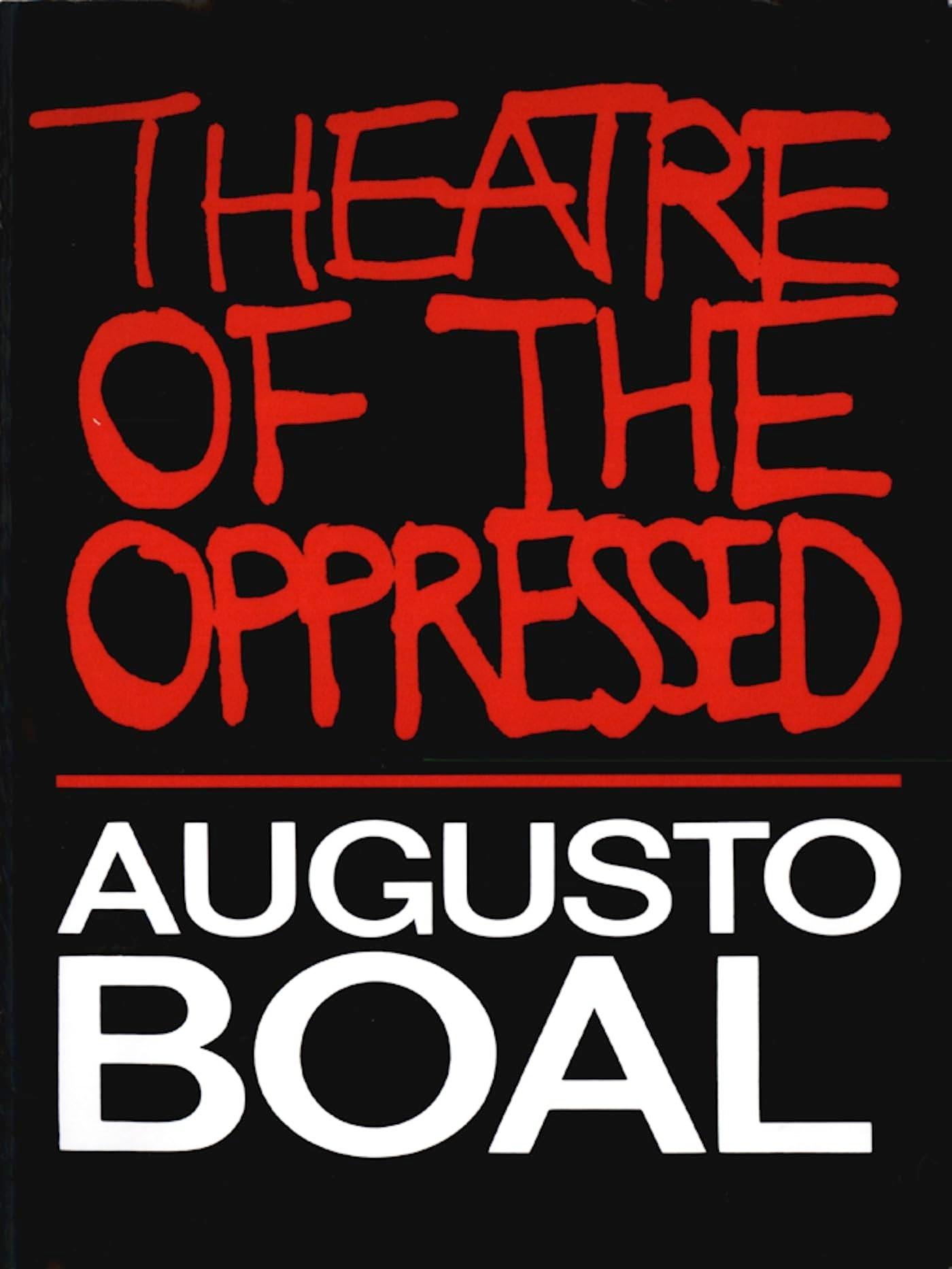
Around 1977 Boal relocated to Paris, where he established a Center for Theatre of the Oppressed and organized international festivals that spread the methods across Europe and Latin America. His first major theoretical text, Teatro do Oprimido, had appeared in Portuguese in 1974 and was translated into English as Theatre of the Oppressed in 1979. Games for Actors and Non-Actors followed in 1992, providing more than 200 practical exercises. Later texts including The Rainbow of Desire (1995), Legislative Theatre (1998), and The Aesthetics of the Oppressed (2006) extended the system into psychotherapeutic and civic domains.
Boal returned to Brazil in 1986 after the post-dictatorship amnesty. He founded the Centro de Teatro do Oprimido (CTO-Rio) in Rio de Janeiro, which by the early 2000s had trained more than a thousand facilitators. From 1992 to 1996 he served as a vereador (city councillor) in Rio de Janeiro on the Workers' Party ticket. In that role he implemented Legislative Theatre, a method through which citizen performance forums generated formal legislative proposals. Of roughly seventy bills introduced, thirteen became municipal law. He also established nineteen permanent Theatre of the Oppressed groups across thirteen administrative regions of the city, embedding the practice in civic infrastructure. Boal died on May 2, 2009, from respiratory failure related to leukemia, at Hospital Samaritano in Rio de Janeiro.
Historical Context
Boal's position in improv history is distinctive but fundamental. He did not build a comedy-school lineage comparable to The Second City or iO, and his starting point was political theatre rather than comedic performance. What he contributed was something of equal importance: a rigorous theoretical and practical account of what improvisation, audience participation, and live theatrical encounter could do when their purpose was collective civic inquiry rather than entertainment.
His critique of Aristotelian catharsis, the idea that spectatorship allows emotional release without demanding active engagement, gave improv and participatory theatre a new philosophical frame. He argued that passive audiences perpetuate passive citizens, and that the point of theatrical encounter was to produce spect-actors who could intervene, test alternatives, and rehearse real action. That argument influenced applied theatre, educational drama, and community performance in ways that still extend through the field.
Boal's methods also arrived at improvisation from a direction that complemented but differed from the University of Chicago lineage represented by Viola Spolin and Paul Sills. Where Spolin developed games to free performers and direct spontaneous creativity, Boal developed games to expose social structures and rehearse resistance to them. That complementary tradition expanded the available vocabulary for thinking about what improvisation could do and why it mattered.
His collaboration with Paulo Freire, developed during the Peruvian exile, linked theatre methodology to the most influential strand of critical pedagogy in the twentieth century. That link gave Boal's methods a readership and a practitioner network far beyond performance. Applied improv, conflict resolution, social work training, and humanitarian education all absorbed his frameworks in ways that remain active today.
Key Events
Augusto Boal, Creator of Theatre of the Oppressed, Dies in Rio de Janeiro
Augusto Boal died on May 2, 2009 in Rio de Janeiro at the age of 78. The Brazilian theatre director created Theatre of the Oppressed, a system of participatory theatrical forms that influenced applied improvisation worldwide. His techniques of Forum Theatre and Image Theatre became foundational tools for community-based and social justice theatre.
Teaching Philosophy
Boal taught that theatre should move from monologue to dialogue, and that the fundamental act of theatrical education was de-mechanizing the body and the social imagination. His exercises begin with physical awareness and sensory perception, then build toward the capacity to construct and analyze social images and to intervene in dramatic situations with genuine agency.
Improvisation in his system is not free play for its own sake. It is a means of testing action under pressure. Participants build images, scenes, and interventions that expose power relations, then use performance as a laboratory for discovering whether alternative behavior is imaginable or effective. The event has to remain open enough for that inquiry to proceed, which is why improvisation is structural rather than incidental to his method.
His concept of the Joker, the skilled facilitator who guides the event without dominating it, represents a specific theory of facilitation: the expert holds process, not content. The knowledge of the room remains distributed among participants, and the facilitator's task is to keep inquiry alive rather than direct outcomes. That model has influenced facilitation practice in applied theatre, organizational development, and conflict transformation well beyond the theatrical context in which Boal originally defined it.
Legacy
Boal's legacy extends through applied theatre, education, community performance, conflict resolution, prison arts, and activist practice on nearly every continent. Theatre of the Oppressed became not a single institution but a replicable method, and the CTO-Rio trained more than a thousand facilitators before his death, spreading the practice through communities confronting racism, labor exploitation, gender violence, authoritarian governance, and internalized oppression.
His books remain foundational because they preserve both philosophy and practice. Theatre of the Oppressed, Games for Actors and Non-Actors, The Rainbow of Desire, and Legislative Theatre give practitioners games, structures, and ethical stakes rather than vague inspiration, which is why the work continues to renew itself across disciplines and generations. Performance studies curricula at institutions including New York University incorporated his frameworks, ensuring that his methods shaped not only practitioners but researchers and theorists working across theatre, education, and social science.
His Legislative Theatre work in Rio de Janeiro, which resulted in thirteen municipal laws generated through citizen performance forums, demonstrated that the methods could function as genuine civic infrastructure rather than community arts programming. That demonstration expanded the imaginative horizon for what participatory performance could accomplish.
For improv history, Boal matters because he permanently widened the frame. He proved that improvisation could serve as a tool for collective agency and democratic rehearsal, not only for professional entertainment or personal development. That expansion remains one of the most important arguments for the social relevance of the art form.
Early Life and Training
Boal was born on March 16, 1931, in Rio de Janeiro, the son of a bakery owner. He completed a degree in chemical engineering at the University of Brazil in 1952, and around the same time he began studying theatre at Columbia University in New York under the critic John Gassner. That formation, simultaneously technical and theatrical, proved consequential. At Columbia he encountered the work of Bertolt Brecht and Erwin Piscator, directors whose approaches subordinated stage aesthetics to social and political analysis. Those models gave Boal a vocabulary for thinking about how theatre could function as critique rather than entertainment, and they shaped everything he built in Brazil and in exile.
Personal Life
Boal was born on March 16, 1931, in Rio de Janeiro, the son of a bakery owner named Jose Augusto Boal and his wife Albertina Pinto Boal. He trained first as a chemical engineer and later as a theatre practitioner, spending time in New York at Columbia University in the early 1950s before returning to Brazil. Following his arrest and torture in 1971, he spent fifteen years in exile before returning to Rio de Janeiro in 1986. He died on May 2, 2009, at Hospital Samaritano in Rio de Janeiro, from respiratory failure caused by leukemia. He was seventy-eight years old.
Games and Formats
Formats, games, and exercises originated by or closely associated with this person.
Recommended Reading
Books are ordered from the strongest direct connection outward to broader relevance.

Legislative Theatre
Using Performance to Make Politics
Augusto Boal
Theatre of the Oppressed
Augusto Boal

Impro
Improvisation and the Theatre
Keith Johnstone

The Improv Handbook
The Ultimate Guide to Improvising in Comedy, Theatre, and Beyond
Tom Salinsky; Deborah Frances-White

Theatrical Improvisation
Short Form, Long Form, and Sketch-Based Improv
Jeanne Leep

Devising Theatre
A Practical and Theoretical Handbook
Alison Oddey
References
In the Archive
External Sources
How to Reference This Page
The Improv Archive. (2026). Augusto Boal. Retrieved September 28, 2026, from https://improvarchive.org/people/augusto-boal
The Improv Archive. "Augusto Boal." The Improv Archive, 2026. https://improvarchive.org/people/augusto-boal.
The Improv Archive. "Augusto Boal." The Improv Archive, 2026, https://improvarchive.org/people/augusto-boal. Accessed September 28, 2026.
The Improv Archive is a systemically maintained repository. The archive itself acts as the corporate author.