Mick Napier (born 1962) is the founder of The Annoyance Theatre in Chicago, a director, teacher, and author whose work defined one of the field's most influential counter-traditions to conventional improv pedagogy. Where other schools emphasized agreement, politeness, and inherited rules, Napier built a practice around stronger individual choices, stranger material, and a belief that improvisers become better scene partners by becoming more powerful players rather than more deferential ones. His dual presence inside The Annoyance and The Second City made him one of Chicago's most consequential figures in the debate over what improv should look like and how it should be taught.
Career
Napier arrived in Chicago in 1987 and almost immediately began building what would become one of the city's defining institutions. His first production, Splatter Theater, premiered on October 10, 1987, at the Cabaret Metro under the company name Metraform. The show was aggressively theatrical, gorier and stranger than the improv and sketch being produced elsewhere in the city, and it announced a sensibility that would define the Annoyance for decades.
In 1989 Metraform rented its first dedicated space in the Ann Sather dining hall on Belmont Avenue, renamed itself The Annoyance, and established itself as Chicago's first improvisational theatre committed to producing original full-length plays and musicals. The flagship production was Co-Ed Prison Sluts, a transgressive comedy musical that opened in April 1988 and ran continuously until June 2000, earning recognition as Chicago's longest-running musical. That production alone demonstrated what the Annoyance stood for: long-form theatrical work that conventional taste would never have sanctioned, built by a company willing to commit fully to its own strange vision.
Over the following decades Napier directed more than twenty original productions at The Annoyance, including Splatter Theater, The Tragedy of Balloon Boy, and That Darn Antichrist, as well as a sustained body of ensemble shows and improvised long-form productions that defined the Annoyance aesthetic and kept the company distinct from Chicago's more rule-bound training institutions.
Concurrently with his Annoyance work, Napier built an extensive career directing at The Second City, where he helmed fifteen revues across multiple years. Among those was Paradigm Lost, widely regarded as one of Second City's landmark productions of the 1990s. The cast included Tina Fey, Rachel Dratch, Scott Adsit, Kevin Dorff, Jim Zulevic, and Jenna Jolovich. That show earned Napier a Jeff Award. He also directed the revue Red Scare, among others. The Paradigm Lost cast alone went on to define a generation of American comedy on television and film.
Napier's directing credits extended into television and film. He directed Exit 57, a sketch comedy series on Comedy Central that ran for two seasons and featured Stephen Colbert, Amy Sedaris, and Paul Dinello. Exit 57 received a Cable Ace Award nomination. He also directed the 1999 Troma film Fatty Drives the Bus.
Other performers Napier directed over his career include Horatio Sanz, Nia Vardalos, Andy Richter, Jeff Garlin, and David Sedaris, among many others who passed through Second City or the Annoyance during the years he was most active in both institutions.
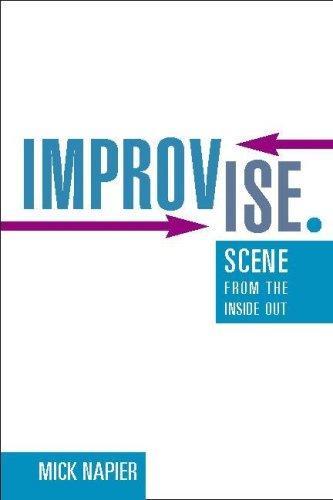
As an author, Napier extended his teaching philosophy into print. His book Improvise: Scene from the Inside Out, published by Heinemann in 2004, became one of the most cited challenge texts in improv pedagogy. Behind the Scenes, a second book, continued the examination of what distinguishes excellent scene work from technically adequate performance. He continued teaching advanced improvisation and directing Annoyance productions through the 2010s and beyond.
Historical Context
Napier is historically significant because he disrupted the flattening tendency of improv pedagogy at a moment when it mattered. By the 1990s, many schools had already begun codifying rules so firmly that scenes could become cautious, interchangeable, and overly deferential. The default improv scene risk becoming a polite, non-committal exercise in agreement rather than a genuinely alive encounter. Napier's work at both The Annoyance and The Second City was a sustained challenge to that drift, and he made the challenge visible in both peripheral and central institutional contexts simultaneously.
The Annoyance became one of Chicago's essential third poles alongside The Second City and iO. It preserved a comic and theatrical wildness inside a city that could otherwise standardize itself through dominant schools. The institution's willingness to sustain long-running original productions and genuinely strange ensemble experiments gave performers a place to build work that did not conform to anyone else's aesthetic rules. Co-Ed Prison Sluts running for twelve years is not incidental. It demonstrated that an audience existed for work that established institutions would never have produced.
Napier's concurrent presence inside The Second City gave his critique institutional leverage that a purely outside position would not have provided. He was not an outsider sniping at the mainstream from a distance. He worked inside one of the field's central institutions, directed some of its most significant revues, and simultaneously built an alternative lineage through the Annoyance. That dual position made his arguments about what improv should look like impossible to dismiss as peripheral.
His book Improvise: Scene from the Inside Out widened that influence beyond the institutions he had built or worked in. Improvisers in cities without a strong Annoyance lineage could encounter his arguments through the text and use them to interrogate the pedagogy they had received.
Key Events
Mick Napier Founds Metraform, the Company That Becomes The Annoyance Theatre
Mick Napier founded Metraform in Chicago on October 10, 1987, with the premiere of Splatter Theatre at the Cabaret Metro. The company renamed itself The Annoyance in 1989 upon renting its first dedicated space in the Ann Sather dining hall on Belmont, establishing Chicago's first improvisational theatre devoted to creating original full-length plays and musicals.
Mick Napier Publishes "Improvise: Scene from the Inside Out"
Heinemann publishes "Improvise: Scene from the Inside Out" by Mick Napier, offering a contrarian take on established improv conventions. Napier argues that many standard rules taught in improv training, such as "never say no," are oversimplifications that can limit performers rather than free them. The book provides an alternative framework grounded in character, specificity, and personal accountability, and becomes an influential counterweight to more prescriptive approaches to improv education.
Teaching Philosophy
Napier's teaching is built around a deliberate rejection of weak consensus play. He has argued repeatedly that improvisers become better partners by being more specific, more active, and more committed to their own playable wants, not by draining scenes of tension in the name of niceness.
That does not make his philosophy anti-ensemble. It redefines ensemble as the collision and support of strong choices rather than the avoidance of friction. Scenes gain shape because players bring force, information, and perspective into them instead of waiting passively for permission to contribute. The central claim is that a performer with a clear, energetic point of view is more genuinely supportive to scene partners than a performer who is agreeable but empty.
His books and classes made this critique unusually clear and practically grounded, which is one reason they have remained influential across different training traditions. Napier gave improvisers language for frustrations many of them already felt inside rule-heavy training systems but had not had words for, and that diagnostic clarity extended his reach well beyond the theatres where he worked directly.
Legacy
Napier's legacy is anchored in The Annoyance Theatre, which became one of the most important incubators of alternative Chicago comedy and a long-running home for performers who did not fit neatly inside more codified schools. The company's model of producing original long-form theatrical work rather than operating primarily as a training program influenced how other alternative improv theaters positioned themselves. The Annoyance demonstrated that a company could sustain a distinct identity over decades without becoming a franchise of rules or a branded training system.
He also left a durable intellectual legacy through his writing. Improvise: Scene from the Inside Out remains one of the field's most cited challenge texts, especially among improvisers trying to rethink inherited classroom dogma. The book's central argument, that individual strength supports ensemble rather than undermining it, continues to circulate as an active counterweight to more prescriptive approaches to scene training. Behind the Scenes extended that argument with additional practical grounding.
His directing work at The Second City produced major productions featuring performers who went on to significant national careers, including Tina Fey, Rachel Dratch, Scott Adsit, and Horatio Sanz, among others. Those productions demonstrated that his methods were not only suited to the Annoyance's idiosyncratic sensibility but could produce work at the highest level inside the field's most established institution. The Jeff Award for Paradigm Lost formalized that recognition.
For the archive, Napier matters because he represents a necessary internal argument within improv history. He did not merely found a theatre. He helped keep the form from becoming too polite, too procedural, and too self-satisfied, and that pressure continues to shape the field's best debates about scene work, ensemble theory, and the limits of rule-based pedagogy.
Early Life and Training
Napier was born on December 12, 1962. He discovered improvisation as a student at Indiana University, where he encountered Jeffrey Sweet's oral history Something Wonderful Right Away, a collection of interviews with the founders and early practitioners of The Second City and The Compass Players. That book oriented him toward Chicago as the field's center of gravity. At Indiana he co-founded the student improv group Dubbletaque with David MacNerland and performed with the group for four years before deciding to relocate to Chicago in 1987 to pursue improvisational theatre seriously.
Personal Life
Napier was born on December 12, 1962. He discovered improvisation as a student at Indiana University and moved to Chicago in 1987 to pursue it professionally. He has been based in Chicago throughout his career as a director, performer, writer, and teacher.
Companies and Organizations
Associated venues and institutional relationships currently documented in the archive.
Recommended Reading
Books are ordered from the strongest direct connection outward to broader relevance.
Improvise
Scene from the Inside Out
Mick Napier

Chicago Comedy
A Fairly Serious History
Margaret Hicks; Mick Napier

Behind the Scenes
Improvising Long Form
Mick Napier

Theatrical Improvisation
Short Form, Long Form, and Sketch-Based Improv
Jeanne Leep

Business Improv
Experiential Learning Exercises to Train Employees
Val Gee
Yes, And
How Improvisation Reverses No, But Thinking and Improves Creativity and Collaboration
Kelly Leonard; Tom Yorton
References
In the Archive
How to Reference This Page
The Improv Archive. (2026). Mick Napier. Retrieved September 28, 2026, from https://improvarchive.org/people/mick-napier
The Improv Archive. "Mick Napier." The Improv Archive, 2026. https://improvarchive.org/people/mick-napier.
The Improv Archive. "Mick Napier." The Improv Archive, 2026, https://improvarchive.org/people/mick-napier. Accessed September 28, 2026.
The Improv Archive is a systemically maintained repository. The archive itself acts as the corporate author.