Theatresports
TheatreSports is a competitive long-form format in which two or more improv teams perform scenes judged by an audience or panel, with scoring, fouls, and challenges drawn from the conventions of athletic competition. Created by Keith Johnstone in Calgary in the 1970s, TheatreSports is one of the most widely performed improv formats in the world and the foundation of a global network of licensed companies operating under the International Theatresports Institute.
Structure
The Competitive Frame
TheatreSports wraps improvised performance in a sporting event structure. Two teams -- typically of three to six players -- compete in a series of scenes and challenges. An audience or a designated judging panel scores each performance. The competitive frame is not incidental to the format; it is the generative mechanism that produces specific improvisational energy: teams must perform, not just play.
Keith Johnstone describes the competitive structure as generating Jo Ha Kyu -- the Japanese aesthetic concept of building tension from a slow beginning through acceleration to a climactic conclusion. The competition creates stakes that drive this arc without requiring the performers to manufacture drama artificially.
Scene Challenges
The competing team issues a challenge to the performing team by naming a specific constraint or game format. Challenges include constraints on style (perform the scene as if it were a silent film), on emotion (perform using only one emotion across all players), on form (perform the scene entirely in questions), or on game structure (play a specific named game such as a word-at-a-time story). The challenging team selects the challenge; the performing team must execute it.
The International Theatresports Institute documents the specific rules governing how challenges are issued, accepted, and scored. A team may accept a challenge, in which case the full scene is performed under the stated constraint. A team may also decline a challenge, accepting a penalty in exchange for the freedom to perform without the constraint.
Fouls
Fouls are violations of the sporting metaphor applied to performance failures. Common fouls include: blocking a partner's offer, canceling a scene by introducing implausible denials, relying on tired forms or easy solutions, or playing below the group's known capability. Audience members or designated judges may call fouls during a performance. The fouled team is penalized.
Johnstone documents specific foul categories in Impro for Storytellers (1999). Fouls serve a pedagogical function: they train players to recognize and correct the improvisational failures that most commonly reduce scene quality, making the competitive format also a vehicle for ongoing ensemble development.
Scoring
Points are awarded by the audience or panel after each scene. In the audience-scoring version, spectators hold up score cards or vote verbally. The scoring system prioritizes audience response over formal technical criteria: a scene that connects with an audience outscores a technically proficient scene that fails to engage. This structure reinforces the performer's responsibility to the audience and directly integrates audience feedback into the competitive arc.
Format Variations
Johnstone developed several variations within the TheatreSports family. Maestro is a format in which one player is designated the Maestro and can interrupt, redirect, or replace performers mid-scene, serving as a live director with authority over the entire ensemble. Gorilla Theatre involves audience members challenging performers from the seats. All three formats are documented in Impro for Storytellers.
The format's global spread has produced regional variations in scoring systems, foul categories, and challenge structures. The International Theatresports Institute licenses and standardizes the format across affiliated companies.
How to Teach It
How to Explain It
"TheatreSports works like an athletic competition. Two teams perform scenes for a panel of judges. Judges award points for strong improv and can call fouls for blocking, hedging, or running down the clock. Teams must accept the call. The game ends when time runs out or a team reaches the agreed point total."
Scaffolding
Groups new to TheatreSports should begin by learning the foul categories before performing competitively. Understanding why a foul is called -- blocking, canceling, low energy, reliance on cliché -- orients players to the format's improvisational values before they experience the competitive pressure.
The challenge system can be introduced gradually: begin with a small menu of five to ten well-known challenge formats and expand as the group's facility with specific games improves. Teams that attempt challenges they have not rehearsed will fail to execute them under competitive pressure.
Common Notes
The most common teaching challenge is managing the relationship between competitive energy and collaborative scene work. Teams that become focused on winning at the expense of scene quality produce performances that the audience does not reward. Johnstone's design intention -- that the scoring system reinforces quality rather than mere competitiveness -- requires players to internalize the paradox that the best strategy for winning is to support the scene rather than to win it.
Coaches note that foul calls must be consistent and credible to maintain the sporting frame. An audience that believes the refereeing is arbitrary will disengage from the competitive structure entirely.
How to Perform It
Cast Size
Two teams of three to six players per team. Formats with fewer players (duos or trios) produce a different competitive dynamic than larger ensembles. The International Theatresports Institute documents recommended team sizes for different venue scales.
Roles
The Referee or Master of Ceremonies manages challenges, calls fouls, and announces scores. This role is distinct from the competing players and is typically held by an experienced performer or the company's designated host. In Maestro, the Maestro serves a combined directing and playing function.
Team Captains issue challenges on behalf of their teams. In some configurations, any team member may issue a challenge; in others, the captain holds exclusive challenge authority.
Key Skills
TheatreSports rewards performers who thrive under constraint and competitive pressure. The format specifically develops: the capacity to execute a specific game or style on demand, the ability to recover from fouls without losing ensemble focus, and the skill of performing for audience approval rather than internal aesthetic satisfaction. Julia Leep notes that long-form improv requires celebration of the form itself, while TheatreSports trains performers for the heightened energy and audience-driven evaluation of the competitive context.
Technical Requirements
Stage: An open stage visible to the full audience. No set pieces required. Teams should have designated areas on stage or in the wings between challenges. Lighting: Blackouts are used between scenes. Individual scenes are played under standard wash. Sound: A bell, buzzer, or whistle is used to signal fouls and end scenes. Some productions use a scoreboard. Scoring materials: Score cards, electronic scoreboard, or designated audience voting mechanism.
How to Promote It
TheatreSports combines the immediacy of sports fandom with the surprise of live improvisation. Audiences are not passive observers but active participants: they score scenes, witness fouls, and invest in team performance in real time. The format is accessible to audience members with no prior exposure to improv because the competitive structure provides an immediate interpretive frame.
Taglines used by affiliate companies: "Improv as a Competitive Sport." "Two Teams Enter. One Team Wins. Everyone Laughs."
The format's global reach -- with licensed companies on six continents -- provides producers with an established brand and a network of reference performances for promotional use.
History
Keith Johnstone created TheatreSports at the Loose Moose Theatre Company in Calgary, Alberta, in the 1970s. Johnstone had been developing his improvisational pedagogy since his work with the Royal Court Theatre in London in the late 1950s and early 1960s, where he directed writers' workshops and developed the status and spontaneity concepts that would underpin his approach. He established the Loose Moose in 1977, and TheatreSports emerged as its signature format.
The format was designed to solve a specific problem: audiences watching improvisation often had no framework for evaluating or engaging with what they were seeing. By embedding improvised performance within the familiar conventions of athletic competition -- teams, scoring, fouls, challenges -- Johnstone gave audiences an immediate participatory role and a structure for investment. The competitive frame also raised the stakes for performers in ways that pure scene work did not.
Johnstone documents the full system of rules, scoring, fouls, and format variations in Impro for Storytellers (1999), which functions as the definitive technical manual for TheatreSports, Maestro, and Gorilla Theatre.
The format spread internationally through licensing. Impro Australia, founded in 1985, became one of the first TheatreSports licensees outside Canada. Bay Area TheatreSports (BATS Improv), founded in 1986 at Fort Mason Center in San Francisco, became one of the longest-running TheatreSports companies in the United States. The International Theatresports Institute (ITI), founded in 1998, now administers the format worldwide, licensing the TheatreSports name to affiliated companies.
Lynda Belt and Rebecca Stockley of BATS Improv co-authored Acting Through Improv / Improv Through TheatreSports, which became a widely used training manual integrating Johnstone's competitive format with classical acting technique. Lyn Pierse published Theatresports Down Under, a manual for short-form players that is considered an excellent reference for the format's execution in the Australasian context.
TheatreSports has also been performed competitively in formats documented by Julia Leep in Theatrical Improvisation, which situates the format within the broader landscape of competitive improv alongside the Canadian Improv Games and ComedySportz.
Worth Reading
See all books →
Theatrical Improvisation
Short Form, Long Form, and Sketch-Based Improv
Jeanne Leep

Devising Performance
A Critical History
Deirdre Heddon; Jane Milling
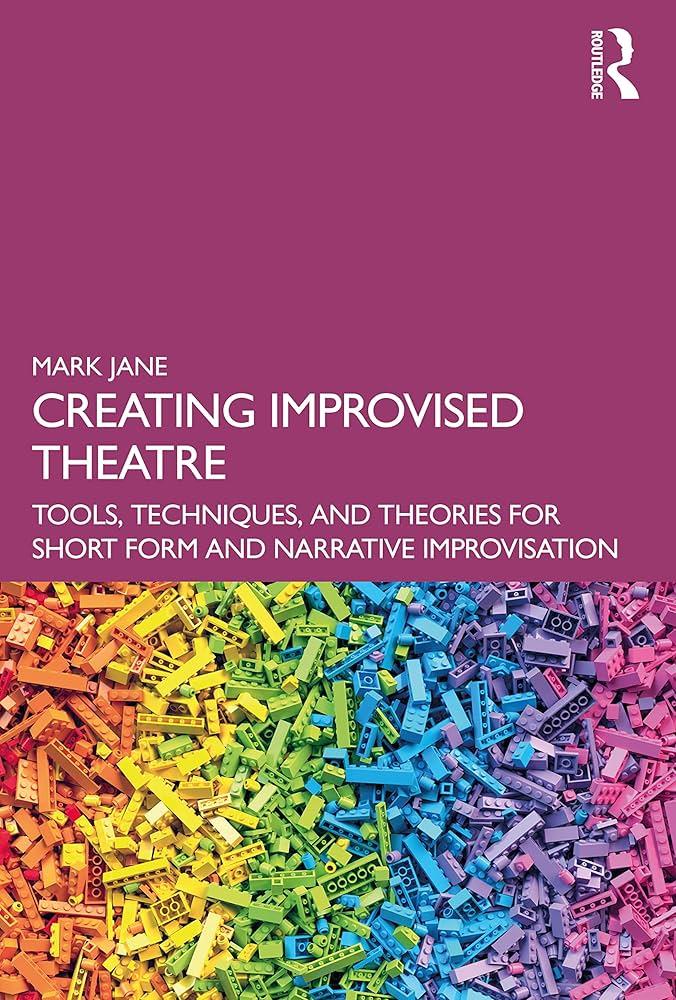
Creating Improvised Theatre
Tools, Techniques, and Theories
Mark Jane

The Routledge Companion to Improvisation in Organizations
Miguel Pina e Cunha; Dusya Vera; António Cunha Meneses

The Improv Handbook
The Ultimate Guide to Improvising in Comedy, Theatre, and Beyond
Tom Salinsky; Deborah Frances-White

Acting Through Improv
Improv Through Theatresports
Lynda Belt; Rebecca Stockley
Related Formats
Comedysportz
ComedySportz is a competitive short-form improv format in which two teams perform improv games head-to-head, with the audience voting to determine the winner of each round. A referee moderates the show, selects games, enforces rules, and calls fouls for jokes that cross established content boundaries. The format frames improvisation as a spectator sport, complete with team names, uniforms, score-keeping, and crowd participation. ComedySportz makes improv accessible to audiences unfamiliar with the art form by providing a clear competitive structure, audience agency through voting, and a family-friendly entertainment guarantee enforced by the foul system.
Gorilla Theatre
Gorilla Theatre is a competitive long-form format created by Keith Johnstone in which individual directors pitch scene ideas to the audience, then direct other performers in executing them. The audience votes on the results, and the director of the least successful scene receives a comedic forfeit. The format combines the creative risk of directing with the accountability of audience judgment, creating a high-stakes dynamic in which directors must balance artistic ambition with crowd-pleasing instincts. Gorilla Theatre foregrounds the director's role in improvisation, making visible a creative function that most formats keep hidden.
The Lineage
Explore the schools and structures that influenced or evolved from Theatresports.
Impro for Storytellers (Johnstone)
How to Reference This Page
The Improv Archive. (2026). Theatresports. Retrieved October 15, 2026, from https://improvarchive.org/formats/theatresports
The Improv Archive. "Theatresports." The Improv Archive, 2026. https://improvarchive.org/formats/theatresports.
The Improv Archive. "Theatresports." The Improv Archive, 2026, https://improvarchive.org/formats/theatresports. Accessed October 15, 2026.
The Improv Archive is a systemically maintained repository. The archive itself acts as the corporate author.