Backwards Interview
Backwards Interview is a short-form game in which a talk show interview is performed in reverse chronological order, beginning with the farewell and ending with the introduction. Players must construct logical narrative links that work backward while maintaining the illusion of a natural conversation. The game rewards sharp memory and structural thinking.
Structure
Setup
- Two performers: one plays a talk show host, one plays a celebrity or notable guest.
- An audience suggestion establishes who the guest is and what the interview would normally be about.
- The scene begins at the end of the interview: the farewell, the closing pleasantries, the walk to the door.
The Reverse Chronology
- The scene proceeds backward through the conversation. Each exchange must logically precede (in real time) the exchange that came before it in the game.
- The interview moves from goodbye through the conversation's climactic revelations, back through the early pleasantries, and ends with the initial introduction.
- The narrative must make sense in reverse: the earlier exchanges should feel like they led to the later ones, even though the later ones were played first.
How to Construct the Backward Narrative
- Begin by establishing what the final state of the interview is: what has been resolved, revealed, or agreed to. That is where the scene starts.
- Each preceding beat should explain or establish the beat that came after it in the game.
- The last moment of the scene (in game terms) is the first moment of the interview: the introduction, the handshake, the opening pleasantry.
What the Game Trains
- Structural thinking: the ability to hold a complete narrative arc in reverse.
- Memory: what has been established earlier in the game must inform what is constructed "before" it.
- Justification: each beat retroactively justifies the beats that came after it.
How to Teach It
How to Explain It
"This interview already happened. We are watching it in reverse. When we meet, that is the moment you say goodbye. When we part, that is when we said hello. Work backward. Figure out what conversation produced the state you were in at the beginning of the game."
Common Notes
- The key challenge is maintaining emotional and narrative continuity across the reverse chronology. Each beat must feel like it is earlier in the same conversation, not like a different conversation altogether.
- The performers should agree in advance on the rough shape of the interview: what is the major revelation? That revelation should appear neither at the start nor the end of the game, but in the middle.
- The introduction at the very end of the game is the hardest moment. It must feel like a genuine opening, not a forced greeting.
Common Pitfalls
- The performers play the reverse chronology abstractly, losing track of the emotional throughline of the interview.
- The scene has no clear event: no revelation, no moment of change. Without something to work backward toward, the reverse structure produces nothing.
- The farewell at the opening of the game does not reflect what was established during the rest of the scene.
How to Perform It
Audience Intro
"In this game, an interview has already happened. We are going to watch it in reverse, starting with the goodbye and ending with the hello. Give us a guest: someone famous, notorious, or fictional. Give us what the interview was supposed to be about."
Cast Size
- Ideal: Two performers: host and guest.
Staging
- Talk show staging: two chairs, a small table, a suggestion of a studio set.
Wrap Logic
- The scene ends when the two performers arrive at the opening moment: the first handshake, the first "Welcome to the show." That moment is the button.
Worth Reading
See all books →
The Improv Handbook
The Ultimate Guide to Improvising in Comedy, Theatre, and Beyond
Tom Salinsky; Deborah Frances-White

Group Improvisation
The Manual of Ensemble Improv Games
Peter Campbell Gwinn; Charna Halpern
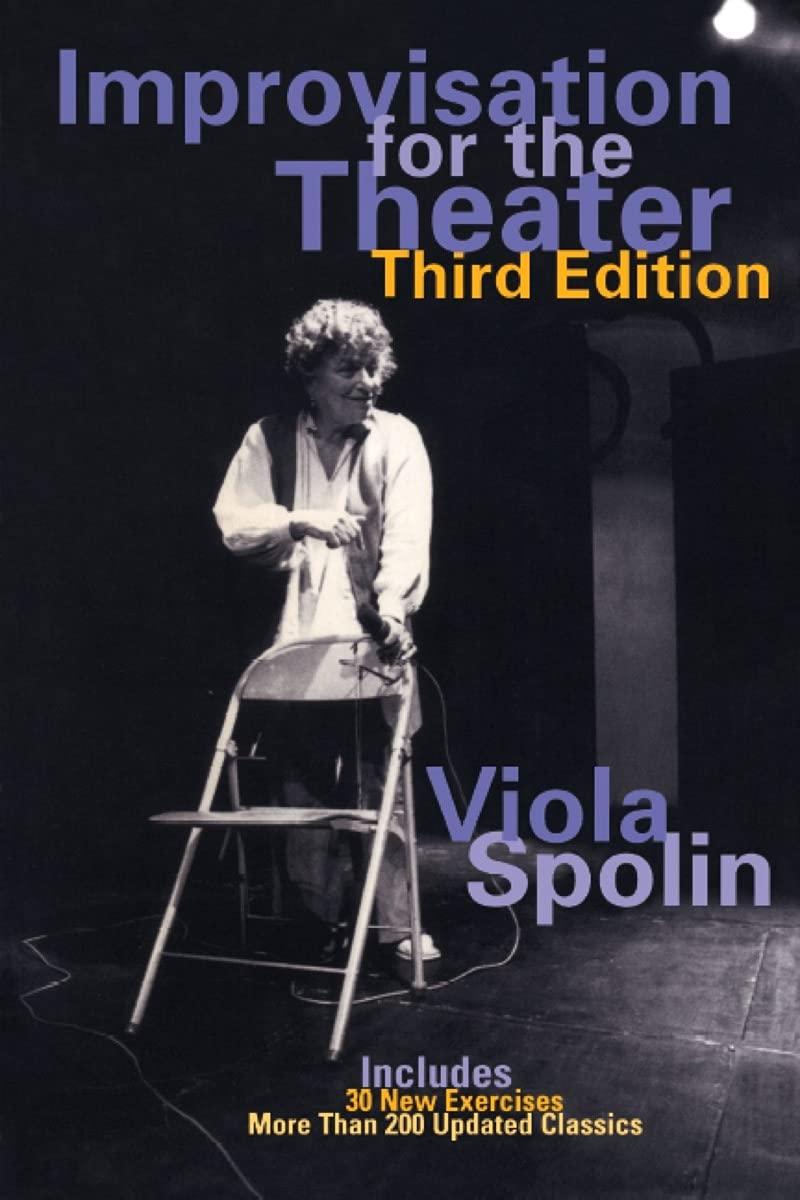
Improvisation for the Theater
A Handbook of Teaching and Directing Techniques
Viola Spolin

Theater Games for Rehearsal
Viola Spolin
Impro for Storytellers
Keith Johnstone
The Improvisation Game
Discovering the Secrets of Spontaneous Performance
Chris Johnston
Related Games
Backwards Scene
Backwards Scene is a short-form game in which performers play a scene from its final moment to its first. Each exchange must logically precede what the audience has already seen, creating a reverse-engineered narrative that rewards careful physical and verbal continuity.
Interview Switch
Interview Switch is a scene game in which the roles of interviewer and interviewee suddenly reverse mid-conversation. The performer who was asking questions is now answering; the performer who was answering is now asking. The power shift catches both performers off guard and changes the scene's relational dynamics in an instant. The game trains the ability to adapt to a changed status dynamic, to find and occupy a new position in a relationship immediately upon the reversal.
Forward/reverse
Forward/Reverse is a short-form game in which a scene plays forward normally until the caller says "reverse," at which point performers rewind their actions and dialogue exactly. Another "forward" call resumes normal play. The game demands precise physical and verbal recall and rewards clear, reproducible choices.
Rewind
Rewind is a short-form game in which a host calls out during a scene, causing performers to physically and verbally reverse their actions back to an earlier moment, then replay forward with different choices. The game rewards strong physical memory, comedic timing at the point of replay, and the ability to generate distinct alternatives quickly when the scene resumes.
Rewind/fast-Forward
Rewind/Fast-Forward is a short-form game in which a host controls the speed and direction of a scene using imaginary playback buttons. "Fast-forward" accelerates the action into the future, "rewind" reverses it, and "play" resumes normal speed. The game demands strong physical commitment and the ability to maintain scene logic across temporal jumps.
Job Interview
Job Interview is a scene game in which one or more performers audition for a position while endowed with secret traits, habits, or identities that the interviewer must guess. The interview setting provides built-in status dynamics, clear stakes, and a familiar social ritual that audiences instantly recognize. The game rewards clear character physicalization, the ability to embed clues through behavior rather than exposition, and the comedy that emerges when inappropriate qualities collide with a formal setting.
How to Reference This Page
The Improv Archive. (2026). Backwards Interview. Retrieved September 28, 2026, from https://improvarchive.org/games/backwards-interview
The Improv Archive. "Backwards Interview." The Improv Archive, 2026. https://improvarchive.org/games/backwards-interview.
The Improv Archive. "Backwards Interview." The Improv Archive, 2026, https://improvarchive.org/games/backwards-interview. Accessed September 28, 2026.
The Improv Archive is a systemically maintained repository. The archive itself acts as the corporate author.