Ensemble
A group of performers who work together as a unified creative unit rather than as a collection of individuals. Ensemble playing emphasizes shared responsibility, mutual support, and collective storytelling. The ensemble tradition in improvisation traces from Viola Spolin through The Second City and iO Chicago.
At the heart of improvisation lies a principle that distinguishes it from most other performing arts: the primacy of the group over the individual. An ensemble in improvisation refers to a group of performers who function as a unified creative unit, sharing responsibility for every aspect of a scene or show. Rather than operating as a collection of soloists waiting for their turn to shine, ensemble players commit to collective storytelling, mutual support, and the understanding that the work belongs to everyone onstage.
The ensemble tradition in American improvisation traces a clear lineage from Viola Spolin, whose theater games were designed to dissolve hierarchies and build group awareness, through The Second City and iO Chicago, where ensemble-based performance became the dominant model. Spolin's work established that play, trust, and shared focus could produce results no individual performer could achieve alone. This philosophy carried forward through practitioners like Del Close, whose long-form work at iO depended on groups that had trained and performed together extensively, and Charna Halpern, who built iO's house ensemble system into one of the most influential training models in modern improvisation.
The concept has deeper roots in theatrical history as well. Devised theater practitioners have long valued ensemble work as "a social expression of nonhierarchical possibilities" and "a model of cooperative and non-hierarchical collaboration," as Deirdre Heddon and Jane Milling describe it. This political and aesthetic commitment to collective creation influenced improvisation and was influenced by it in return. The ensemble ideal also appears in applied improvisation contexts, where, as Theresa Robbins Dudeck notes, it creates "intelligent climates where individuals own their own agency while being sensitive to ensemble responsibilities," promoting "true listening and self-organization."
In practice, ensemble playing manifests in specific behaviors. Performers track one another's offers closely, building on what has been established rather than redirecting scenes toward their own ideas. They distribute focus across the stage, stepping forward when a scene needs energy and stepping back when a fellow player has a strong initiation. In ensemble-style shows, as Shawn Kinley describes in "Creating Improvised Theatre," there may be "numerous protagonists who have equal weight in the narrative" rather than a single lead character driving the action.
Teaching ensemble skills typically begins with group movement and awareness exercises. Tina Fey's oft-quoted observation that improvisation is about making your partner look good captures the ensemble ethic in its simplest form. Exercises like group counting, mirrored movement, and synchronized walking help students experience collective rhythm before applying it to scene work. As one practitioner notes, group movement exercises "can make the students feel like a dance ensemble," building cohesion and concentration once performers move past initial self-consciousness.
A common pitfall is confusing ensemble playing with the absence of strong individual choices. Ensemble work does not mean playing small or deferring constantly; it means making bold offers in service of the group's story rather than one's own agenda. Another misunderstanding is treating ensemble as something that happens automatically when experienced players share a stage. In reality, ensembles require sustained work together over time. Companies that cannot maintain a permanent ensemble, as Alison Oddey observes in her study of devised theater, often struggle to achieve the depth of connection that distinguishes true ensemble performance from competent group improvisation.
Ensemble connects closely to several other core improvisation concepts, including agreement, support, group mind, and yes-and. Where yes-and describes a moment-to-moment behavior, ensemble describes the broader commitment and identity from which that behavior emerges.
Further Reading
See all books →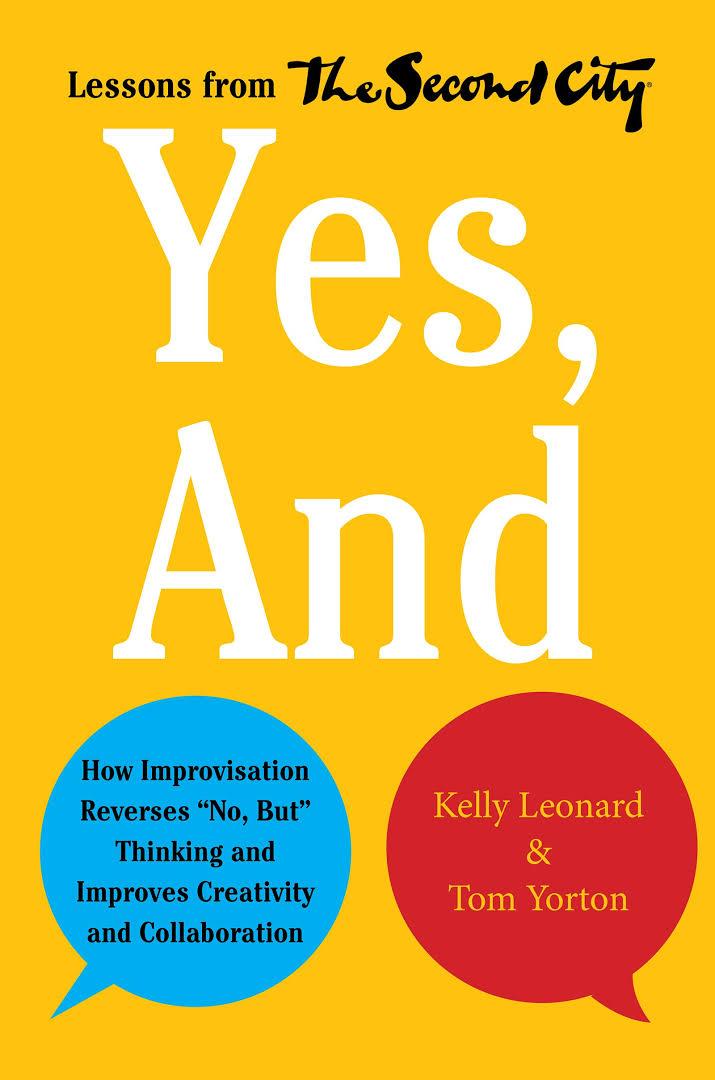
Yes, And
How Improvisation Reverses No, But Thinking and Improves Creativity and Collaboration
Kelly Leonard; Tom Yorton

Business Improv
Experiential Learning Exercises to Train Employees
Val Gee
The Actor's Book of Improvisation
Sandra Caruso; Paul Clemens

Legislative Theatre
Using Performance to Make Politics
Augusto Boal

Theatrical Improvisation
Short Form, Long Form, and Sketch-Based Improv
Jeanne Leep

Devising Performance
A Critical History
Deirdre Heddon; Jane Milling
How to Reference This Page
The Improv Archive. (2026). Ensemble. Retrieved September 28, 2026, from https://improvarchive.org/learn-improv/concepts/ensemble
The Improv Archive. "Ensemble." The Improv Archive, 2026. https://improvarchive.org/learn-improv/concepts/ensemble.
The Improv Archive. "Ensemble." The Improv Archive, 2026, https://improvarchive.org/learn-improv/concepts/ensemble. Accessed September 28, 2026.
The Improv Archive is a systemically maintained repository. The archive itself acts as the corporate author.