Game of the Scene
The central comedic pattern or dynamic that emerges organically within an improv scene. Once discovered, the game is heightened and explored through repetition with variation. The concept is central to the UCB and iO Chicago traditions and is articulated in detail in the Upright Citizens Brigade Comedy Improvisation Manual.
At the heart of long-form improvisation lies a deceptively simple idea: every scene contains a central comedic pattern or dynamic that, once discovered, can be heightened and explored through repetition with variation. This pattern is known as the game of the scene. The concept has become one of the most widely taught and debated principles in modern improv, serving as a foundational element in the curricula of the Upright Citizens Brigade and iO Chicago, among other institutions.
The game of the scene is not something performers bring into a scene; it is something that emerges organically from the interaction between characters. A scene begins with what UCB methodology calls a "base reality," an ordinary situation grounded in recognizable human behavior. Within that base reality, something unusual surfaces: an unexpected reaction, an odd point of view, a behavioral quirk. That unusual thing is the first beat of the game. The performers' task is to recognize it, commit to it, and then heighten it, finding new ways to revisit and escalate the pattern while maintaining the internal logic of the scene. As Clay Drinko illustrates, if one character laughs after another says something serious, the game might become one person saying progressively sadder things while the other laughs harder and harder.
The roots of game-based scene work can be traced to the Harold and the broader iO tradition. Jill Bernard Fotis notes that instead of calling recurring comedic patterns "lazzi" or "bits," iO and the landmark text Truth in Comedy reframed them as "finding the game of the scene." Performers in a Harold were encouraged to discover patterns within scenes and exploit them. The Upright Citizens Brigade Comedy Improvisation Manual later codified this approach in extensive detail, devoting entire sections to what a game is, how to find it, and how to play it, including the use of character as a vehicle for game moves.
Mick Napier uses the term "the deal" as a near synonym, describing it as what the scene is about or what it is centered in. Tom Salinsky and Deborah Frances-White frame game discovery as the process that generates the connective tissue of a long-form show: finding the game within individual scenes creates the runners and callbacks that unify an entire performance into a cohesive whole.
Not all practitioners embrace the concept without reservation. Dave Razowsky, as quoted in Andrew Griggs's account, has argued that an overemphasis on finding the game of the scene and the point of conflict can constrain performers and diminish the art form. Nick Raitt observes that children improvising naturally on a playground have no awareness of game, narrative, or conflict, yet produce remarkable spontaneous play. These critiques point to a tension in improv pedagogy between structured discovery and organic, intuitive creation.
Common pitfalls in game work include forcing a pattern before one has naturally emerged, abandoning a game too early in favor of a new idea, and prioritizing cleverness over genuine connection between scene partners. Amy Seham notes that when a pattern is interrupted, performers must find another angle and may even turn the act of calling out the broken game into the new game of the scene, a meta-theatrical move that requires both awareness and flexibility.
The concept sits in close relationship to several other improv principles. Heightening and exploration are the primary tools for playing game once it is found. Base reality provides the grounding from which unusual elements can be identified. Yes-and sustains the collaborative agreement needed for both partners to commit to the same pattern. The game of the scene, in essence, is the organizing principle that transforms a series of improvised moments into a structured comedic experience, giving performers a shared compass for where a scene wants to go.
Further Reading
See all books →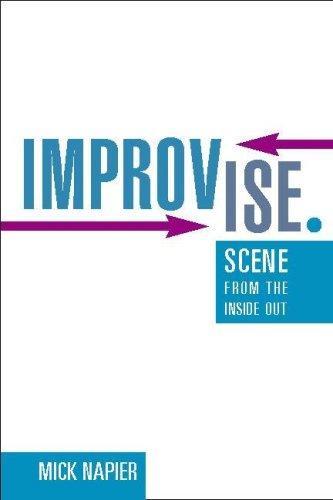
Improvise
Scene from the Inside Out
Mick Napier

The Improv Handbook
The Ultimate Guide to Improvising in Comedy, Theatre, and Beyond
Tom Salinsky; Deborah Frances-White

The Upright Citizens Brigade Comedy Improvisation Manual
Matt Besser; Ian Roberts; Matt Walsh

Theatrical Improvisation, Consciousness, and Cognition
Clayton D. Drinko

Long Form Improvisation and American Comedy
The Harold
Matt Fotis

The Improv Illusionist
Using Object Work, Environment, and Physicality in Performance
David Raitt
How to Reference This Page
The Improv Archive. (2026). Game of the Scene. Retrieved November 5, 2026, from https://improvarchive.org/learn-improv/concepts/game-of-the-scene
The Improv Archive. "Game of the Scene." The Improv Archive, 2026. https://improvarchive.org/learn-improv/concepts/game-of-the-scene.
The Improv Archive. "Game of the Scene." The Improv Archive, 2026, https://improvarchive.org/learn-improv/concepts/game-of-the-scene. Accessed November 5, 2026.
The Improv Archive is a systemically maintained repository. The archive itself acts as the corporate author.