One Voice
One Voice is a game and exercise in which two or more performers speak simultaneously, attempting to produce the same words at the same time without prior coordination. The group must listen intently and follow collective impulses rather than individual intention, producing coherent shared speech as a single entity. The game develops group mind, deep listening, and the capacity to surrender individual control to collective will.
Structure
Setup
Two performers stand side by side, facing the audience or a partner. They are told that they will speak simultaneously and must attempt to say the same words at the same time. There is no agreed text or signal: the speech must emerge from shared listening.
Gameplay
Jill Campbell in Improv to Improve Your Leadership Team documents the setup for the standard two-player version: performers stand side-by-side, lock arms or otherwise connect physically, and speak. The physical connection provides a channel of nonverbal communication that supports synchronization.
Viola Spolin's coaching prompts for the exercise in Improvisation for the Theater capture the attention required: "Reflect only what you hear! Reflect only what you see! Move your lips! Become one voice! One body!" The exercise requires performers to shift from initiating speech to receiving and reflecting it simultaneously, treating the shared voice as a single organism.
Edward Nevraumont in The Ultimate Improv Book describes One Voice as a sound-based progression from movement mirroring: just as players can learn to mirror each other's movements until neither is leading, the same principle applied to speech produces shared vocalization in which neither player is initiating.
The exercise can be performed as pure sound (performers synchronize vocal sounds without meaningful language) or as speech (performers attempt to produce coherent sentences or answer questions as a shared entity). The latter version creates more comedy and is better suited to performance.
In the interview variant, a host asks the two-player entity questions, and the pair must answer together. The audience delight comes from watching the pair navigate disagreement, hesitation, and unexpected synchronization.
Debrief
After the exercise, players discuss where synchronization emerged spontaneously versus where it was forced. The moments of genuine unplanned synchronization are often surprising to both players and audiences. Players often report that the instinct to lead must be actively suppressed before the collective voice can emerge.
How to Teach It
How to Explain It
"Two of you stand together. You are going to speak as one voice. Start simple: count out loud together, 1, 2, 3. No signals, no conductor. Listen and speak at the same time. Once you can do that, try a sentence. The goal is to sound like one person, not two people who rehearsed."
Objectives
One Voice trains the group mind instinct: the capacity to attune to a collective rhythm rather than to lead or respond individually. Keefe identifies the fundamental obstacle: the need to be the individual voice in the room. One Voice makes this tendency visible by creating an immediate consequence (divergence from the partner) when the drive for individual expression overrides collective listening.
The exercise also trains what might be called receptive initiation: the paradox of speaking first while following. In One Voice, the first syllable must already be in sync; there is no turn-taking from which to derive the next word. Performers must learn to speak from a collectively held impulse rather than from an individual decision.
Scaffolding
Nevraumont suggests building One Voice from movement mirroring: begin with two players mirroring each other's physical movements until neither is leading, then apply the same principle to sound (matching tones, rhythms, and qualities before attempting words), and finally to speech. This progression builds the attunement capacity that One Voice requires.
Campbell suggests beginning the exercise with brief individual conversations (one-word-at-a-time) before moving to the full simultaneous version, allowing players to experience the rhythm of shared speech before attempting complete synchronization.
For groups that struggle with the simultaneous version, begin with the sound version: players synchronize on a single sustained tone, varying it together, before attempting words.
Common Coaching Notes
- "Stop trying to lead. You cannot lead and listen at the same time."
- "The voice is already there. You are finding it, not making it."
- "If you diverge, don't panic. Listen for where your partner is and meet them."
- "Slower is easier. The slower you speak, the more time there is to synchronize."
How to Perform It
In performance, the exercise is most effective in the interview format: a host asks questions, and the two-player entity answers. The comedy comes from the visible negotiation of synchronization: moments of perfect unison are impressive; moments of divergence are funny; moments where the pair recovers synchronization after divergence are satisfying.
The strongest performances occur when both players have genuinely surrendered individual initiative and are operating from receptive attention rather than strategic leadership. Audiences can see when one player is driving and the other following; the game is most impressive when neither player appears to be in control.
Coaching from outside is useful: a director who asks questions of the entity creates external pressure that reveals how well the performers have internalized the game's core demand. Questions that require specific information (names, numbers, preferences) tend to produce more interesting negotiation than open-ended questions.
In Applied Settings
Learning Objectives
One Voice trains synchronized attention and the suppression of individual control. In organizational settings, this maps to moments when a team must present a unified position, make a shared decision, or speak with one organizational voice. The exercise reveals how quickly individual instincts override collective alignment, and gives participants a physical experience of what real synchronization requires.
Workplace Transfer
Team alignment failures often manifest as mixed messages: different team members give different answers to the same question, or different departments pursue conflicting directions. One Voice makes the cost of non-alignment visceral and immediate. When two voices diverge, everyone in the room hears it. The same is true in organizations, though the divergence is usually slower and harder to hear.
Facilitation Context
Suitable for leadership workshops, cross-functional team alignment sessions, and communication training. Works with pairs or small groups. Requires no materials or space configuration. Runs in five to ten minutes including debrief.
Adaptation Notes
For participants with no improv background, frame the exercise as a synchronization challenge rather than a performance drill. Remove theatrical language. The instruction is simple: two people, one voice, no plan. The experience of trying and failing to synchronize is the content.
Debrief Framing
"What happened when you felt yourself getting out of sync? What did you do?" "When did it work? What was different about those moments?" "Where in your work do you need to speak with one voice? What makes that hard?"
Skills Developed
History
Viola Spolin documents the exercise in Improvisation for the Theater (1963), with characteristic coaching directions: "Become one voice! One body!" Spolin's framing places the exercise within her concern for "group awareness" and ensemble responsiveness, two pillars of her pedagogical framework.
Tom Salinsky and Deborah Frances-White in The Improv Handbook list "Speak In One Voice" alongside Arms Through, Pillars, and He Said She Said as games that exploit and teach group mind skills, positioning it as one of a family of exercises designed to develop the instinct for ensemble attunement.
Bob Keefe in Improv Yourself names the exercise "Two Players: One Voice" and frames it around the theory of give-and-take, arguing that the tendency to assert individual voice is a fundamental obstacle that the exercise helps practitioners recognize and overcome.
The exercise has been adopted extensively in applied improv contexts. Jill Campbell in Improv to Improve Your Leadership Team presents it as a leadership development exercise (Exercise 8b) that demonstrates the capacity for collective decision-making and attuned responsiveness in organizational settings.
Worth Reading
See all books →
Improv Yourself
Business Spontaneity at the Speed of Thought
Joseph A. Keefe
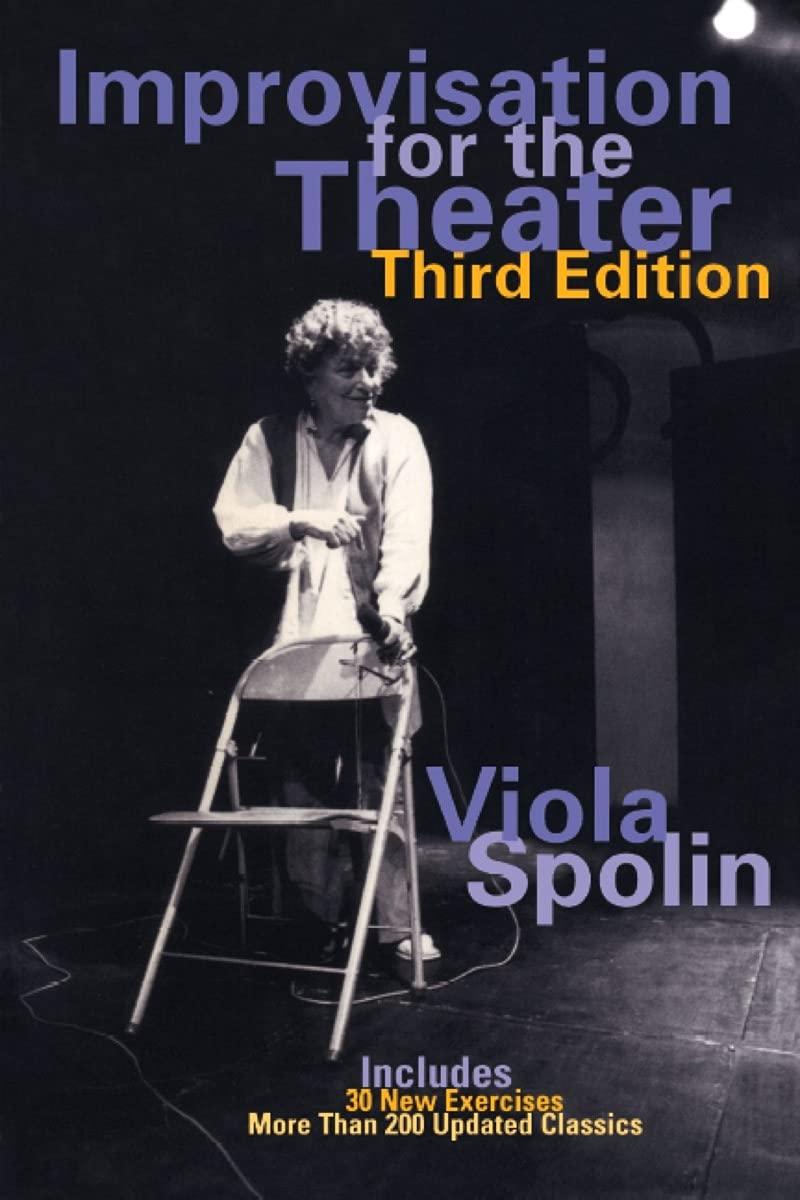
Improvisation for the Theater
A Handbook of Teaching and Directing Techniques
Viola Spolin

The Improv Handbook
The Ultimate Guide to Improvising in Comedy, Theatre, and Beyond
Tom Salinsky; Deborah Frances-White

Something Wonderful Right Away
An Oral History of The Second City and The Compass Players
Jeffrey Sweet

Truth in Comedy
The Manual of Improvisation
Charna Halpern; Del Close; Kim Howard Johnson

The Ultimate Improv Book
A Complete Guide to Comedy Improvisation
Edward J. Nevraumont; Kurt Smeaton; Nicholas P. Hanson
Related Exercises
Two Players -- One Voice
Two Players One Voice is an applied exercise in which two participants speak simultaneously as a single character, committing to matching word choices, rhythm, and volume in real time, training deep listening, surrender of individual agenda, and the construction of shared voice.
One Voice Expert
One Voice Expert is an applied improvisation exercise in which two or more participants stand side by side and speak simultaneously as a single expert, answering audience questions or delivering a presentation as if they are one person with one voice. The exercise demands extreme listening, mutual agreement in real time, and the willingness to follow a partner's lead word by word.
One Line Scene
One Line Scene is a scene-building exercise in which two or more performers create a complete scene using only one line of dialogue each. The constraint forces performers to make every word count, to communicate volumes through subtext, physicality, and relationship, and to find the essence of a scene without the luxury of extended dialogue.
Communal Monologue
Communal Monologue is an exercise in which multiple performers deliver a single monologue together, trading off mid-sentence or mid-thought without any performer beginning a new idea. Each speaker must continue seamlessly from where the last one stopped, maintaining the same voice, tone, and thought. The exercise trains verbal listening, agreement, and the construction of a collective voice.
Mirror
Mirror is a foundational partner exercise in which one player moves and the other copies with as much precision as possible. The basic challenge is simple to see and simple to feel: both players must stay connected closely enough that the movement reads as one shared action instead of one person chasing the other. Across published training material, Mirror is used to build concentration, body awareness, responsiveness, and nonverbal listening.
Non Sequitor
Non Sequitur is a hybrid game and exercise in which performers deliberately break logical connections between lines of dialogue, forcing each new statement to have no apparent relationship to the one before it. The exercise trains performers to let go of the need to make sense, builds comfort with absurdity, and paradoxically reveals how audiences will construct meaning even from disconnected material.
How to Reference This Page
The Improv Archive. (2026). One Voice. Retrieved September 28, 2026, from https://improvarchive.org/exercises/one-voice
The Improv Archive. "One Voice." The Improv Archive, 2026. https://improvarchive.org/exercises/one-voice.
The Improv Archive. "One Voice." The Improv Archive, 2026, https://improvarchive.org/exercises/one-voice. Accessed September 28, 2026.
The Improv Archive is a systemically maintained repository. The archive itself acts as the corporate author.