Rituals
Rituals is a scene exercise in which performers explore the behavioral rhythms of repeated, patterned actions: the small ceremonies people perform when making coffee, setting a table, greeting a colleague, or preparing for sleep. By slowing down and physicalizing the precise sequence of a ritual, players develop attention to behavioral specificity and discover that the way a character moves through their routines reveals character, relationship, and emotional state as clearly as explicit dialogue.
Structure
Setup
No materials are required. The facilitator introduces the concept of ritual as any repeated, patterned sequence of actions that a person or group performs in a consistent way. Rituals may be private (morning routines, bedtime sequences) or social (greetings, meal customs, workplace habits).
Players are given a ritual to perform, or they choose one. The ritual should be specific and personal enough to be recreated in physical detail.
Progression
A player or pair begins performing their ritual in silence or with minimal sound. The facilitator encourages attention to the precise order of actions, the weight and quality of each movement, and the emotional texture underlying the sequence. Players are coached to resist generalizing: not "making coffee" as an idea, but the specific action of filling the kettle, the weight of the lid, the sound of the water.
Augusto Boal developed a series of exercises in Games for Actors and Non-Actors (1992) that use ritual structure to investigate social and psychological patterns. Boal's ritual exercises ask participants to identify the gestures, postures, and sequences that constitute socially codified behavior, and then to examine what those patterns reveal about power, relationship, and suppressed emotion.
Viola Spolin's side coaching tradition, which emphasizes moment-to-moment physical awareness rather than conceptual performance, informs the approach to daily-life ritual exercises: the player is coached to discover what is actually there, not to perform an idea of the ritual.
Once a solo sequence is established, pairs or small groups can explore how two ritual behaviors interact in shared space, what happens when rituals are disrupted, or how the same ritual performed by different characters reveals different relationships to routine.
Variation
Social rituals (greetings, farewells, ceremonies) can be explored in the same structure with an emphasis on the relationship encoded in the ritual rather than its private function. Groups from different cultural contexts often discover that the same general ritual (greeting, mealtime, departure) contains sharply different behavioral grammars.
How to Teach It
How to Explain It
"You are going to physicalize a ritual: a repeated, intentional sequence of actions with a specific purpose. It could be a morning routine, a religious ceremony, a superstition, anything performed the same way each time because it matters. Begin with the first action. Make each step distinct and deliberate."
Objectives
The Rituals exercise trains behavioral specificity: the ability to physicalize a sequence of actions with precision and intention rather than mining through generalized mime. It also develops the improvisational principle that character is revealed through behavior as much as through dialogue, and that the specific way a person moves through their environment communicates who they are.
In Boal's tradition, the exercise has an additional critical dimension: players examine how social rituals encode relationships of power, expectation, and conformity. This layer is especially useful in applied improvisation contexts where groups are examining workplace culture, organizational dynamics, or social norms.
Scaffolding
Begin with familiar private rituals (morning routine, making a drink, washing hands) before moving to social rituals involving interaction. Private rituals allow players to work individually and develop precision without the complexity of partner coordination.
For groups unfamiliar with Boal-style work, frame the exercise in terms of behavioral detail and discovery rather than social analysis. The political dimension can be introduced once players are comfortable with the physical vocabulary.
Common Coaching Notes
- "Be specific about the weight of that object. What does it feel like in your hand?"
- "You have done this a hundred times. Where does your body go automatically?"
- "What does this ritual protect you from? What would happen if it were interrupted?"
- "When you perform this ritual, who taught it to you? Are you doing it their way or your way?"
History
The use of ritual structure in actor training draws from multiple converging traditions. Augusto Boal's Theatre of the Oppressed work, developed in Brazil from the 1960s and documented in Theatre of the Oppressed (1979) and Games for Actors and Non-Actors (1992), treats ritual as a primary site for investigating how social power is encoded in repeated bodily behavior. Boal's exercises ask participants to decompose social rituals into their constituent gestures and then examine what those gestures reveal and conceal.
The incorporation of everyday-life rituals as an improv exercise also reflects the influence of Viola Spolin's theater games tradition, which emphasizes physical specificity and behavioral observation as foundations for scene work. Spolin's coaching method consistently redirects attention from performed emotion to actual physical action in specific space.
In creative drama traditions, Bill Keller's Improvisations in Creative Drama (1989) includes structured lessons using ritual and ceremony as frameworks for exploring how people manage emotion through formalized behavior, noting that rituals help channel feelings into socially acceptable or concealed forms.
No single practitioner originated the Rituals exercise in its daily-life-behavioral form. It represents a convergence of physical theatre, applied theatre, and improvisational pedagogy around the insight that habitual, repeated action is both personally revealing and dramatically generative.
Worth Reading
See all books →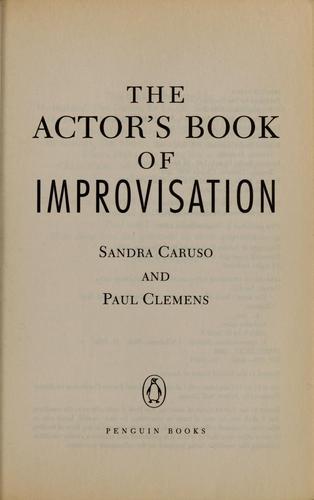
The Actor's Book of Improvisation
Sandra Caruso; Paul Clemens

Devising Performance
A Critical History
Deirdre Heddon; Jane Milling

The Young Actor's Book of Improvisation
Dramatic Situations
Sandra Caruso; Susan Kosoff

The Art of Chicago Improv
Short Cuts to Long-Form Improvisation
Rob Kozlowski

Mask Improvisation for Actor Training and Performance
the compelling image
Sears A. Eldredge

Long Form Improvisation and American Comedy
The Harold
Matt Fotis
Related Exercises
Virus
Virus is a physical ensemble exercise in which one player begins with a specific behavior, sound, or movement that spreads to others through proximity or contact, eventually infecting the whole group. The exercise demonstrates how energy and impulse propagate through an ensemble and trains players to notice and respond to the influence of their partners.
Ali Baba and the 40 Thieves
Ali Baba and the 40 Thieves is a circle rhythm exercise in which players accumulate a sequence of gestures. The first player establishes a repeating movement; each subsequent player adds a new gesture while maintaining all previous ones. The compounding complexity tests memory, coordination, and group synchronization.
Hello
Hello is a simple greeting exercise in which players practice making contact through the single word "hello," varying their delivery to express different emotions, characters, and relationships. The exercise demonstrates the range of meaning a single word can carry. It builds vocal variety and the ability to communicate intention through tone.
Barney
Barney is an energy and movement warm-up exercise in which players adopt an exaggerated, lumbering physical character and interact with the group through simple, playful commands. The exercise asks participants to embody a large, slow, friendly creature (often described as a dinosaur or monster) and move through the space with maximum physical commitment and minimum self-consciousness. The inherent silliness of the character lowers inhibitions quickly, making Barney effective as an early warm-up for groups that are new to physical work or uncomfortable with large physical choices. The exercise builds comfort with exaggerated movement, vocal projection, and the willingness to look ridiculous in front of others, all foundational skills for improv performance.
Presents
Presents is a short-form game and warm-up exercise in which players mime giving and receiving wrapped gifts. The recipient opens the imaginary package and enthusiastically identifies what is inside through physical reaction and commitment, while the giver must accept whatever the recipient names. The game trains object work, acceptance, and generous physical commitment to offers.
How to Reference This Page
The Improv Archive. (2026). Rituals. Retrieved September 28, 2026, from https://improvarchive.org/exercises/rituals
The Improv Archive. "Rituals." The Improv Archive, 2026. https://improvarchive.org/exercises/rituals.
The Improv Archive. "Rituals." The Improv Archive, 2026, https://improvarchive.org/exercises/rituals. Accessed September 28, 2026.
The Improv Archive is a systemically maintained repository. The archive itself acts as the corporate author.