Triangles
Triangles is a movement exercise in which each player secretly selects two other people in the space and attempts to maintain an equilateral triangle with them as all players move simultaneously. Because everyone's target pairs are different and unknown to others, the formation shifts continuously with no fixed resolution. The exercise demonstrates how invisible individual choices produce complex collective patterns, and builds sustained spatial awareness and attention to others.
Structure
Setup
Actors stand scattered throughout the room with space to move. No one announces their choices aloud.
Exercise
Mark documents the exercise under the name "Secret Triangles": each actor secretly chooses two other actors in the group. On the coach's signal, all actors begin moving simultaneously, attempting to position themselves so that their two chosen actors and themselves form an equilateral triangle. Because each actor's target pair is unknown to everyone else, the group moves in a continuous, self-organizing pattern with no stable resolution.
The exercise continues until the coach stops it. Actors typically cannot achieve a stable equilateral triangle because their own movement changes the triangles others are trying to form.
Debrief
After the exercise, actors reveal which two others they had chosen. The group can then see the network of connections that produced the observed movement pattern.
How to Teach It
How to Explain It
"Walk through the space. Choose two other people, without letting them know they are chosen. Keep yourself equidistant from both of them at all times. Everyone is doing this simultaneously, with different choices. Follow where the space takes you."
Objectives
Triangles builds sustained spatial awareness and attention to multiple simultaneous partners. The exercise trains performers to track several people at once, adjusting continuously as others move, without losing sight of the whole room. This attention quality is directly applicable to ensemble performance, in which a performer must be aware of where everyone is and what they are doing at any moment.
The Debrief
The debrief is the exercise's most instructive phase. Revealing the individual choices produces a map of the hidden network that governed the observed movement. Ask actors: did the group seem to be moving with purpose? Did any patterns emerge? The answers reveal how much emergent coherence arises from simple individual rules operating in parallel, a principle relevant to ensemble scene work.
Connection to Group Mind
The exercise demonstrates that complex, coherent-seeming group behavior can emerge from simple individual rules without any central coordination. The connection to ensemble improv is direct: each performer's individual attentiveness and responsiveness, operating without a director, produces the collective behavior of the ensemble.
History
Mark documents the exercise as "Secret Triangles" in Creating Improvised Theatre. The exercise belongs to a family of self-organizing group movement exercises in which actors follow individual rules that produce emergent collective behavior. Similar exercises appear in systems thinking, organizational theory, and complexity science education, where they are used to demonstrate emergent order from simple individual rules.
No specific originator is documented in published improv sources.
Worth Reading
See all books →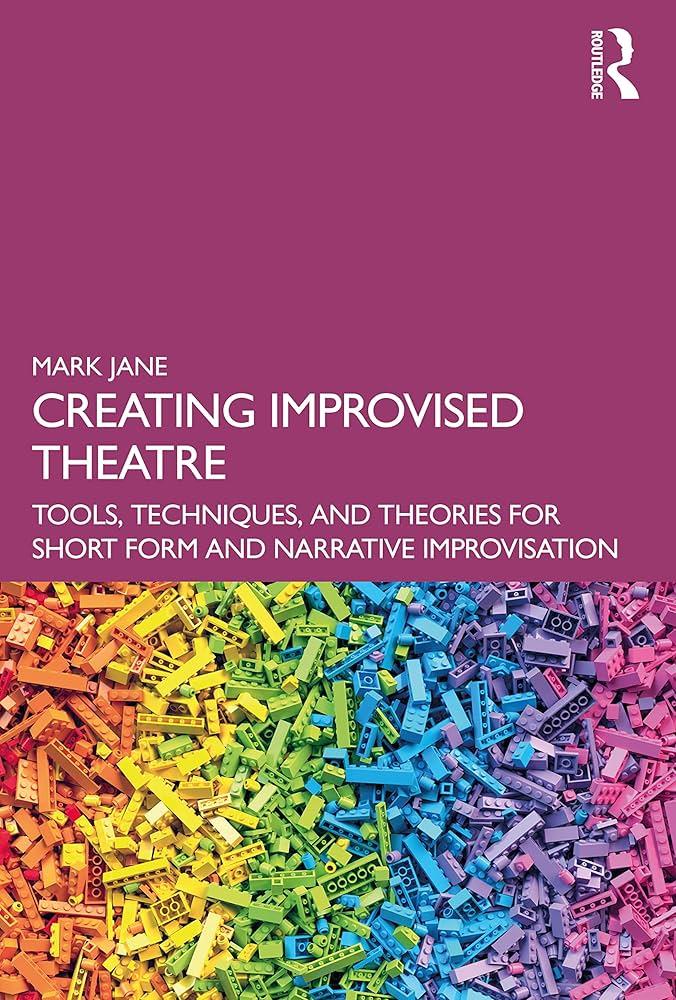
Creating Improvised Theatre
Tools, Techniques, and Theories
Mark Jane

Mask Improvisation for Actor Training and Performance
the compelling image
Sears A. Eldredge

The Applied Improvisation Mindset
Tools for Transforming Individuals, Organizations, and Communities
Theresa Robbins Dudeck; Caitlin McClure
Improvisation for the Theater
A Handbook of Teaching and Directing Techniques
Viola Spolin
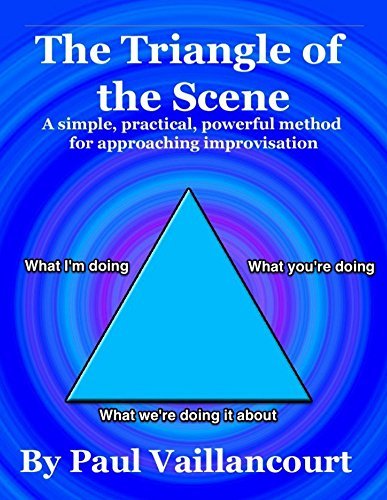
The Triangle of the Scene
A Simple, Practical, Powerful Method for Approaching Improvisation
Paul Vaillancourt

Group Improvisation
The Manual of Ensemble Improv Games
Peter Campbell Gwinn; Charna Halpern
Related Exercises
Alliances
Alliances is a spatial awareness exercise in which each player secretly selects one person in the group as their ally and another as their enemy, then moves through the space trying to keep the ally positioned between themselves and the enemy at all times. No one announces their choices, so the resulting group movement becomes complex, organic, and unpredictable as every participant simultaneously pursues their own spatial objective. The exercise produces a constantly shifting formation that resembles flocking behavior, with sudden accelerations, direction changes, and clusters forming and dissolving. Alliances develops spatial awareness, peripheral vision, and the ability to read and respond to group movement patterns without verbal communication. It also demonstrates how simple individual rules can generate complex group behavior, a principle that applies directly to ensemble scene work.
Janus Dance
Janus Dance is a physical awareness and space exercise named for the two-faced Roman god of transitions, in which participants move through the space while maintaining simultaneous awareness of what lies in front of them and behind them. The exercise trains the expanded spatial attention that performers need when navigating a stage populated by multiple scene partners, objects, and audience sightlines.
Predator/Defender
Predator Defender is an applied improvisation exercise from Putting Improv to Work in which each player secretly chooses one person as their predator and another as their defender. On the signal to move, everyone must keep their defender between themselves and their predator at all times, creating a dynamic, self-organizing system of constant movement.
The Magnet
The Magnet is a physical ensemble exercise in which one player acts as a magnet moving through the space while other players respond as if they are iron filings, drawn toward or pushed away depending on the magnet's orientation. The exercise develops physical responsiveness, spatial sensitivity, and ensemble attunement through non-verbal interaction.
How to Reference This Page
The Improv Archive. (2026). Triangles. Retrieved September 28, 2026, from https://improvarchive.org/exercises/triangles
The Improv Archive. "Triangles." The Improv Archive, 2026. https://improvarchive.org/exercises/triangles.
The Improv Archive. "Triangles." The Improv Archive, 2026, https://improvarchive.org/exercises/triangles. Accessed September 28, 2026.
The Improv Archive is a systemically maintained repository. The archive itself acts as the corporate author.