Yes And is the foundational improv exercise and philosophical principle in which performers practice accepting a partner's offer (the "yes") and adding new information that builds on it (the "and"). One player makes a statement; the partner responds by first affirming the reality of that statement and then contributing something new. The exercise trains the most essential skill in improvisation and has become the defining principle of the entire art form.
Structure
Setup
Two players sit or stand facing each other. No setup, set, or audience suggestion is required. The exercise is purely verbal in its most basic form, though physical variants exist.
Progression
Player 1 makes a positive, declarative statement establishing a fact about a shared reality. The statement should be specific: not "I am somewhere," but "I am standing on a pier that smells like fish and oil." Generic statements reduce the richness of the building chain.
Player 2 responds by first affirming the stated reality -- verbally or through direct extension -- and then adding a new piece of information that builds on it. The classic format uses the literal phrase: "Yes, and [new information]." The new information must genuinely build on what Player 1 established, not redirect or contradict it. Tom Salinsky and Deborah Frances-White describe the chain logic: each statement is linked to the previous one, with the phrase "yes, and" designed to program that linkage before the player has decided what to add.
Player 1 then responds with "yes, and" to Player 2's addition, accepting it as established fact and adding a further layer. The exchange continues, each player building exclusively on the accumulated reality of the prior statements.
Variations
In the narrative variant, players build a story together rather than a static environment, each "yes, and" advancing the plot. The phrase may be dropped once the habit is internalized -- players are simply required to begin each turn by accepting and extending.
In the constraint variant, players are explicitly forbidden from introducing any information that contradicts, qualifies, or redirects what has been established. The exercise reveals how often players instinctively deflect, diminish, or redirect offers rather than accepting them.
In the applied variant, documented by Bob Kulhan in Getting to Yes And, participants apply the principle to business scenarios: responding to colleagues' proposals by first affirming their merit before introducing new considerations. The verbal mechanic is the same; the content shifts from theatrical fiction to professional reality.
Conclusion
The exercise reaches its instructional goal when players can sustain a long chain of linked statements without contradiction or deflection, and when the accumulated reality is rich, specific, and shared. In applied contexts, the facilitator may end the exercise after each pair has built a chain of ten or more linked statements.
Common Pitfalls
The most common failure is the "yes, but": affirming in words while immediately negating in content. "Yes, and I think we should reconsider" is a masked no. Salinsky notes that "the phrase 'yes, and' is designed to program that [linkage] before the player has decided what to add" -- the mechanical habit of beginning with the phrase helps override the instinct to redirect.
A second failure is passive acceptance without genuine addition: "Yes, and it's interesting." This nominally satisfies the mechanic but adds nothing to the shared reality. Players must contribute specific information, not mere acknowledgment.
A third failure occurs when players treat yes-and as a license to add anything regardless of connection to the prior statement. The "and" is not just additive -- it must follow from what came before. Disconnected additions produce a chain of unrelated statements, not a shared reality.
How to Teach It
Objectives
Yes And trains acceptance (receiving a partner's offer as established reality), generosity (contributing something that serves the shared scene rather than the individual player's plan), and connection (building from what the partner established rather than from one's own internal agenda).
How to Explain It
"Yes And is the foundational agreement exercise. Two players face each other. One starts with any statement: 'I just found a dog.' The other responds with yes-and: they accept what was said as true and add something new. 'Yes, and it is wearing a tiny hat.' No questions, no corrections, no redirects. Each response accepts and adds. Try to build a ten-statement chain without dropping the agreement. Go."
Scaffolding
For beginners, require the literal phrase "yes, and" at the start of every response. The mechanical requirement overrides the analytical instinct to redirect. Once players can sustain a ten-statement chain without deflection, the literal phrase may be dropped in favor of demonstrated acceptance.
For intermediate players, introduce the constraint version: any response that qualifies, diminishes, or redirects the prior statement is called as a failure. This reveals how many ways players block without technically saying "no."
For advanced players, remove the round-robin structure and ask players to yes-and within a full scene without the explicit drill format. The target is internalized acceptance visible in scene behavior, not a verbal formula.
Common Coaching Notes
- "Yes, but is still no. Agree first, then add."
- "What did your partner just establish? Start from there."
- "Add a specific detail, not a general acknowledgment."
- "The 'and' must follow from the 'yes.' Don't just add anything -- add something that grows from what's already there."
In Applied Settings
Bob Kulhan documents extensive use of Yes And as a leadership and collaboration training tool in Getting to Yes And: The Art of Business Improv (2017). Kulhan has delivered this training to companies including PepsiCo, Google, and American Express, positioning yes-and as a framework for building collaborative team culture.
Learning Objectives: Active listening; building on others' contributions; reducing reflexive opposition; collaborative idea development; openness to unexpected directions.
Facilitation Context: Suitable for corporate workshops, leadership training, classroom settings, and community programs. Pairs of any size can participate simultaneously. Recommended group size: any even number from 4 to 30. The exercise requires no props or space configuration beyond two participants facing each other.
Adaptation Notes: For participants with no improv background, frame the exercise as a "collaborative storytelling drill" rather than an improv exercise. Remove the theatrical framing and focus on the communication principle: before you add your idea, affirm your partner's contribution. In corporate settings, Kulhan often frames this as "don't start your response with 'but'" as an initial accessible goal, before introducing the fuller yes-and mechanic.
Debrief Questions:
- "What did it feel like when your partner genuinely built on your idea instead of redirecting it?"
- "When were you tempted to say 'yes, but' instead of 'yes, and'? What was driving that impulse?"
- "How does the chain you built together compare to what either of you would have created alone?"
- "Where in your work does 'yes, but' thinking show up? What does it cost you?"
- "What would change in your team's meetings if everyone started from yes-and before introducing qualifications?"
In Applied Settings
Learning Objectives
Yes And trains active listening and collaborative idea-building. The mechanic forces participants to accept and build before introducing their own direction. This makes visible the reflex that causes most meeting friction: the instinct to redirect rather than extend. When participants succeed at yes-and, they produce more complete ideas with less interpersonal cost.
Workplace Transfer
Bob Kulhan documents in Getting to Yes And (2017) that the core behavior change is pre-acceptance: before contributing your idea, affirm your partner's. In organizational settings, this principle shows up in brainstorming, feedback conversations, and cross-functional handoffs. The "yes, but" response, which is the most common redirecting move in team meetings, signals that the speaker has not fully processed the prior contribution before offering their own.
Facilitation Context
Yes And is used in corporate workshops, leadership training, onboarding programs, classroom settings, and community programs. Kulhan has delivered this training to PepsiCo, Google, and American Express. Pairs of any size can participate simultaneously. Recommended group size: any even number from 4 to 30. The exercise requires no props or space configuration.
Adaptation Notes
For participants with no improv background, frame the exercise as a collaborative storytelling drill rather than an improv exercise. Remove theatrical framing and focus on the communication principle. In corporate settings, Kulhan frames the initial goal as simply: do not start your response with "but." The fuller yes-and mechanic follows once the reflex is interrupted.
Debrief Framing
"What did it feel like when your partner genuinely built on your idea instead of redirecting it?"
"When were you tempted to say 'yes, but' instead of 'yes, and'? What was driving that impulse?"
"Where in your work does 'yes, but' thinking show up? What does it cost the team?"
Skills Developed
History
The principle underlying "yes and" emerged from the earliest work of the Compass Players in St. Louis in the mid-1950s. Mike Nichols recounts in Kim Johnson's The Funniest One in the Room (2008) and Jeff Griggs documents in Guru that it was in St. Louis that the most important rule of improv was articulated: players who agreed with and built on each other's offers produced scenes that held audience attention, while players who contradicted or blocked each other's offers produced scenes that collapsed. The rule was not yet named "yes and" at this stage but the principle was operative.
ImprovOlympic (now iO Chicago) named its production company "Yes And Productions," as noted by Ron Kozlowski in The Art of Chicago Improv (2002), signaling the centrality of the principle to the Chicago long-form tradition founded by Del Close and Charna Halpern.
The exercise as a specific drill -- two players building a chain of linked statements using the literal phrase -- is documented across multiple curricula. Pamela Gesell describes a version in Playing Along in which Player 1 makes a positive declarative statement and Player 2 responds with "Yes and..." before adding her own. Tom Salinsky and Deborah Frances-White analyze the game mechanics in The Improv Handbook (2008), emphasizing that the phrase programs the linking behavior before the player's analytical mind can intervene.
The UCB Theatre in New York enshrined yes-and as the definitional principle of long-form improvisation in The Upright Citizens Brigade Comedy Improvisation Manual (2013): "These two simple words are the building blocks of every Long Form improv scene."
In applied contexts, Bob Kulhan extended the principle in Getting to Yes And: The Art of Business Improv (2017), documenting its use in organizational settings by companies including PepsiCo, Google, and American Express.
Worth Reading
See all books →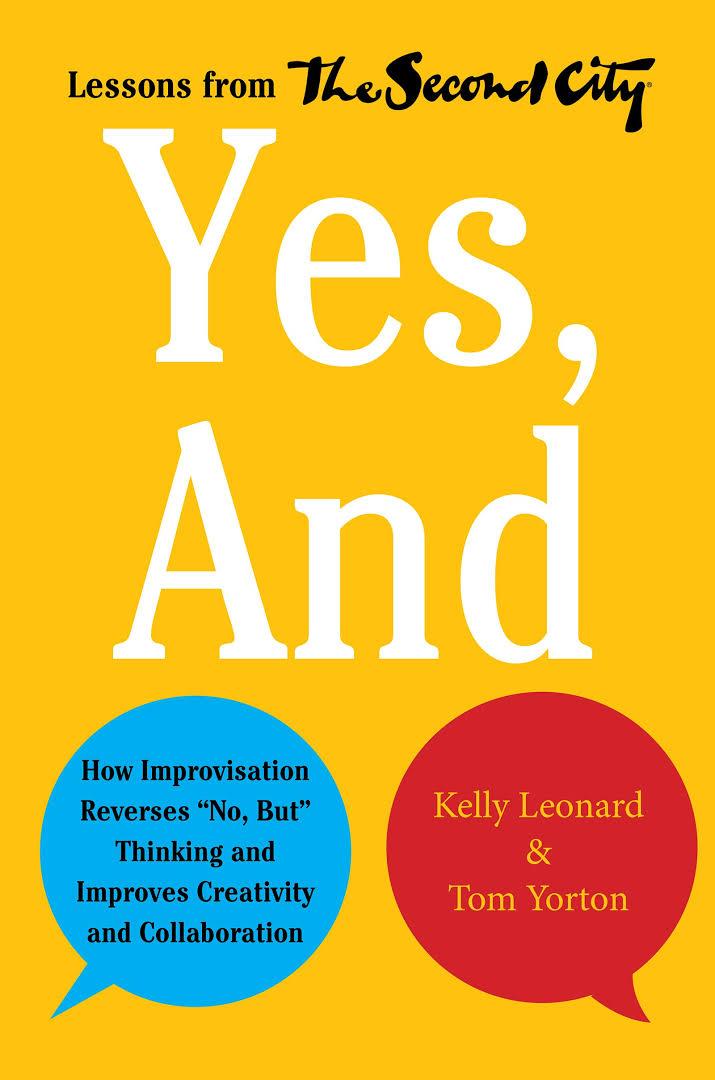
Yes, And
How Improvisation Reverses No, But Thinking and Improves Creativity and Collaboration
Kelly Leonard; Tom Yorton

Theatrical Improvisation
Short Form, Long Form, and Sketch-Based Improv
Jeanne Leep

The Art of Chicago Improv
Short Cuts to Long-Form Improvisation
Rob Kozlowski
Improvise
Scene from the Inside Out
Mick Napier
Creating Improvised Theatre
Tools, Techniques, and Theories
Mark Jane

The Routledge Companion to Improvisation in Organizations
Miguel Pina e Cunha; Dusya Vera; António Cunha Meneses
Related Exercises
Pass Yes
Pass Yes is a circle warm-up in which players attempt to say the word "yes" at the exact same moment as a partner. One player turns to a neighbor and both try to speak simultaneously, then the receiving player turns to the next person and repeats the process. The exercise trains listening, eye contact, and the willingness to synchronize with another person rather than lead or follow.
I Know
I Know is a scene-building exercise in which performers respond to every offer with the two-word affirmation that names the game, followed by an addition that expands the shared reality. The response functions as an amplified form of yes-and: it validates the partner's offer, implies pre-existing shared knowledge, and propels the scene forward through rapid mutual agreement. The exercise prevents denial and forces each player to build on their partner's contributions without hesitation, creating scenes that accumulate detail and emotional weight at speed.
Accepting Circle
Accepting Circle is a warm-up exercise in which players stand in a circle and practice receiving and building on each other's offers. One player initiates a sound, gesture, or phrase; the next player accepts it fully before adding their own. The exercise reinforces the foundational improv principle of "yes, and" in its simplest physical form.
Fish Sticks
Fish Sticks is a circle exercise in which players ask simple "Do you ... ?" questions while everyone tracks their own answers by lowering fingers. The round quickly reveals shared experiences, differences inside the group, and how honestly participants are listening to the question being asked.
Non Sequitor
Non Sequitur is a hybrid game and exercise in which performers deliberately break logical connections between lines of dialogue, forcing each new statement to have no apparent relationship to the one before it. The exercise trains performers to let go of the need to make sense, builds comfort with absurdity, and paradoxically reveals how audiences will construct meaning even from disconnected material.
Hello
Hello is a simple greeting exercise in which players practice making contact through the single word "hello," varying their delivery to express different emotions, characters, and relationships. The exercise demonstrates the range of meaning a single word can carry. It builds vocal variety and the ability to communicate intention through tone.
How to Reference This Page
The Improv Archive. (2026). Yes And. Retrieved September 28, 2026, from https://improvarchive.org/exercises/yes-and
The Improv Archive. "Yes And." The Improv Archive, 2026. https://improvarchive.org/exercises/yes-and.
The Improv Archive. "Yes And." The Improv Archive, 2026, https://improvarchive.org/exercises/yes-and. Accessed September 28, 2026.
The Improv Archive is a systemically maintained repository. The archive itself acts as the corporate author.