Mystery Word
Mystery Word is a short-form game in which performers play a scene while one performer -- unbeknownst to the others -- has been given a specific secret word that they must work into the dialogue naturally and without drawing attention to it. The rest of the performers and audience try to identify when the mystery word has been successfully used, creating a dual layer of engagement: the scene itself and the detective puzzle of watching for the hidden word.
Structure
Setup
While one performer waits offstage or covers their ears, the host obtains a word from the audience and shares it with the other performers and the audience. The mystery performer returns and the scene begins.
Progression
The mystery performer attempts to work the mystery word into the scene's dialogue naturally -- as if it is a perfectly ordinary word to say in that context -- without triggering obvious suspicion from their scene partners. The other performers may attempt to make the mystery word difficult to say naturally by steering the scene in directions that make the word awkward to use.
The audience watches for the successful use of the word. Once the mystery performer uses the word naturally, the audience may respond with recognition or applause.
Ending
The game ends when the mystery word has been used successfully, after a set time limit, or when the host calls the scene.
How to Teach It
Objectives
Mystery Word trains the ability to integrate a specific constraint naturally into scene work without telegraphing the effort, and develops the scene partners' skill of maintaining genuine scene coherence while creating opportunities or obstacles for the mystery performer.
How to Explain It
"Work the word in as if it's just a word you're saying. The moment it sounds like you're trying to use it, you've lost. Find the right moment in the scene where the word lands naturally -- like you would have said it anyway."
Scaffolding
Begin with high-frequency words that can be worked into most scenes naturally before using obscure or difficult words. The game's best moments come from words that are unusual enough to be challenging but common enough to have natural deployment opportunities.
Common Pitfalls
The mystery performer sometimes forces the word in awkwardly, breaking scene coherence to achieve the technical goal. Coach performers to prioritize scene integrity -- the word should serve the scene, not interrupt it.
How to Perform It
Audience Intro
"One of our performers doesn't know the word you're about to give us. The rest of us do. Their job is to use it naturally in the scene. Your job is to watch for when they do it."
Cast Size
Ideal: 3 performers (1 mystery performer, 2 who know the word).
Staging
Standard scene staging. The mystery performer should be visible to the full audience so their attempts and near-misses are clearly readable.
Wrap-Up Logic
End when the mystery word is successfully used with genuine scene integration, or after two to three minutes if the word has proven impossible to land naturally.
Worth Reading
See all books →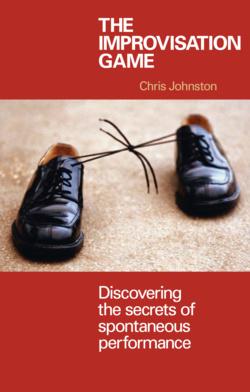
The Improvisation Game
Discovering the Secrets of Spontaneous Performance
Chris Johnston
Theater Games for Rehearsal
Viola Spolin

The Young Actor's Book of Improvisation
Dramatic Situations
Sandra Caruso; Susan Kosoff

Something from Nothing
The Technique of Improvisation
Richard Goteri

Mask Improvisation for Actor Training and Performance
the compelling image
Sears A. Eldredge

Drama Games and Improvs
Games for the Classroom and Beyond
Justine Jones; Mary Ann Kelley
Related Games
No P
No P is a short-form guessing game in which one performer must communicate an idea, tell a story, or answer questions without using any word that contains the letter P. The audience and host watch for violations, and the comedy arises from the performer's increasingly creative circumlocutions and the sudden, involuntary slips that reveal how deeply embedded common letters are in everyday speech.
Rebel Without a Clue
Rebel Without a Clue is a guessing game in which one performer must figure out their secretly assigned rebellious cause, crime, or antisocial behavior by interpreting the reactions and clues of their scene partners. The other performers know the secret and play characters who respond to the rebel with varying degrees of shock, admiration, or disgust.
Gibberish Malapropism
Gibberish Malapropism is a scene game in which performers speak mostly in English but periodically substitute gibberish for key nouns or verbs. The audience and scene partners must infer the meaning of each gibberish word from context. The game rewards clear, specific scene-work: the more vividly the scene establishes its world, the more accessible the gibberish substitutions become. It trains contextual specificity and attentiveness in both performers and audience.
Non Sequitor
Non Sequitur is a hybrid game and exercise in which performers deliberately break logical connections between lines of dialogue, forcing each new statement to have no apparent relationship to the one before it. The exercise trains performers to let go of the need to make sense, builds comfort with absurdity, and paradoxically reveals how audiences will construct meaning even from disconnected material.
Last Letter Scene
Last Letter Scene is a hybrid game and exercise in which each line of dialogue must begin with the last letter of the previous line. The constraint forces performers to listen with acute precision -- not to the general content of what is said but to the exact final sound of each utterance -- while maintaining scene coherence, character, and forward momentum simultaneously.
How to Reference This Page
The Improv Archive. (2026). Mystery Word. Retrieved September 28, 2026, from https://improvarchive.org/games/mystery-word
The Improv Archive. "Mystery Word." The Improv Archive, 2026. https://improvarchive.org/games/mystery-word.
The Improv Archive. "Mystery Word." The Improv Archive, 2026, https://improvarchive.org/games/mystery-word. Accessed September 28, 2026.
The Improv Archive is a systemically maintained repository. The archive itself acts as the corporate author.