No P is a short-form guessing game in which one performer must communicate an idea, tell a story, or answer questions without using any word that contains the letter P. The audience and host watch for violations, and the comedy arises from the performer's increasingly creative circumlocutions and the sudden, involuntary slips that reveal how deeply embedded common letters are in everyday speech.
Structure
Setup
One performer takes the stage. The host explains the restriction: the performer cannot use any word containing the letter P. The host or audience provides a topic for the performer to discuss or a scenario to act out.
Progression
The performer begins speaking on the given topic while avoiding every word that contains a P. This includes obvious words like "people," "place," and "important," but also less obvious ones like "up," "open," "stop," and "help." The host monitors for violations and signals with a buzzer, bell, or verbal call when a P-word slips through.
The game escalates naturally as the performer attempts increasingly complex ideas and discovers how many common words are suddenly unavailable. Audience members often catch violations before the host, creating collective participation.
Ending
The game ends after a set time (typically two to three minutes), after a set number of violations, or when the host decides the performer has mined the premise thoroughly. The audience applauds the performer's effort regardless of violation count.
How to Teach It
Objectives
No P trains verbal dexterity, real-time vocabulary substitution, and the ability to maintain coherent communication under an artificial constraint. It also reveals how automatic speech production normally is by making it suddenly manual.
How to Explain It
"Talk about anything you want, but you cannot use any word that has a P in it. Not just words that start with P -- any word where P appears anywhere. If you slip, we buzz you. Try to make it through."
Scaffolding
Start with a familiar topic that the performer knows well, so they can focus on word choice rather than content generation. For beginners, allow a brief pause before starting to let them mentally scan their opening sentence. For advanced performers, assign topics that are rich in P-words -- politics, sports, cooking -- to increase the difficulty.
Common Pitfalls
Performers sometimes slow down so much that the scene loses energy, becoming a careful word search rather than a dynamic performance. Coach them to maintain conversational pace and accept that violations will happen -- the comedy is in the slips, not in perfect avoidance. A second pitfall is performers who find a safe sentence structure and repeat it; push them into new territory by changing the topic mid-game.
How to Perform It
Audience Intro
"Our performer is going to talk about [topic] -- but they cannot say any word that has the letter P in it. If they do, you'll hear the buzzer. Help us listen."
Cast Size
One performer plus a host or monitor. A second performer can be added for dialogue scenes, doubling the difficulty.
Staging
Minimal -- a microphone or downstage position. The host stays visible with a buzzer or bell to signal violations. A scoreboard or tally of violations adds visual comedy.
Wrap-Up Logic
End after a natural peak of difficulty or when the performer has survived the full time limit. Celebrate survival or spectacular failure equally.
Worth Reading
See all books →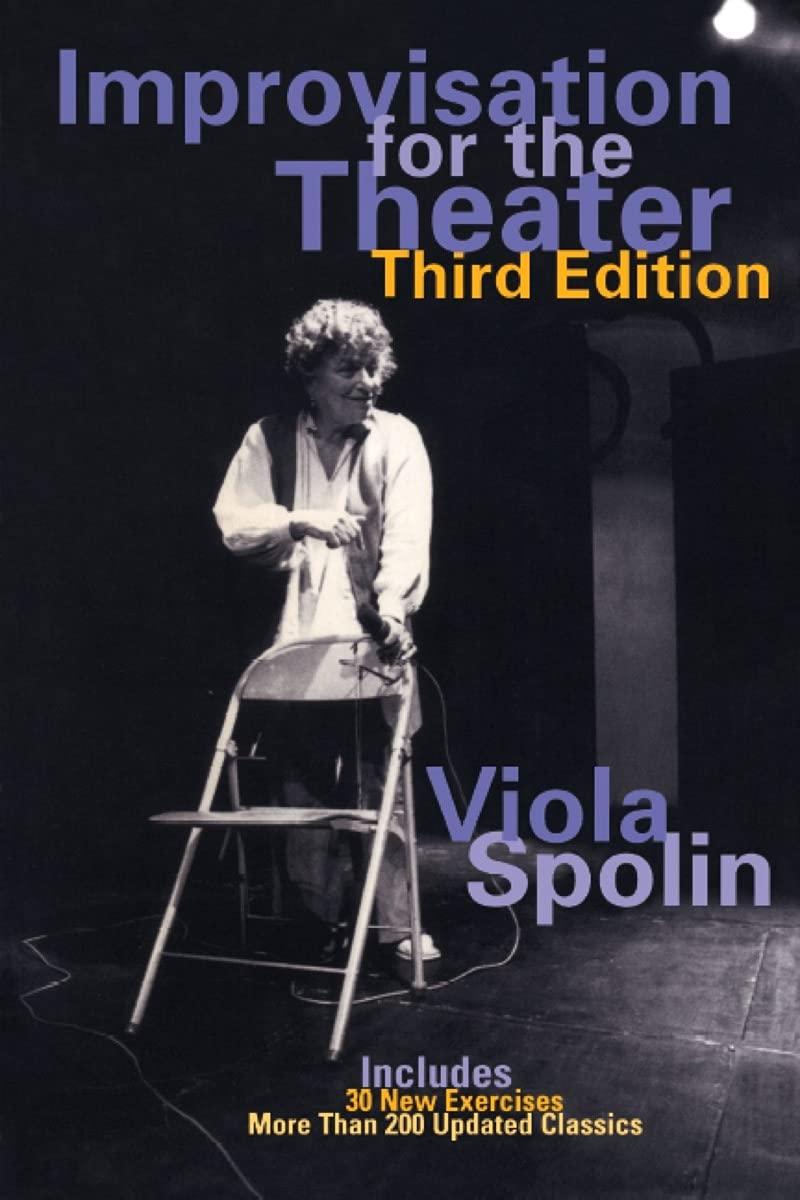
Improvisation for the Theater
A Handbook of Teaching and Directing Techniques
Viola Spolin
The Improvisation Game
Discovering the Secrets of Spontaneous Performance
Chris Johnston
Theater Games for Rehearsal
Viola Spolin

Something from Nothing
The Technique of Improvisation
Richard Goteri

The Young Actor's Book of Improvisation
Dramatic Situations
Sandra Caruso; Susan Kosoff

Improvisation for Actors and Writers
A Guidebook for Improv Lessons in Comedy
Bill Lynn
Related Games
Mystery Word
Mystery Word is a short-form game in which performers play a scene while one performer -- unbeknownst to the others -- has been given a specific secret word that they must work into the dialogue naturally and without drawing attention to it. The rest of the performers and audience try to identify when the mystery word has been successfully used, creating a dual layer of engagement: the scene itself and the detective puzzle of watching for the hidden word.
Jeopardy
Jeopardy is a short-form game modeled on the television quiz show format, in which performers provide improvised questions to audience-supplied answers. The reversed format (answer first, then question) demands quick thinking and the ability to construct comedic setups from arbitrary punchlines. A host manages the game board and selects categories, while performer-contestants buzz in with their responses. The game rewards wit, timing, and the ability to find unexpected connections within the quiz show framework.
Non Sequitor
Non Sequitur is a hybrid game and exercise in which performers deliberately break logical connections between lines of dialogue, forcing each new statement to have no apparent relationship to the one before it. The exercise trains performers to let go of the need to make sense, builds comfort with absurdity, and paradoxically reveals how audiences will construct meaning even from disconnected material.
Last Letter Scene
Last Letter Scene is a hybrid game and exercise in which each line of dialogue must begin with the last letter of the previous line. The constraint forces performers to listen with acute precision -- not to the general content of what is said but to the exact final sound of each utterance -- while maintaining scene coherence, character, and forward momentum simultaneously.
Id
Id is a scene game in which a performer's unfiltered subconscious desires are voiced by a second player, creating a running commentary of primal wants beneath the surface dialogue. The tension between polite conversation and raw impulse generates comedy and dramatic irony. The game highlights the gap between social behavior and inner life.
How to Reference This Page
The Improv Archive. (2026). No P. Retrieved September 28, 2026, from https://improvarchive.org/games/no-p
The Improv Archive. "No P." The Improv Archive, 2026. https://improvarchive.org/games/no-p.
The Improv Archive. "No P." The Improv Archive, 2026, https://improvarchive.org/games/no-p. Accessed September 28, 2026.
The Improv Archive is a systemically maintained repository. The archive itself acts as the corporate author.