Yes And
A foundational principle of improvisation in which a performer accepts the reality established by their scene partner ("Yes") and builds on it with new information ("And"). Widely taught as the first rule of improv, it governs both scenic agreement and collaborative storytelling.
At the foundation of all improvisational performance lies a deceptively simple agreement between scene partners: accept what has been established and contribute something new. This principle, universally known as "Yes And," asks performers to treat their partner's contributions as real within the world of the scene (the "Yes") and then extend that reality with additional information, emotion, or action (the "And"). It is widely taught as the first rule of improv and governs both scenic agreement and collaborative storytelling.
The historical roots of "Yes And" trace back to the Compass Players in St. Louis during the 1950s. As documented in accounts of that era, improvisers and directors watched scenes devolve into conflict and noticed audiences becoming disinterested and bored. The observation that scenes thrived on collaborative building rather than competitive blocking led to the codification of agreement as the central operating principle. From the Compass forward through Second City, iO, and virtually every training program worldwide, "Yes And" became not merely a technique but what many practitioners describe as a philosophy of communication at any level.
In teaching contexts, the principle is typically introduced through simple exercises that demonstrate the difference between blocking and accepting. One common format, sometimes called "The Hairdresser," places performers in a scenario where one version uses denial and another uses acceptance, making the contrast visceral for students. Coaches instruct performers to listen and respond directly to their partners, to watch what their scene partners are doing and remain aware. The directive to "Yes And" your partner appears in foundational curricula across traditions, from Viola Spolin's lineage through Keith Johnstone's work and into contemporary programs.
A significant misunderstanding of the principle is that it requires literal verbal agreement or passive compliance. In practice, "Yes And" refers to accepting the underlying reality of what a partner has established, not necessarily agreeing with it as a character. A character can argue, resist, or express displeasure while the performer still honors the established fiction. The acceptance operates at the level of the improvisers' shared reality, not at the level of character opinion. Outright denial of established facts, known as blocking, is what the principle guards against.
The concept has proven remarkably portable beyond performance contexts. Bob Kulhan's work in business improvisation applies "Yes And" as a framework for organizational creativity and collaboration. In therapeutic and educational settings, practitioners have found that employing the principle allows facilitators to enter a participant's perceived situation and guide it toward productive outcomes rather than shutting down the experience through denial. The "Cycle of Deep Yes, And" described in applied improvisation literature extends the concept into sustained practices of acknowledgment and building within professional development programs.
"Yes And" connects directly to several other core improv concepts. It is the positive expression of what improvisers frame negatively as "don't block." It underpins the practice of listening for and accepting offers, which are any moves that advance a scene. It creates the conditions necessary for group mind, heightening, and collaborative discovery. Without the foundational agreement that "Yes And" provides, the more advanced techniques of long-form improvisation, including pattern games, montages, and the Harold, cannot function. The principle remains, decades after its articulation, the single concept most identified with improvisation as an art form.
Further Reading
See all books →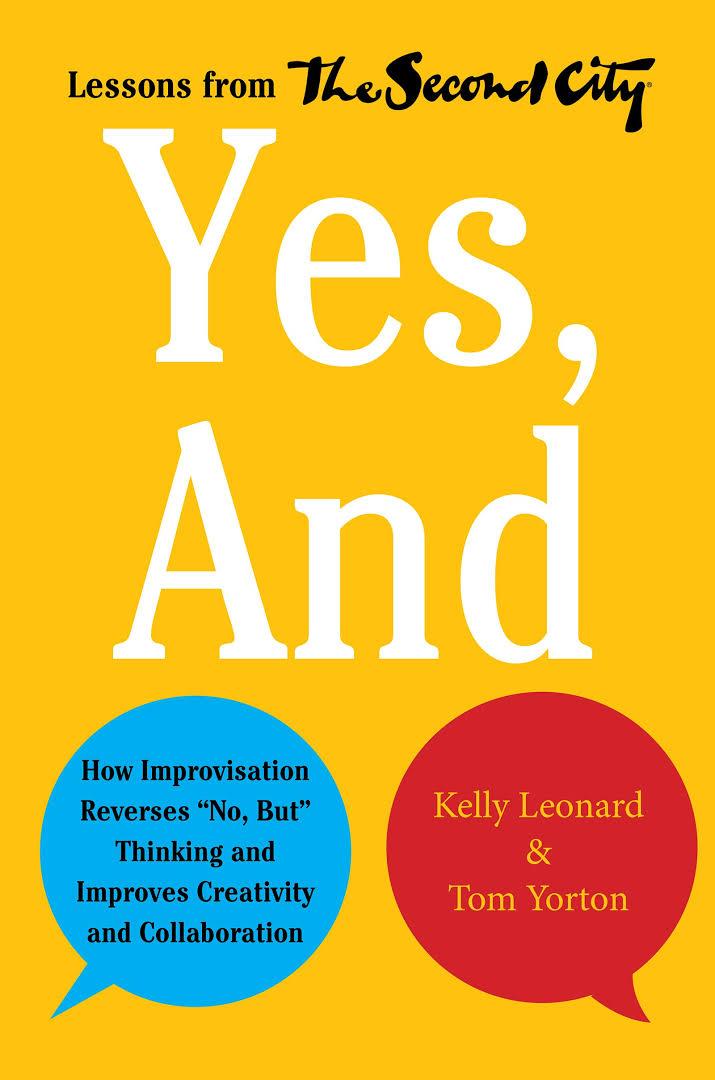
Yes, And
How Improvisation Reverses No, But Thinking and Improves Creativity and Collaboration
Kelly Leonard; Tom Yorton

Legislative Theatre
Using Performance to Make Politics
Augusto Boal

Theatrical Improvisation
Short Form, Long Form, and Sketch-Based Improv
Jeanne Leep

The Art of Chicago Improv
Short Cuts to Long-Form Improvisation
Rob Kozlowski
Improvise
Scene from the Inside Out
Mick Napier
Creating Improvised Theatre
Tools, Techniques, and Theories
Mark Jane
How to Reference This Page
The Improv Archive. (2026). Yes And. Retrieved October 14, 2026, from https://improvarchive.org/learn-improv/concepts/yes-and
The Improv Archive. "Yes And." The Improv Archive, 2026. https://improvarchive.org/learn-improv/concepts/yes-and.
The Improv Archive. "Yes And." The Improv Archive, 2026, https://improvarchive.org/learn-improv/concepts/yes-and. Accessed October 14, 2026.
The Improv Archive is a systemically maintained repository. The archive itself acts as the corporate author.