Advance Jointly
Exercises where teams must move forward together on a task, requiring synchronized decision-making and mutual support.
Structure
Context
Advance Jointly exercises require teams to make forward progress on a task simultaneously - no one can move ahead while others are left behind. The structure makes visible whether a group is advancing as a unit or as a collection of fast-movers and slow-movers.
Core Exercise: Synchronized Completion
The group receives a task that must be completed by every participant before any single participant can "finish." Examples:
- Write a one-sentence insight about the workshop so far. When everyone has one, share simultaneously (not one at a time).
- Move from one side of the room to the other, but the group cannot be spread out more than two body-lengths from front to back. Fastest movers must slow; slowest must be helped.
- In a written brainstorm, no idea can be moved to the "action" column until everyone in the group has had a chance to comment on it.
Variation: The Slowest Sets the Pace
Explicitly name the rule: the group can only move as fast as the slowest person currently working. Fast-movers must either assist or wait - not visibly disengage.
Variation: Chain Writing
Each person adds one sentence to a shared document or whiteboard. No sentence can be written until the previous one is read aloud. The group advances the story together, at a pace governed by the reading.
Timing
15-25 minutes including debrief.
How to Teach It
How to Explain It
"The task is only complete when everyone has completed it. Moving ahead alone doesn't count. Watch what happens to the group's pace."
Why It Matters
Many team failures stem from the disconnect between individual and group progress: high performers move fast and leave others behind; slower participants fall into dependency; the gap widens. Advance Jointly exercises create a structural condition where that gap is directly consequential - the group literally cannot proceed until it advances together. This is a powerful concrete experience for groups that know intellectually that they should "collaborate" but don't feel why in the body.
Common Coaching Notes
- Don't explain the lesson before the exercise. Let participants discover the pace-setting dynamic by experiencing it.
- Fast movers need specific coaching. Rather than waiting impatiently, they should actively assist. Prompt: "What does helping look like right now?"
- Slow movers need respect. The exercise fails if the pace-setter is made to feel like a problem. Frame it as the group's responsibility to find a pace that works for everyone.
Debrief Questions
- What happened when the fastest person reached the front?
- What would the team have lost if you'd allowed individuals to finish on their own timeline?
- Where in your real work do you face this dynamic?
In Applied Settings
Organizational Context
Advance Jointly exercises address one of the most persistent challenges in organizational teamwork: the gap between individual pace and team pace. In high-performing teams, participants often self-select toward autonomous, fast-paced individual work that creates the appearance of progress while the team falls out of alignment. Applied improv makes this dynamic immediately visible in a way that is direct, experiential, and impossible to rationalize away.
Workplace and Team Applications
These exercises are especially valuable in team development contexts where there is a visible pace mismatch: technical and non-technical members moving at different speeds, experienced and new members with different learning curves, or functions that move at structurally different rates (sales vs. implementation, strategy vs. operations). The exercises provide a shared vocabulary and a felt sense of what synchronized advancement requires.
Meeting and Workshop Contexts
Advance Jointly exercises pair naturally with collaborative work sessions - strategic planning workshops, retrospectives, or learning programs - where the goal is genuinely shared understanding rather than individual takeaways. Facilitators can use the exercise to set a norm for the workshop: "We're going to move together in this session. If you're ahead, your job is to help."
Debrief for Organizations
The organizational debrief can explore structural questions: "What does your organization do when some people advance faster than others? Who is responsible for pace management? What would it mean to make that a team responsibility rather than a management responsibility?" These questions surface real cultural and structural issues that the exercise makes discussable.
Skills Developed
Worth Reading
See all books →
Business Improv
Experiential Learning Exercises to Train Employees
Val Gee

Playing Along
37 Group Learning Activities Borrowed from Improvisational Theater
Izzy Gesell

Group Improvisation
The Manual of Ensemble Improv Games
Peter Campbell Gwinn; Charna Halpern

Improv to Improve Your Leadership Team
Tear down Walls and Build Bridges
Candy Campbell
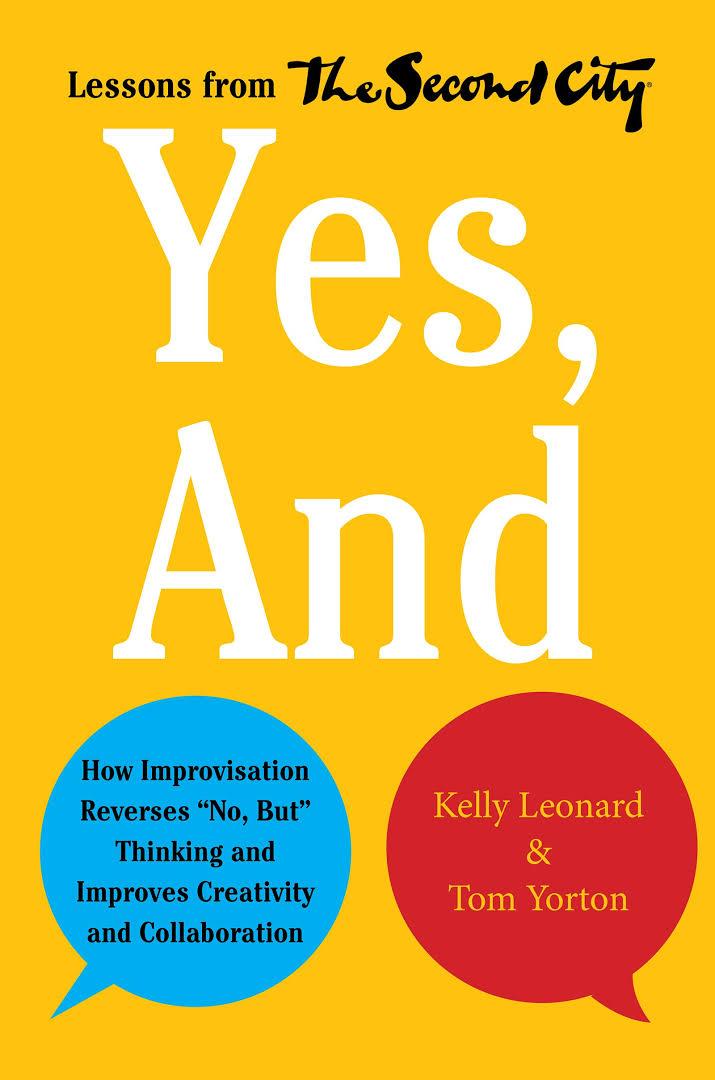
Yes, And
How Improvisation Reverses No, But Thinking and Improves Creativity and Collaboration
Kelly Leonard; Tom Yorton

The Improvisation Edge
Secrets to Building Trust and Radical Collaboration at Work
Karen Hough
Related Exercises
Synchronised Dance
Synchronised Dance is an exercise in which players attempt to move and dance together without choreography or a designated leader. The group must develop collective movement awareness, finding shared rhythm and motion through mutual observation and response.
Collaboration
Collaboration is a category of applied improvisation exercises in which group tasks are designed so that individual success is structurally impossible: the design requires coordinated effort, shared information, and mutual accountability to complete. The exercises are used to surface how groups actually function under cooperative pressure, revealing patterns of self-organization, communication, and shared decision-making.
And Then
And Then is a storytelling exercise in which each contribution to a group story must begin with the phrase "and then." The connective phrase enforces forward momentum and prevents storytellers from stalling or backtracking. The exercise trains narrative drive and the habit of advancing rather than circling.
Synchro Clap
Synchro Clap is a group focus exercise in which players attempt to clap simultaneously without any verbal coordination or designated leader. The exercise develops ensemble awareness and the ability to read and respond to the group's collective energy.
Team Confidence
Team Confidence is an applied exercise in which participants build collective self-assurance through structured sequences of shared achievement. The exercise uses graduated challenges and group acknowledgment to create a felt sense of competence that transfers to workplace contexts.
No Doubles 1-10
No Doubles 1-10 is a group focus exercise in which participants attempt to count from one to ten as a collective, with only one person speaking each number at a time. If two or more people speak simultaneously, the count resets to one. The exercise trains group listening, patience, and the shared impulse awareness that underlies ensemble work.
The Lineage
Explore the schools and structures that influenced or evolved from Advance Jointly.
Business Improv (Gee & Gee)
How to Reference This Page
The Improv Archive. (2026). Advance Jointly. Retrieved September 28, 2026, from https://improvarchive.org/exercises/advance-jointly
The Improv Archive. "Advance Jointly." The Improv Archive, 2026. https://improvarchive.org/exercises/advance-jointly.
The Improv Archive. "Advance Jointly." The Improv Archive, 2026, https://improvarchive.org/exercises/advance-jointly. Accessed September 28, 2026.
The Improv Archive is a systemically maintained repository. The archive itself acts as the corporate author.