Collaboration
Collaboration is a category of applied improvisation exercises in which group tasks are designed so that individual success is structurally impossible: the design requires coordinated effort, shared information, and mutual accountability to complete. The exercises are used to surface how groups actually function under cooperative pressure, revealing patterns of self-organization, communication, and shared decision-making.
Structure
Design Principle
Collaboration exercises share a common structure: the task cannot be completed by any individual working alone, and the conditions of success require genuine interdependence. Common forms include:
Information jigsaw: Each participant holds a piece of information that others need. The group must pool and organize information to reach a shared understanding or decision. No single participant can solve the problem without contributions from others.
Shared-resource tasks: The group is given materials (physical objects, a shared whiteboard, a single voice in a conversation) that must be managed collectively. Participants negotiate access and use in real time.
Sequential contribution: Each participant adds one element to a growing collective product (a story, a plan, a design) without the ability to revise or override what others have contributed. The group's output is the sum of all contributions.
Progression
Tasks run until the group reaches a resolution or the time limit expires. Multiple rounds allow the group to adjust its approach based on what they observed in the previous round.
Conclusion
The facilitator pauses the activity before debrief, allowing participants a moment to reflect silently on what they noticed before discussion opens.
How to Teach It
Objectives
Collaboration exercises target the group's actual cooperative behavior rather than its stated commitment to collaboration. They make visible how groups self-organize under pressure: who takes initiative, who waits, how decisions get made without formal authority, and where communication breaks down.
How to Explain It
"This task is designed so no one can finish it alone. You'll need everyone's input to get there. Notice how your group figures out how to work together -- that's as important as whether you finish."
Scaffolding
With groups new to this kind of work, start with shorter, simpler tasks before introducing complexity. With experienced groups, add constraint or pressure to reveal how the group's collaborative patterns change when time or resources are reduced.
Common Pitfalls
Groups often appoint an informal leader who then runs the task as a directed project rather than a genuine collaboration. This is not wrong, but it is worth naming in the debrief. A second common pattern is that some participants disengage when they do not see a clear role for themselves. Facilitators can intervene to draw those participants back in by asking the group what information or input has not yet been incorporated.
In Applied Settings
Learning Objectives
Collaboration exercises in applied improv address the gap between groups that describe themselves as collaborative and groups that function collaboratively. The exercise creates observable evidence: participants can see who contributed, how decisions were made, and whether the group actually used what everyone brought. The debrief focuses on those observable patterns rather than on participants' intentions or self-assessments.
Workplace Transfer
The mechanics of the exercise directly mirror the mechanics of cross-functional project work, consensus decision-making, and any organizational situation where no single person or role holds all the necessary information or authority. Organizations use these exercises in team formation workshops, cross-departmental training, leadership programs, and culture-building work to examine how their stated values around collaboration appear in actual group behavior.
Facilitation Context
Collaboration exercises are used across a wide range of applied settings: corporate team development, classroom group work, community organizing, healthcare team training, and nonprofit leadership programs. They work with groups of any size, though tasks should be scaled to the group: smaller tasks for pairs and triads, more complex multi-stakeholder tasks for larger groups.
Debrief Framing
Facilitators ask: "Who spoke first? Who spoke least? How were decisions made? What happened when someone's contribution was not incorporated? What would the group do differently in round two?" These questions move from observable behavior to pattern recognition and then to behavioral intention.
Skills Developed
Worth Reading
See all books →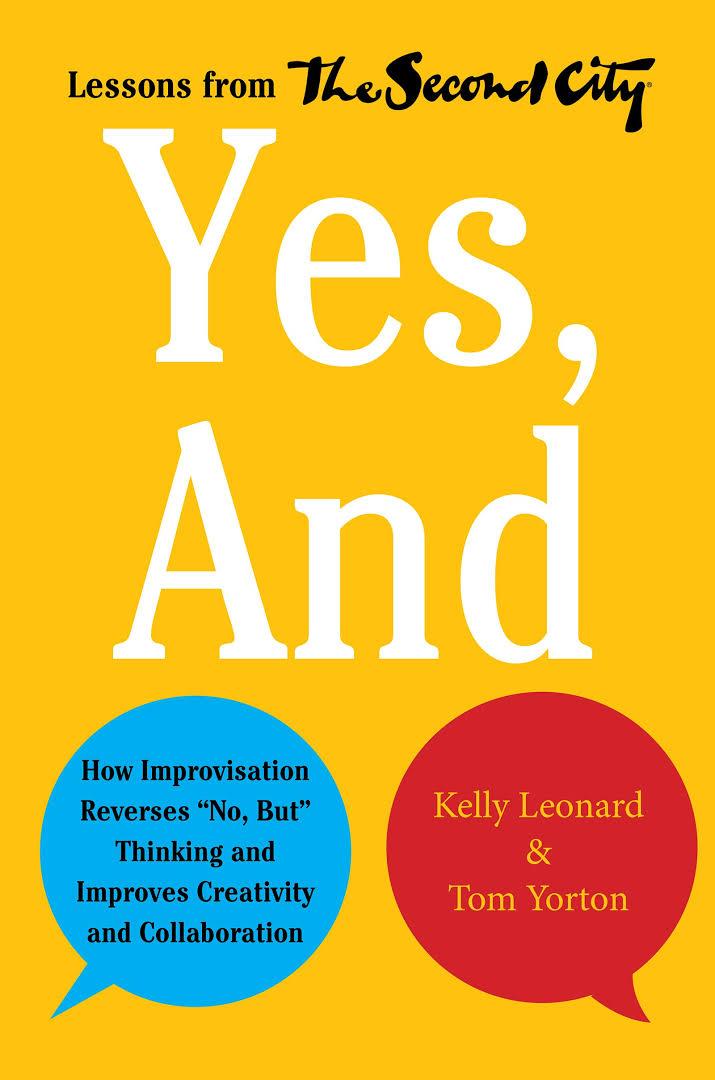
Yes, And
How Improvisation Reverses No, But Thinking and Improves Creativity and Collaboration
Kelly Leonard; Tom Yorton

Business Improv
Experiential Learning Exercises to Train Employees
Val Gee

Legislative Theatre
Using Performance to Make Politics
Augusto Boal

Theatrical Improvisation
Short Form, Long Form, and Sketch-Based Improv
Jeanne Leep

Devising Performance
A Critical History
Deirdre Heddon; Jane Milling

The Art of Chicago Improv
Short Cuts to Long-Form Improvisation
Rob Kozlowski
Related Exercises
Problem Solving
Problem Solving is an applied improvisation exercise from Business Improv in which teams tackle challenges using "Yes, And" principles and other improvisational techniques. Rather than following traditional analytical frameworks, participants generate solutions through rapid ideation, collaborative building, and the willingness to explore unconventional approaches.
Silo-Busting Exercise
Silo-Busting Exercise is an applied improvisation exercise in which a team facing a real challenge invites people from a completely separate department to join their brainstorming session. The outside participants bring fresh perspectives, unfamiliar frameworks, and no institutional assumptions, breaking the echo-chamber dynamic that limits innovation within isolated teams.
Achievement
Goal-oriented exercises that celebrate accomplishment while maintaining the improvisational principle of process over outcome.
Delegation
Delegation is an applied improvisation exercise in which groups create silent human tableaux depicting delegation at its worst and its best. Using only bodies and physical relationships -- no words, no props -- participants explore the dynamics of empowerment, control, and collaborative trust that characterize effective and ineffective delegation. The exercise surfaces assumptions about authority, ownership, and trust in ways that verbal discussion alone often cannot reach.
SNAP!
Snap is a high-energy ensemble exercise using snapping to create patterns and rhythms, developing group coordination, focus, and the ability to maintain individual contributions within a collective effort. The exercise builds from simple unison snapping to complex polyrhythmic structures.
Managing Change
Managing Change is an applied improv exercise that uses structured improvisation to help participants navigate and practice the psychological and behavioral responses to unexpected change in organizational contexts. The exercise creates controlled conditions of disruption and adaptation, training the specific skills of remaining present, communicating openly, and collaborating effectively when plans, expectations, or structures are suddenly altered.
The Lineage
Explore the schools and structures that influenced or evolved from Collaboration.
Business Improv (Gee & Gee)
How to Reference This Page
The Improv Archive. (2026). Collaboration. Retrieved September 28, 2026, from https://improvarchive.org/exercises/collaboration
The Improv Archive. "Collaboration." The Improv Archive, 2026. https://improvarchive.org/exercises/collaboration.
The Improv Archive. "Collaboration." The Improv Archive, 2026, https://improvarchive.org/exercises/collaboration. Accessed September 28, 2026.
The Improv Archive is a systemically maintained repository. The archive itself acts as the corporate author.