Effective Meetings
Effective Meetings is a category of applied improv exercises that use improvisational principles to make group meetings more productive, inclusive, and engaging. The exercises target the specific dysfunctions common in professional meeting culture -- passive participation, hierarchical gatekeeping of ideas, unfocused discussion, and unconstructive pushback -- by installing collaborative improv norms in their place.
Structure
Agreement and Ideation Structures
Exercises like Yes-And rounds, in which each participant must accept the previous idea and build on it before offering a new direction, replace defensive critique with forward momentum. The rule forces participants to engage with ideas before evaluating them, generating a larger pool of possibilities than traditional meeting formats produce.
Status and Participation Equity
Facilitators use structured turn-taking, talking sticks, or improv-style physical cues to ensure all voices are heard. The techniques interrupt the common pattern in which two or three high-status participants dominate while others disengage.
Improv Listening Contracts
Before a meeting, the group establishes listening norms using improv language: one conversation at a time, paraphrase before responding, and signal agreement physically before adding. These contracts reframe meeting norms as shared agreements rather than imposed rules.
Conclusion
Applied improv meeting exercises close with a brief debrief identifying which behaviors changed during the meeting and what participants want to carry forward.
How to Teach It
Objectives
Effective Meetings exercises target specific meeting dysfunctions: idea blockage, dominant voices, agenda drift, and passive participation. The improv frame gives facilitators a lightweight, non-threatening language for addressing these patterns without prescribing corporate process.
How to Explain It
"We're going to run this meeting using a few improv rules. The main one is Yes-And: before you push back on an idea, build on it first. You can still disagree -- but build first."
Scaffolding
Introduce one improv norm per meeting session rather than overhauling meeting structure all at once. Starting with the Yes-And rule alone produces measurable change in group dynamics without requiring participants to master a new format entirely.
Common Pitfalls
Participants sometimes treat Yes-And as a trick to avoid accountability or critical thinking. Facilitators should clarify that building on an idea is not endorsing it -- it is expanding it before evaluating it. Evaluation comes after the generative phase, not during.
In Applied Settings
Learning Objectives
Effective Meetings exercises address the gap between what organizations intend their meetings to accomplish and what meetings actually produce. The improv principles of acceptance, building, listening, and equal status participation directly counter the dynamics that make meetings unproductive: premature criticism, hierarchy-driven participation, and passive attendance. The exercises do not fix meeting agendas; they develop the human behavior that makes any agenda more likely to succeed.
Workplace Transfer
Organizations that apply improv meeting norms report faster ideation, fewer blocked conversations, and higher participation rates from quieter team members. The Yes-And structure, applied to brainstorming or problem-solving sessions, consistently produces a larger and more diverse set of ideas than traditional free-form discussion. The listening structures reduce the time spent on repetition and misunderstanding, because participants paraphrase and confirm before adding.
Facilitation Context
Effective Meetings exercises are used in leadership development programs, team effectiveness workshops, and communication training. They are most useful for teams with established dysfunctional meeting patterns -- chronic silences, dominant voices, or sessions that routinely end without decisions. Group sizes of 5 to 20 are optimal; very large meetings require additional structural support beyond the improv layer.
Debrief Framing
After the meeting or exercise, ask: "What felt different about how we talked to each other's ideas today? What did you notice about your own participation? Which of these norms would you want to keep?"
Skills Developed
Worth Reading
See all books →
Business Improv
Experiential Learning Exercises to Train Employees
Val Gee
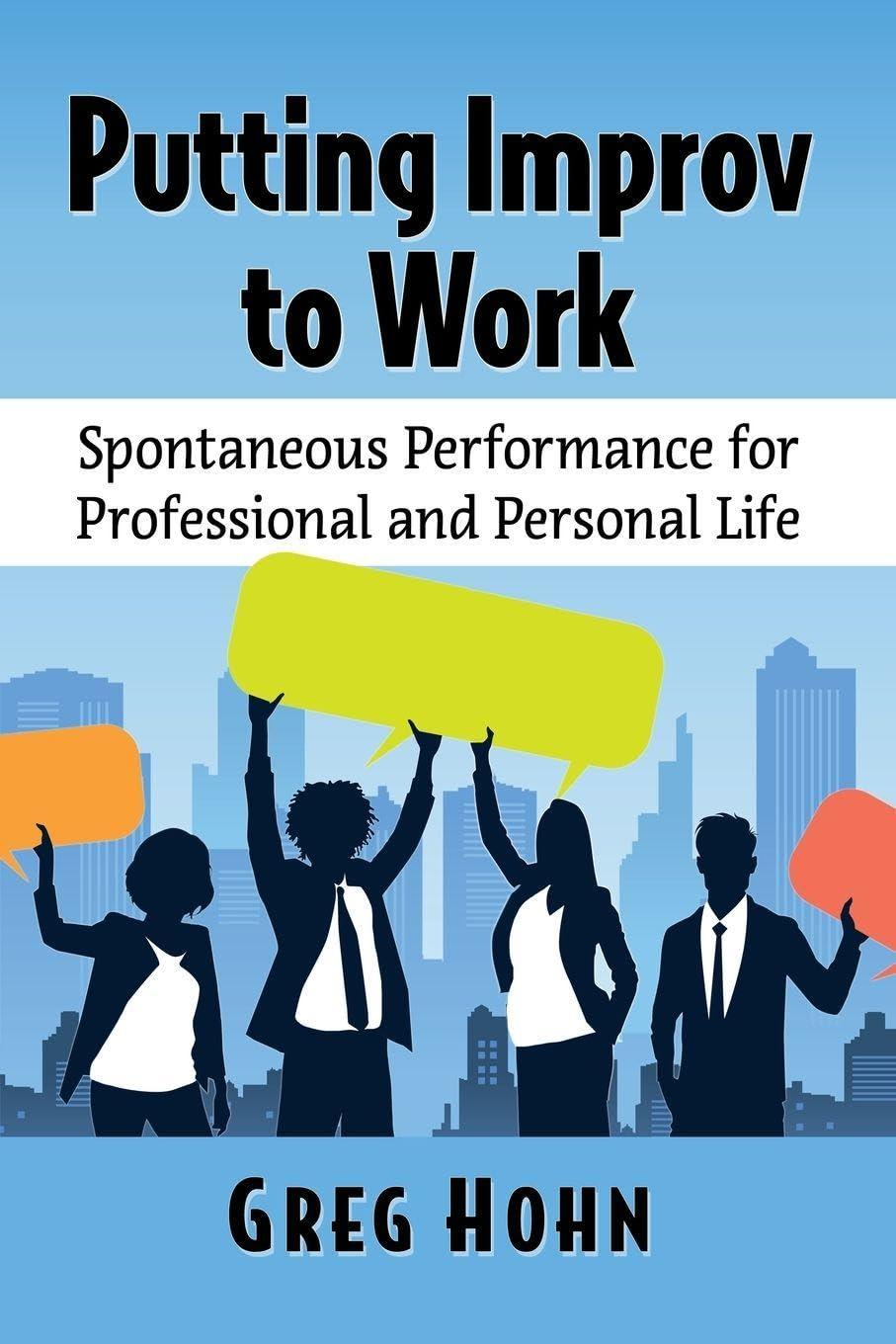
Putting Improv to Work
Spontaneous Performance for Leadership, Learning, and Life
Greg Hohn
The Improvisation Book
How to Conduct Successful Improvisation Sessions
John S.C. Abbott

Improv to Improve Your Leadership Team
Tear down Walls and Build Bridges
Candy Campbell
Improvise!
Use the Secrets of Improv to Achieve Extraordinary Results at Work
Max Dickins

The Applied Improvisation Mindset
Tools for Transforming Individuals, Organizations, and Communities
Theresa Robbins Dudeck; Caitlin McClure
Related Exercises
Meetings That Matter
Meetings That Matter is an applied improv exercise and facilitation framework in which participants practice the specific behaviors that transform routine professional meetings into focused, productive, and genuinely collaborative exchanges. The exercise uses improv principles -- agreement, active listening, present-moment attention, and collaborative building -- to address the characteristic patterns that cause meetings to lose clarity, momentum, or collective purpose.
Fabulous Conference Calls
Fabulous Conference Calls is an applied improv exercise that uses structured activities to make virtual or phone meetings more engaging, participatory, and purposeful. The exercises divide the agenda among participants, assign roles, and use improv-derived interaction norms to replace the passive, one-directional format typical of conference calls with a shared, active participation structure.
Managing Change
Managing Change is an applied improv exercise that uses structured improvisation to help participants navigate and practice the psychological and behavioral responses to unexpected change in organizational contexts. The exercise creates controlled conditions of disruption and adaptation, training the specific skills of remaining present, communicating openly, and collaborating effectively when plans, expectations, or structures are suddenly altered.
Maintain the Improv Culture
Maintain the Improv Culture is an applied improv exercise in which participants practice identifying and responding to moments when the core principles of improv culture -- agreement, support, mutual listening, and collaborative generosity -- are drifting in a group setting. The exercise trains organizational facilitators and team leaders to recognize when a group's collaborative norms are eroding and to intervene or remodel the desired culture through action rather than declaration.
Meal
Meal is an applied improv exercise structured around the experience of sharing a meal -- real or imagined -- as a vehicle for group connection, honest conversation, and collaborative presence. The exercise uses the social ritual of eating together as a framework for lowering defensive barriers, encouraging personal disclosure, and building the interpersonal familiarity that applied improv programs often need to establish quickly at the start of a workshop or retreat.
Problem Solving
Problem Solving is an applied improvisation exercise from Business Improv in which teams tackle challenges using "Yes, And" principles and other improvisational techniques. Rather than following traditional analytical frameworks, participants generate solutions through rapid ideation, collaborative building, and the willingness to explore unconventional approaches.
The Lineage
Explore the schools and structures that influenced or evolved from Effective Meetings.
Business Improv (Gee & Gee)
How to Reference This Page
The Improv Archive. (2026). Effective Meetings. Retrieved September 28, 2026, from https://improvarchive.org/exercises/effective-meetings
The Improv Archive. "Effective Meetings." The Improv Archive, 2026. https://improvarchive.org/exercises/effective-meetings.
The Improv Archive. "Effective Meetings." The Improv Archive, 2026, https://improvarchive.org/exercises/effective-meetings. Accessed September 28, 2026.
The Improv Archive is a systemically maintained repository. The archive itself acts as the corporate author.