Love You
Love You is a scene exercise in which performers practice expressing love in all its forms: romantic, familial, platonic, competitive, reluctant, and unexpected. The exercise builds emotional courage and the ability to play genuine affection onstage without ironic distance. Most improv defaults to conflict, sarcasm, or comedic hostility because these emotions feel safer to perform. Love You confronts this tendency directly, requiring performers to invest scenes with authentic warmth, vulnerability, and care. The exercise develops the emotional range that produces the most affecting and memorable scene work.
Structure
Two performers receive a relationship from the facilitator: parent and child, old friends, romantic partners, strangers who have just helped each other, rivals who secretly admire each other. The performers play a scene in which love must be expressed, directly or indirectly, at some point during the exchange.
The expression of love does not need to be verbal. A performer who places a hand on a scene partner's shoulder, takes over a difficult task without being asked, or simply sits in comfortable silence with another character expresses love through behavior. The exercise values behavioral expression as highly as spoken declaration.
The facilitator varies the relationship types across rounds, ensuring the group explores the full spectrum of love: the fierce love of a parent protecting a child, the quiet love of longtime partners, the awkward love of someone who cannot find the words, the complicated love of people who have hurt each other.
Advanced variations include scenes in which love is never spoken but must be communicated entirely through subtext, scenes in which one character loves and the other does not (or cannot) reciprocate, and scenes in which the expression of love is the scene's climax rather than its given circumstance.
The exercise runs for ten to twenty minutes, with short scenes of two to four minutes each.
How to Teach It
Objectives
Love You targets the emotion that performers most frequently avoid. Students who can play anger, frustration, and comedy with ease often freeze when asked to play love. The exercise normalizes vulnerability as a performance skill and develops the emotional range that full scene work requires.
How to Explain It
"Two of you will get a relationship. It could be parent and child, old friends, rivals who secretly admire each other, strangers who just helped each other. At some point in the scene, love has to come through, but you don't have to say it directly. It can be a gesture, a small action, a silence. Play the scene."
Common Notes
Coach for specificity in the expression of love. Generic statements of affection are less effective than specific behavioral choices: the performer gently adjusts the scene partner's collar while talking about something else entirely. The most powerful expressions of love in scene work are indirect, expressed through action rather than declaration.
The most common drift is performers undermining the emotional moment with a joke. Humor is a natural defense against vulnerability, and many performers deflect genuine emotional connection with a punchline. Coach performers to hold the emotion without rescuing themselves. The audience responds more strongly to a moment of genuine tenderness than to the laugh that replaces it.
Common Pitfalls
Performers who play love as sentimentality lose specificity. The most effective love in improv is specific and behavioral, not generalized and declarative.
The exercise teaches a principle that extends to all emotional scene work: the emotions that are hardest to perform are the ones most worth performing. Scenes built on genuine connection resonate in ways that clever scenes cannot match.
Worth Reading
See all books →
The Second City Unscripted
Revolution and Revelation at the World-Famous Comedy Theater
Mike Thomas
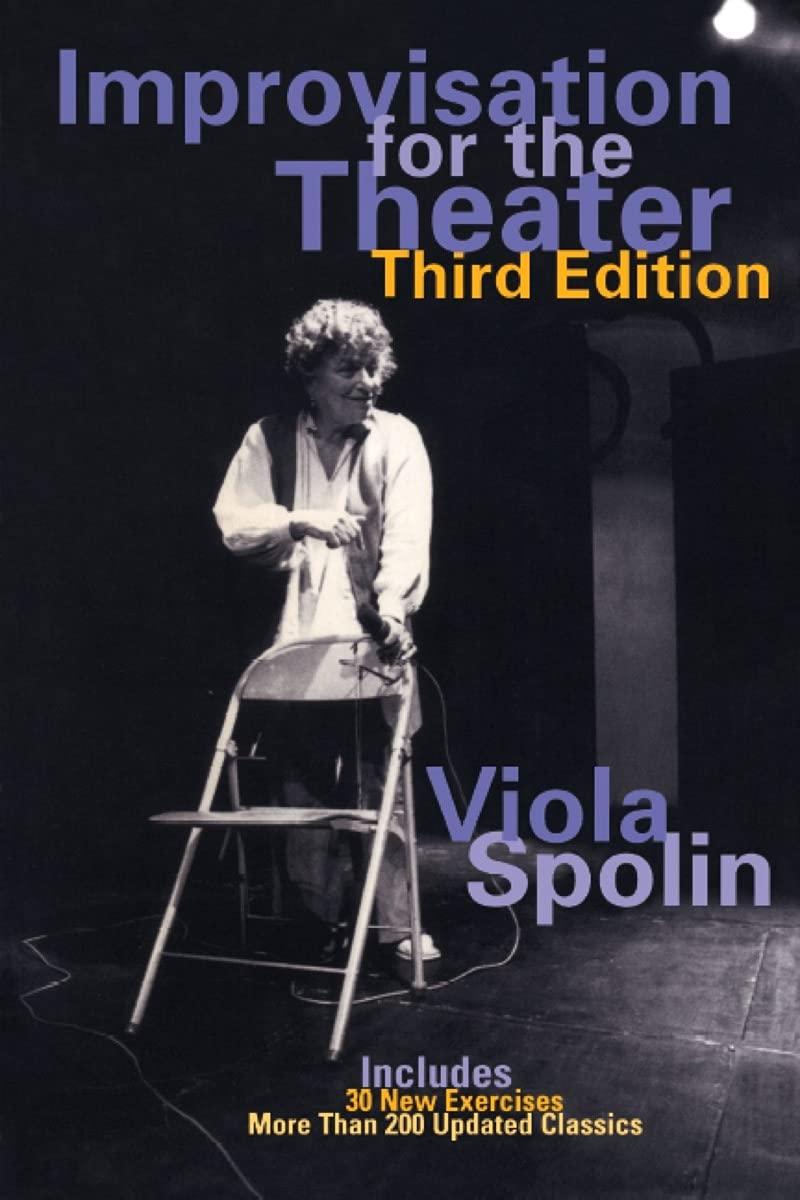
Improvisation for the Theater
A Handbook of Teaching and Directing Techniques
Viola Spolin

Impro
Improvisation and the Theatre
Keith Johnstone

The Upright Citizens Brigade Comedy Improvisation Manual
Matt Besser; Ian Roberts; Matt Walsh

Long Form Improvisation and American Comedy
The Harold
Matt Fotis

Improve
How I Discovered Improv Comedy and Conquered Social Anxiety
Alex Graudins
Related Exercises
I Love You
This exercise takes its name from the three-word declaration at the heart of every scene it generates. Performers say the title phrase to each other in as many contexts, relationships, and emotional registers as possible, discovering the vast range of meaning the words carry depending on delivery, history, and circumstance. The same phrase spoken between parent and child, between rivals, between strangers, or between lifelong partners produces entirely different scenes. The exercise builds emotional range, comfort with vulnerability onstage, and the ability to invest familiar words with specific, truthful feeling.
I Love You, I Hate You
I Love You, I Hate You is an emotional range exercise in which performers rapidly alternate between expressing love and hatred toward the same person or object. The exercise builds emotional agility, the ability to shift between extreme states without losing commitment, and the physical experience of how quickly emotional reality can transform. It demonstrates that emotional truth in performance is not about feeling -- it is about full physical and vocal commitment to the declared state.
You
You is a circle exercise in which players point at another person and say "you," passing focus around the group with clear eye contact and decisive gestures. The exercise trains the habit of making specific, committed choices about who receives an offer. It builds directness and the ability to give and receive attention cleanly.
Hello
Hello is a simple greeting exercise in which players practice making contact through the single word "hello," varying their delivery to express different emotions, characters, and relationships. The exercise demonstrates the range of meaning a single word can carry. It builds vocal variety and the ability to communicate intention through tone.
Barney
Barney is an energy and movement warm-up exercise in which players adopt an exaggerated, lumbering physical character and interact with the group through simple, playful commands. The exercise asks participants to embody a large, slow, friendly creature (often described as a dinosaur or monster) and move through the space with maximum physical commitment and minimum self-consciousness. The inherent silliness of the character lowers inhibitions quickly, making Barney effective as an early warm-up for groups that are new to physical work or uncomfortable with large physical choices. The exercise builds comfort with exaggerated movement, vocal projection, and the willingness to look ridiculous in front of others, all foundational skills for improv performance.
How to Reference This Page
The Improv Archive. (2026). Love You. Retrieved September 28, 2026, from https://improvarchive.org/exercises/love-you
The Improv Archive. "Love You." The Improv Archive, 2026. https://improvarchive.org/exercises/love-you.
The Improv Archive. "Love You." The Improv Archive, 2026, https://improvarchive.org/exercises/love-you. Accessed September 28, 2026.
The Improv Archive is a systemically maintained repository. The archive itself acts as the corporate author.