Open Improv Scenes
Open Improv Scenes is an applied improvisation exercise in which participants perform unscripted scenes drawn from workplace or professional scenarios, using improv principles to navigate realistic situations they encounter in their jobs. Unlike traditional improv scenes that prioritize entertainment, Open Improv Scenes prioritizes transfer -- the scenes serve as behavioral rehearsals for real professional interactions.
Structure
Setup
The facilitator gathers scenarios from the group: a difficult conversation with a direct report, a client meeting that went sideways, a team brainstorm that stalled. Participants volunteer or are assigned to play roles in the scenario. The facilitator establishes the context briefly and lets the scene begin.
Progression
The scene unfolds without a script. Participants play the situation using improv fundamentals: listening before responding, accepting the reality of what is offered, building on contributions rather than blocking them. The facilitator may pause the scene at critical moments to coach a participant through a stuck moment or to replay a key exchange with a different approach.
Multiple scenes run in sequence, drawn from different participants' real contexts. After each scene, the group debriefs what they observed and what alternatives were possible.
Conclusion
The session ends with a group reflection on which improv principles felt most relevant to the workplace scenarios and what participants plan to try differently in their actual professional interactions.
How to Teach It
Objectives
Open Improv Scenes develops the ability to apply improv principles -- listening, agreement, building, emotional availability -- to realistic professional situations. The exercise creates a safe space for behavioral rehearsal of difficult or high-stakes interactions.
How to Explain It
"We are going to play out real situations from your work using improv. No script, no planning. Just step into the scene and respond to what happens. We can pause, replay, and try different approaches."
Scaffolding
Begin with lower-stakes scenarios (a team check-in, a casual feedback moment) before moving to high-stakes ones (a performance review, a client complaint). For groups new to improv, the facilitator should play one of the roles in the first scene to model the approach. Advanced groups can run scenes with observers who coach from the sideline in real time.
Common Pitfalls
Participants sometimes treat the scene as a chance to vent about a real situation rather than explore alternatives. The facilitator should redirect toward behavioral experimentation. A second pitfall is participants breaking character to discuss strategy rather than discovering it through action; keep them in the scene.
In Applied Settings
Learning Objectives
Open Improv Scenes develops the ability to navigate unscripted professional interactions with listening, adaptability, and collaborative intent. The exercise targets the specific behaviors that make difficult conversations productive: active listening, acknowledging before responding, building on what is offered, and managing emotional reactivity.
Workplace Transfer
The exercise is a direct behavioral rehearsal for workplace scenarios: difficult conversations, client interactions, team conflicts, feedback delivery, and collaborative problem-solving. Participants practice the exact skills they need in a low-risk environment, then transfer those behaviors to high-stakes professional situations.
Facilitation Context
Open Improv Scenes is used in leadership development, management training, sales training, and team effectiveness programs. It works best with groups of 8 to 16 where the facilitator can give individual coaching. Sessions of 60 to 90 minutes allow for multiple scenes with meaningful debrief. The exercise is most effective when scenarios come from participants' real contexts rather than hypothetical situations.
Debrief Framing
Ask participants: "What moment in the scene felt most like your real work experience?" and "What did you try differently here that you could try in your actual situation?" Follow with: "What improv principle made the biggest difference?" The debrief should connect the behavioral practice to specific upcoming professional interactions.
Skills Developed
Worth Reading
See all books →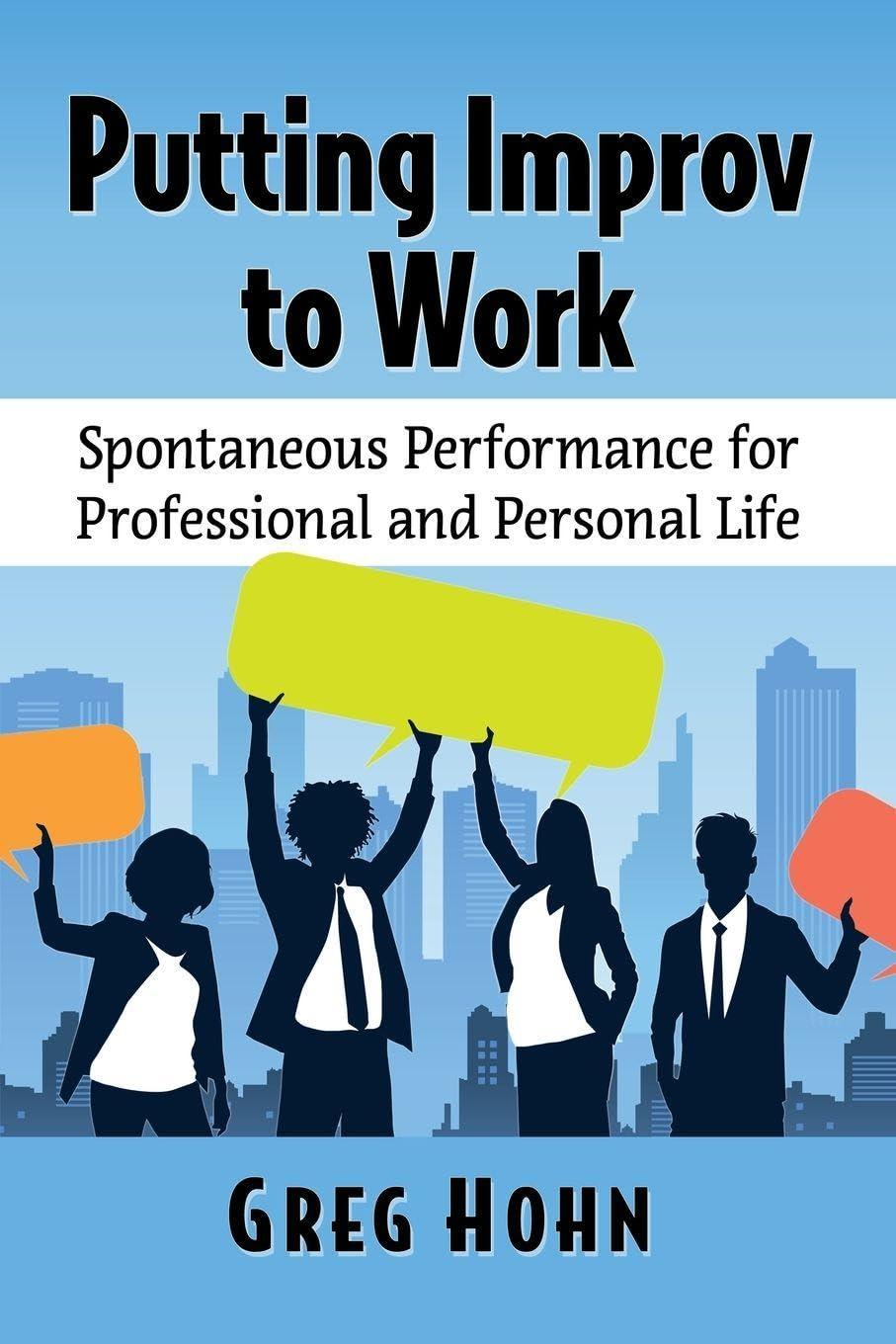
Putting Improv to Work
Spontaneous Performance for Leadership, Learning, and Life
Greg Hohn

Improvising Now
A Practical Guide to Modern Improv
Rob Norman

Improvisation Starters
A Collection of 900 Improvisation Situations for the Theater
Philip Bernardi

Applied Improvisation
Leading, Collaborating, and Creating Beyond the Theatre
Theresa Robbins Dudeck; Caitlin McClure

The 5 Elements of Improv
How to Take Your Improv to the Next Level
Andrew M. Spragge; Karen L. Eichler
Improv for Actors
Dan Diggles
Related Exercises
Ethics
Ethics is a category of applied improv exercises that use improvised scenario work to explore ethical dilemmas and practice principled decision-making under pressure. The exercises place participants in situations where competing values, interests, or obligations create genuine tension, requiring real-time choices without the luxury of extended analysis. The improv frame makes abstract ethical reasoning concrete and behavioral.
Good Improviser Bad Improviser
Good Improviser Bad Improviser is a teaching exercise in which performers deliberately demonstrate both strong and weak improv technique in side-by-side scenes or moments. The contrast makes abstract principles -- yes-and, listening, specificity, agreement, presence -- tangible and visible. Watching a scene break down under denial, blocking, or inattention, and then watching the same scene succeed when those behaviors are reversed, gives students a concrete reference point that description alone cannot provide. The exercise is most useful for newer students and as an orientation to core principles.
Empathy
Empathy is a category of applied improv exercises designed to develop perspective-taking and emotional understanding of others' experiences, viewpoints, and situations. The exercises use improvisational role-play, embodiment, and listening structures to move participants beyond intellectual acknowledgment of another person's experience toward felt, experiential understanding. They are used in organizational, educational, and therapeutic settings to build the capacity for genuine human connection across difference.
Actor Switch
## Actor Switch: Content Actor Switch is a foundational improv structure, frequently utilized as both a game and an exercise. It centers on the rapid and unexpected exchange of character traits or roles between performers. The core mechanic involves one player initiating a switch by verbally or physically signaling another player to adopt a specific characteristic, emotion, or even a complete persona from the initiating player. This creates a dynamic shift in the scene, demanding adaptability and responsiveness from all involved. The origins of Actor Switch, like many early improv games, are challenging to definitively trace. It likely evolves organically within the burgeoning Chicago improv scene of the 1960s and 70s, drawing from techniques explored by Second City and Del Close. No single individual receives credit for its invention, but its consistent presence in improv training materials suggests early adoption and subsequent refinement by numerous practitioners. It serves as a crucial tool for developing active listening and quick thinking. To execute Actor Switch, a scene begins as usual, with performers establishing a baseline scenario. At any point, a player can declare "Actor Switch!" and then specify the element to be transferred, for example, "Actor Switch: Your frustration!" The targeted player immediately embodies that element, integrating it into their existing character or behavior. This process repeats, with players continually switching elements, creating a layered and unpredictable performance. The goal is not necessarily to create a coherent narrative, but to explore the possibilities of character and reaction. Actor Switch offers several benefits. It encourages performers to observe and react to their scene partners, fostering a heightened sense of ensemble awareness. The rapid shifts challenge performers to abandon preconceived notions and embrace spontaneity. Ultimately, Actor Switch cultivates a playful and dynamic approach to improvisational storytelling.
Scenes from a Suggestion
Scenes from a Suggestion is a foundational exercise in which performers build a scene directly from a single audience suggestion, practicing the core skill of transforming a word or phrase into characters, relationships, and situations without additional prompting or warm-up games.
Open Offer
Open Offer is a scene-starting exercise in which one performer enters the space and makes a clear, specific opening offer -- a line of dialogue, a physical action, or an emotional state -- that establishes a strong starting point for their scene partner to build on. The exercise trains the ability to begin scenes with purpose and generosity rather than caution or ambiguity.
The Lineage
Explore the schools and structures that influenced or evolved from Open Improv Scenes.
Putting Improv to Work (Hohn)
How to Reference This Page
The Improv Archive. (2026). Open Improv Scenes. Retrieved September 28, 2026, from https://improvarchive.org/exercises/open-improv-scenes
The Improv Archive. "Open Improv Scenes." The Improv Archive, 2026. https://improvarchive.org/exercises/open-improv-scenes.
The Improv Archive. "Open Improv Scenes." The Improv Archive, 2026, https://improvarchive.org/exercises/open-improv-scenes. Accessed September 28, 2026.
The Improv Archive is a systemically maintained repository. The archive itself acts as the corporate author.