Yes But vs Yes And Conversation
Participants pair off and hold conversations starting every sentence with 'Yes, but...' then switch to 'Yes, and...' to experience how language choice impacts connection and energy.
Worth Reading
See all books →
When I Say This, Do You Mean That?
Enhancing Communication
Cherie Kerr; Julia Sweeney
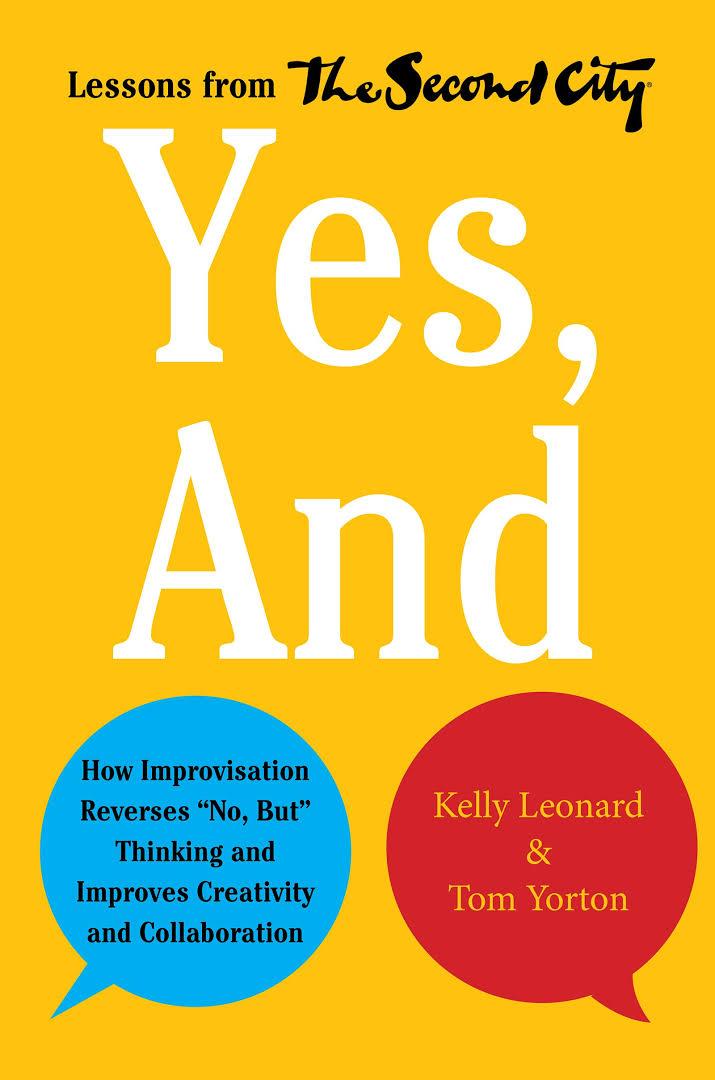
Yes, And
How Improvisation Reverses No, But Thinking and Improves Creativity and Collaboration
Kelly Leonard; Tom Yorton

The "Yes And" Business Evolution
Improv Skills for Leadership and Life
Tracy Shea-Porter

Getting to Yes And
The Art of Business Improv
Bob Kulhan; Chuck Crisafulli

You Can Teach Improv (Yes, You!)
The Ultimate Guide to Class Planning, Skill Building, and Helping Every Student Leave With a Win
Andrew Berkowitz

Improv Yourself
Business Spontaneity at the Speed of Thought
Joseph A. Keefe
Related Exercises
Yes But vs Yes And
Pairs plan an imaginary holiday. First responding with Yes, but then repeating with Yes, and. The contrast demonstrates how language affects collaboration and energy.
Yes Based Conversations
Yes Based Conversations is an exercise in which performers practice having conversations built entirely on agreement and mutual support. Each speaker accepts what the other has said and adds their own perspective without contradiction. The exercise breaks the habit of default negation and demonstrates how agreement generates more productive scenes than conflict.
Yes-And Story
The group constructs a story one sentence at a time in a circle, each sentence starting with 'Yes-And.' Practices listening and building without trying to be clever.
You Should, You Could, You Would
Participants reframe directive language ('you should') into collaborative forms ('you could'), exploring how word choice affects relationships.
The Cycle of Deep Yes And
The Cycle of Deep Yes And is an applied exercise in which participants practice full acceptance and active building in paired conversation, moving through multiple rounds that progressively deepen their commitment to the yes-and principle. The exercise trains the habit of genuine affirmation before contribution.
Word Choice
Word Choice is an applied exercise in which participants reframe the same message using different word selections, discovering how specific word choices alter perception, emotional tone, and implicit authority, training precise language awareness and the ability to select words with intention rather than habit.
The Lineage
Explore the schools and structures that influenced or evolved from Yes But vs Yes And Conversation.
Getting to 'Yes And' (Bob Kulhan)
How to Reference This Page
The Improv Archive. (2026). Yes But vs Yes And Conversation. Retrieved September 28, 2026, from https://improvarchive.org/exercises/yes-but-vs-yes-and-conversation
The Improv Archive. "Yes But vs Yes And Conversation." The Improv Archive, 2026. https://improvarchive.org/exercises/yes-but-vs-yes-and-conversation.
The Improv Archive. "Yes But vs Yes And Conversation." The Improv Archive, 2026, https://improvarchive.org/exercises/yes-but-vs-yes-and-conversation. Accessed September 28, 2026.
The Improv Archive is a systemically maintained repository. The archive itself acts as the corporate author.