3 Some is a warm-up association game in which three performers build a linked set of complementary identities, then cycle through a rotating trio structure. The game develops ensemble cohesion and playful object association in a low-stakes group format.
Structure
Setup
Any number of players stand in a loose group. Three players step forward to form the active trio.
Progression
The first player declares an identity: "I am a slice of cheese." The second player adds a complementary object or character: "I am a slice of bread." The third player completes the grouping: "I am a pickle." All three have now established a linked trio of identities.
The first player then exits, taking one of the other two along. The remaining player re-establishes their identity for the group. Two new players step in to complete the trio with complementary additions. The cycle continues until all players have rotated through.
Conclusion
The game ends when the facilitator calls time or when all players have participated. It runs as an energiser at the start of a session rather than as a scored or extended activity.
How to Teach It
How to Explain It
"Three of you step forward. The first person says 'I am a...' and names any object. The next person says 'I am a...' and names something that goes with it. The third person names a third thing that fits. Then the first person leaves and takes one of you along. The person who stays says their thing again, two new people step in, and we keep going."
Scaffolding
Introduce this in the first minutes of a session before more complex exercises. It requires no previous improv experience. The association requirement is loose enough that most groupings work; coaches can accept almost any trio rather than correcting choices.
Common Notes
"Keep the pairings broad. 'I am a lamp / I am a lampshade / I am a light bulb' is just as valid as something more surprising."
Common Pitfalls
Players sometimes freeze trying to find the perfect complementary object. Remind them that speed and commitment matter more than logical precision.
Worth Reading
See all books →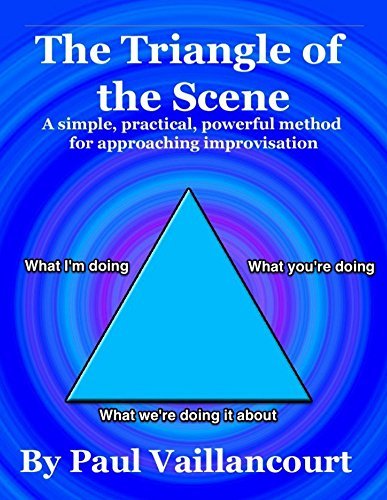
The Triangle of the Scene
A Simple, Practical, Powerful Method for Approaching Improvisation
Paul Vaillancourt

Group Improvisation
The Manual of Ensemble Improv Games
Peter Campbell Gwinn; Charna Halpern

Playing Along
37 Group Learning Activities Borrowed from Improvisational Theater
Izzy Gesell

Drama Games and Improvs
Games for the Classroom and Beyond
Justine Jones; Mary Ann Kelley
The Improvisation Game
Discovering the Secrets of Spontaneous Performance
Chris Johnston
112 Acting Games
Gavin Levy
Related Games
3 Things
3 Things is a quick-response listing game in which one player gives another player a category and the second player rapidly names three things that fit it. The chant that follows each answer keeps the room playful and makes the speed of response more important than correctness.
3 Series
3 Series is a short-form game in which three unrelated scenes run simultaneously. The host or caller switches between the scenes, and performers must pick up each thread exactly where it left off. The game tests memory, commitment, and the ability to sustain multiple narratives at once.
3 Lines
3 Lines is a scene game in which each performer enters with exactly three predetermined or improvised lines that they must use during the scene. Players weave their fixed lines into the emerging narrative, creating unexpected connections. The constraint generates surprising juxtapositions and trains adaptability.
How to Reference This Page
The Improv Archive. (2026). 3 Some. Retrieved September 28, 2026, from https://improvarchive.org/games/3-some
The Improv Archive. "3 Some." The Improv Archive, 2026. https://improvarchive.org/games/3-some.
The Improv Archive. "3 Some." The Improv Archive, 2026, https://improvarchive.org/games/3-some. Accessed September 28, 2026.
The Improv Archive is a systemically maintained repository. The archive itself acts as the corporate author.