Puppets
Puppets is a physical game and exercise in which one performer manipulates another as a puppet, controlling their body positions and movements by touching or guiding their limbs. The puppet commits fully to whatever position they are placed in and speaks only during or just after the manipulation. Also known as Moving Bodies, the game creates comedy from the disconnect between the puppet's physical situation and their dialogue, while training physical surrender and trust.
Structure
Setup
Players pair off: one is the puppeteer, one is the puppet. In performance versions, audience members may serve as puppeteers. The pair receives a scene suggestion: a relationship, location, or situation. The puppeteer positions the puppet for the start of the scene.
Gameplay
As the scene develops, the puppeteer physically moves the puppet's body: repositioning limbs, turning the head, raising an arm, bending the torso. The puppet speaks during and immediately following these manipulations, treating whatever position they have been placed in as physically motivated and real. If the puppeteer pushes the puppet's hand toward the other player's face, the puppet finds the dialogue that makes that gesture make sense.
Asaf Ronen in Directing Improv notes that in the standard version, players can only talk while audience volunteers serve as their puppeteers, making the physical constraint continuous and the dialogue reactive. This version transfers control almost entirely to the puppeteers, requiring performers to speak only from positions they did not choose.
A common variant has the puppeteer silent while the puppet speaks; another involves switching roles mid-scene. In the Automation variant (documented by Spolin), players move as though mechanical or robotic, self-generating the constraint rather than receiving it from a partner.
Debrief
Players discuss the experience of physical surrender: the moments when a position suggested unexpected dialogue, and the moments when the puppet tried to fight the constraint and find a natural posture. The debrief surfaces the relationship between physical commitment and imaginative availability.
How to Teach It
How to Explain It
"One of you is the puppet. Your partner is the puppeteer. Puppeteer, you control your partner's physical movement with your hands. Do not touch them: use gesture and proximity. Puppet, follow exactly. Your body does what the puppeteer shapes it to do."
Objectives
Puppets develops two skills. The first is physical surrender: the capacity to relinquish control of one's body and treat externally imposed positions as dramatically real rather than embarrassing impositions. This is a core acting skill that applies beyond the game: performers who are physically defended or controlled rarely make bold physical choices in scene work.
The second is physical listening: reading a partner's physical intentions and responding to them before they complete the movement. In puppet work, this means committing to positions as they are being created, not waiting until the puppeteer is finished.
Scaffolding
Begin with a non-verbal version: the puppet only moves (no speaking), and the pair must tell a wordless story through position changes alone. This removes language from the exercise and focuses entirely on physical commitment.
Once players can surrender physically, add dialogue: the puppet speaks only in response to the positions they have been placed in. Introduce a simple constraint to prevent improvised justification: the puppet must begin each line from whatever position they find themselves in, not from a position they chose.
For groups new to physical contact, establish clear touch protocols in advance: puppeteers may only touch limbs and torso, not the head or face.
Common Coaching Notes
- "Trust the position. What does this body know that you don't?"
- "Don't escape the position. Find the scene inside it."
- "Puppeteer: you're the director. Make choices that serve the scene."
- "Puppet: commit before you understand. The understanding comes after."
How to Perform It
The game's comedy arises from the gap between the physical situation and the performed dialogue. A puppet placed in a grand, sweeping gesture speaks dialogue that must justify that gesture; one placed in a cringing, low posture speaks dialogue appropriate to submission or fear. The more specifically the puppet commits to reading their position as dramatically real, the more the game works as performance.
The risk is that puppet performers speak regardless of their physical state, treating the positions as incidental rather than informative. When this happens, the scene is two people talking who happen to be moving oddly, rather than a scene driven by physical constraint.
Salinsky notes that the game has been performed in versions where the puppeteers are directed to simply move players around without intention, producing random physical comedy. The stronger performance version requires puppeteers who understand that their choices drive the scene: a puppeteer who makes deliberate, scene-serving choices gives the puppet more productive constraints to respond to.
Audience puppeteers benefit from brief coaching before the scene: "Move them like you are telling a story with their bodies."
History
Viola Spolin documents the exercise as "Puppets and/or Automation" in Improvisation for the Theater (1963), presenting it as a total body involvement exercise in Chapter V alongside Rhythmic Movement and Tense Muscle. Spolin's framing situates the exercise within a curriculum concerned with physical freedom and responsiveness: the puppet's complete surrender to external physical guidance is a formalization of the physical listening that all scene work requires.
The game later entered the short-form performance repertoire under the name Moving Bodies, in which audience members volunteer as puppeteers for a scene performed by two improvisers. Tom Salinsky and Deborah Frances-White in The Improv Handbook note that Moving Bodies (also known as Puppets) achieved television exposure and became widely recognized as a standard short-form game, though they document instances of the game being simplified in ways that diminished its theatrical demands.
Asaf Ronen in Directing Improv categorizes Puppets (a.k.a. Moving Bodies) as a scenic game and describes the core mechanic: players speak only while audience volunteers physically manipulate them, removing performers' control over their own physical choices.
Worth Reading
See all books →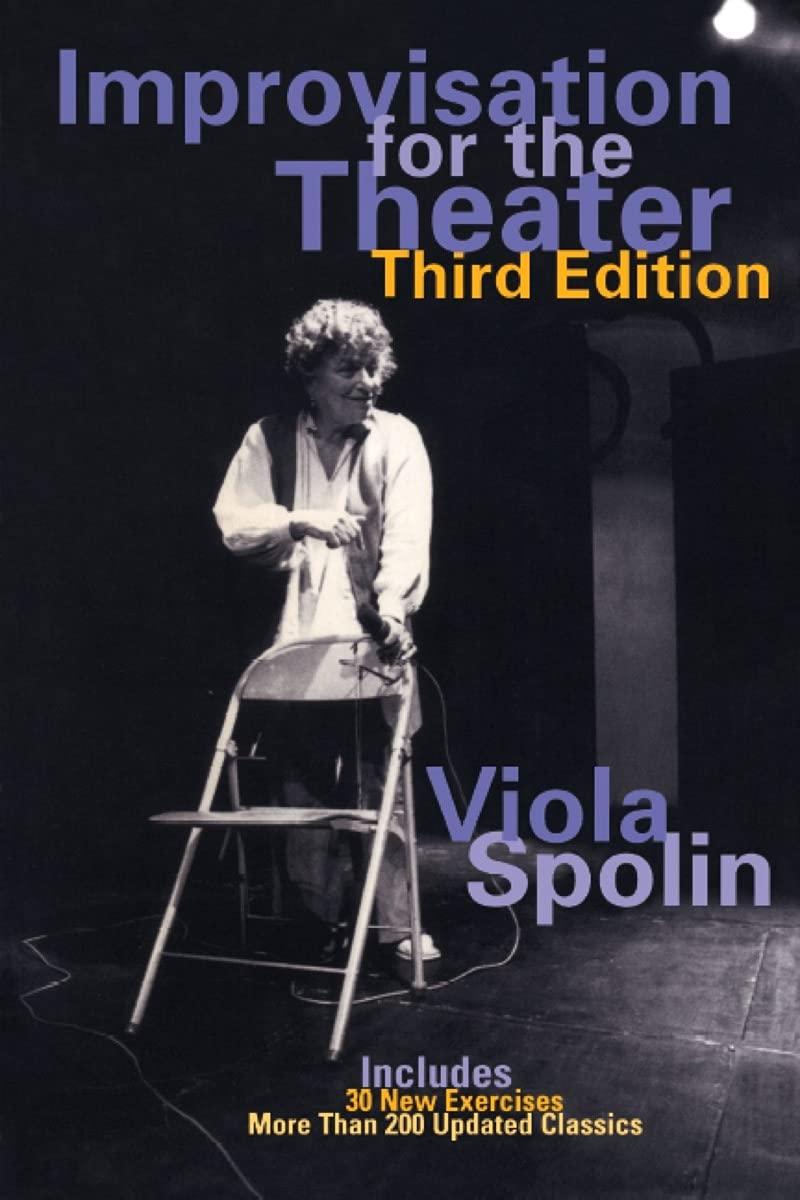
Improvisation for the Theater
A Handbook of Teaching and Directing Techniques
Viola Spolin

Mask Improvisation for Actor Training and Performance
the compelling image
Sears A. Eldredge

The Improv Handbook
The Ultimate Guide to Improvising in Comedy, Theatre, and Beyond
Tom Salinsky; Deborah Frances-White

Acting Through Improv
Improv Through Theatresports
Lynda Belt; Rebecca Stockley

Long Form Improvisation and American Comedy
The Harold
Matt Fotis
Theater Games for Rehearsal
Viola Spolin
Related Games
Helping Hands
Helping Hands is a short-form game in which one performer stands in front of another and extends their arms through the front performer's sleeves or from behind, so that the back performer's hands serve as the front performer's arms. The front performer speaks and reacts while the back performer's hands gesture, handle props, and physically enact whatever the scene requires. The dissonance between speech and gesture -- and the unpredictable behavior of the "helping hands" -- generates the game's comedy.
Statues
Statues is a family of exercises and games in which players freeze or are sculpted into specific physical positions and must then commit to, justify, or animate from those positions. The game teaches that physicality can precede and generate narrative: when the body is placed in a specific shape, the character and scene emerge from what the body already knows. Statues appears in improv, Image Theatre, applied settings, and children's game traditions.
Arms
Arms is a short-form game in which one player stands behind another, extending their arms through the front player's sleeves to serve as their hands. The front player speaks and reacts while the hidden player's arms create unpredictable physical business. It is one of the most recognized and widely performed short-form games.
How to Reference This Page
The Improv Archive. (2026). Puppets. Retrieved September 28, 2026, from https://improvarchive.org/games/puppets
The Improv Archive. "Puppets." The Improv Archive, 2026. https://improvarchive.org/games/puppets.
The Improv Archive. "Puppets." The Improv Archive, 2026, https://improvarchive.org/games/puppets. Accessed September 28, 2026.
The Improv Archive is a systemically maintained repository. The archive itself acts as the corporate author.