Base Reality
The grounded, realistic circumstances of a scene: who the characters are, where they are, and what their ordinary life looks like. Base reality serves as the foundation against which the game or unusual behavior is measured. The more specific and believable the base reality, the more impact the departures from it carry.
At the foundation of every improvised scene lies a set of grounded, realistic circumstances: who the characters are, where they are, and what their ordinary life looks like. This foundation is known as base reality, and it serves as the bedrock against which any unusual behavior, heightened pattern, or comic game is measured. The more specific and believable the base reality, the more impact the departures from it carry.
The concept is central to the methodology developed at the Upright Citizens Brigade Theatre, where it forms the first major topic in the UCB Comedy Improvisation Manual. In the UCB approach, improvisers begin every scene by establishing a base reality through the fundamentals of Who, What, and Where. Once that reality feels concrete and lived-in, the performers watch for a "first unusual thing" that breaks from the established pattern. That break only registers as unusual, and therefore as potentially funny, because the normal world of the scene has been clearly drawn. Without a strong base reality, there is no contrast, and without contrast, there is no game.
In the Harold, one of the most widely performed long-form structures, the first beat of each scene thread is devoted to establishing base reality. These opening scenes plant the DNA of the performance, grounding each thread in recognizable human behavior before subsequent beats heighten, explore, or transform what was introduced. The principle applies equally in short-form and scenework: a scene about two coworkers in a break room only becomes interesting when the audience understands what "normal" looks like for those two people in that space.
Teachers in the UCB lineage, such as Rick Crom, emphasize base reality as inseparable from character work. Crom's instruction reflects the idea that establishing the facts of a scene is what allows any departure to be recognized as unusual. A character quirk or strange choice registers precisely because the performer has first committed to the ordinary details of the relationship and environment. This teaching framework encourages improvisers to resist the urge to be immediately funny and instead invest in the patient work of building a believable world.
A common pitfall is treating base reality as mere setup to rush through before getting to the comedy. When improvisers skip or shortchange the grounding work, scenes tend to float in abstraction, leaving audiences without a clear sense of what is normal and therefore unable to appreciate what is strange. Another frequent mistake is confusing base reality with exposition or narration; base reality is best established through behavior, interaction, and specificity rather than through characters explaining their circumstances to each other.
As Nick Raitt observes in The Improv Illusionist, the concept connects directly to the game of the scene. Base reality and game exist in a dependent relationship: the game is defined by its contrast with base reality, and the base reality gains dramatic purpose by providing the stable ground from which the game departs. This interplay between the ordinary and the unusual is what gives well-crafted scenes their structure and momentum, allowing improvisers to heighten a pattern while maintaining a coherent, believable world that the audience can follow.
Further Reading
See all books →
The Upright Citizens Brigade Comedy Improvisation Manual
Matt Besser; Ian Roberts; Matt Walsh

The Improv Illusionist
Using Object Work, Environment, and Physicality in Performance
David Raitt
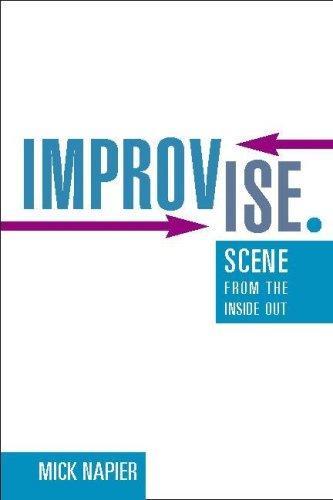
Improvise
Scene from the Inside Out
Mick Napier

How to Be the Greatest Improviser on Earth
Will Hines

Truth in Comedy
The Manual of Improvisation
Charna Halpern; Del Close; Kim Howard Johnson

The Second City Almanac of Improvisation
Anne Libera
How to Reference This Page
The Improv Archive. (2026). Base Reality. Retrieved September 28, 2026, from https://improvarchive.org/learn-improv/concepts/base-reality
The Improv Archive. "Base Reality." The Improv Archive, 2026. https://improvarchive.org/learn-improv/concepts/base-reality.
The Improv Archive. "Base Reality." The Improv Archive, 2026, https://improvarchive.org/learn-improv/concepts/base-reality. Accessed September 28, 2026.
The Improv Archive is a systemically maintained repository. The archive itself acts as the corporate author.