Gibberish Commands
Gibberish Commands is an exercise in which a facilitator gives instructions entirely in gibberish -- an invented, wordless language -- and the group must interpret and execute what they believe was communicated. The exercise sharpens nonverbal reading: tone, gesture, pacing, and physical demonstration carry meaning in the absence of recognizable words. The group discovers how much information travels through channels other than vocabulary, and develops responsiveness to a speaker's full communicative presence.
Structure
Setup
The group stands in an open space facing the facilitator. No prior explanation of content is given beyond the fact that instructions will be delivered in a made-up language and the group should try to do what they think they are being asked to do.
The Exercise
The facilitator issues a series of short commands in gibberish, using expressive tone, facial expression, gesture, and rhythm to communicate intent. Commands might suggest movement, formation, action, or interaction. The group interprets and responds together.
After each command-and-response cycle, the facilitator may nod, repeat the command, or proceed to the next one. No explicit verbal confirmation is given. The group calibrates its understanding through collective action and by observing whether the facilitator proceeds or repeats.
Escalation
Commands can increase in complexity -- from single-action instructions to sequences or spatially coordinated directives. The facilitator may also issue commands that require the group to act in relationship to one another, not just individually.
Conclusion
The exercise ends after a set series of commands or when the facilitator signals closure in gibberish. A brief debrief asks the group to name what cues they used to interpret the commands.
How to Teach It
Objectives
Gibberish Commands trains attentiveness to nonverbal communication -- tone, gesture, rhythm, and context -- and develops the group's capacity to act together on shared interpretation rather than individual certainty.
How to Explain It
"I am going to give you instructions in a language none of you know. Your job is to figure out what I'm asking and do it together. You can't ask for clarification. You just have to read me and try."
Scaffolding
Begin with physically clear commands -- point to the floor, gesture toward a wall, mime a specific action -- before adding more abstract or relational directives. This gives the group early confidence before the difficulty increases.
Common Pitfalls
Groups sometimes freeze rather than commit to an interpretation. The coaching note is that a wrong guess executed with conviction is more useful than paralysis: the facilitator can correct through repetition, and the group learns from seeing its interpretation tested. Encourage confident collective action.
Worth Reading
See all books →
Business Improv
Experiential Learning Exercises to Train Employees
Val Gee

When I Say This, Do You Mean That?
Enhancing Communication
Cherie Kerr; Julia Sweeney

Playing Along
37 Group Learning Activities Borrowed from Improvisational Theater
Izzy Gesell

Semiotics and Pragmatics of Stage Improvisation
Domenico Pietropaolo; Paul Bouissac

Group Improvisation
The Manual of Ensemble Improv Games
Peter Campbell Gwinn; Charna Halpern
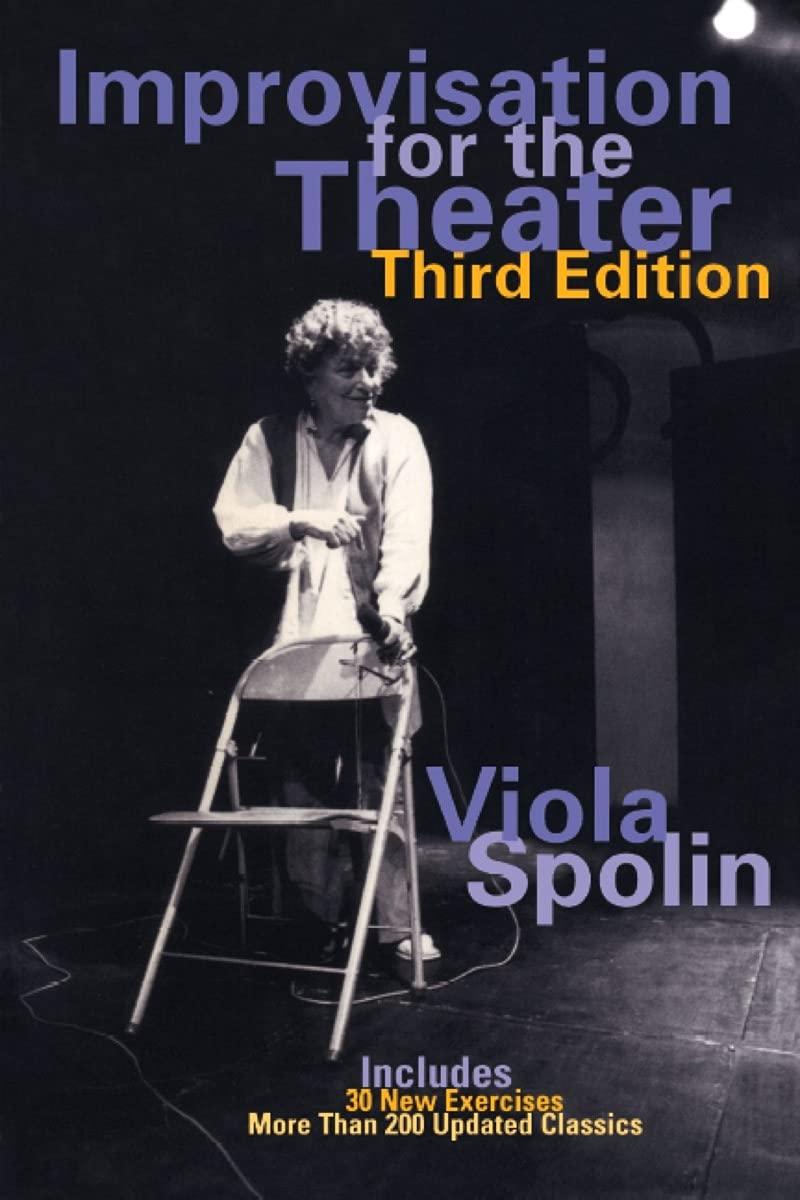
Improvisation for the Theater
A Handbook of Teaching and Directing Techniques
Viola Spolin
Related Exercises
Gibberish Games
Gibberish Games is an applied exercise in which two participants hold a conversation entirely in made-up, invented language -- gibberish -- while a third person translates for the rest of the group. The exercise trains attention to nonverbal cues: tone, rhythm, gesture, facial expression, and physical presence carry the meaning that words normally would. Participants learn to read and respond to a speaker's full communicative body rather than filtering attention through vocabulary alone.
Gibberish
Gibberish is a foundational improv exercise in which performers communicate using invented nonsense language while relying on vocal tone, facial expression, gesture, and physical action to convey meaning. The exercise demonstrates that communication transcends words and that audiences read emotional truth through nonverbal channels. Gibberish builds confidence in physical and vocal expression, frees performers from dependence on clever dialogue, and reveals how much information the body communicates before language enters the picture. It is one of the most widely used exercises across all improv traditions and appears in the training curricula of Viola Spolin, Keith Johnstone, and nearly every major improv school.
Translate Gibberish
Translate Gibberish is an exercise and short-form game in which one performer speaks in invented nonsense language while a second performer translates their speech into English for a third performer or the audience. The exercise trains commitment, physical storytelling, and the skill of reading emotional and physical information rather than linguistic content.
Nonverbal Communication
Nonverbal Communication is an applied improvisation exercise in which participants interact, negotiate, and collaborate without spoken language, relying entirely on gesture, facial expression, body positioning, and physical presence. The exercise reveals how much information is transmitted nonverbally and trains participants to read and use body language with greater awareness and precision.
Switch Gibberish
Switch Gibberish is a scene game in which performers alternate between speaking coherent dialogue and speaking in invented gibberish language. The switch happens on a signal from the facilitator or host, requiring performers to maintain scene continuity across radically different modes of communication.
Silent Organization
Silent Organization is an applied improvisation exercise in which the group must arrange themselves in a specific order without using any words, relying only on eye contact, gestures, and nonverbal negotiation. The exercise reveals how much communication is possible without language and how groups self-organize under constraint.
How to Reference This Page
The Improv Archive. (2026). Gibberish Commands. Retrieved September 29, 2026, from https://improvarchive.org/exercises/gibberish-commands
The Improv Archive. "Gibberish Commands." The Improv Archive, 2026. https://improvarchive.org/exercises/gibberish-commands.
The Improv Archive. "Gibberish Commands." The Improv Archive, 2026, https://improvarchive.org/exercises/gibberish-commands. Accessed September 29, 2026.
The Improv Archive is a systemically maintained repository. The archive itself acts as the corporate author.