Adjective Scene
Adjective Scene is an exercise in which a caller periodically inserts an adjective that the performers must immediately incorporate into the tone or style of the scene. A scene might shift from "romantic" to "furious" to "confused" at the caller's discretion. The exercise trains emotional agility and the ability to justify abrupt tonal shifts.
Structure
Setup
- Two or more performers play an improvised scene.
- A caller stands outside with a list of adjectives or generates them in the moment.
- An audience suggestion establishes the scene.
The Adjective Rule
- The caller periodically calls an adjective: "romantic," "furious," "confused," "terrified," "childlike."
- Performers must immediately shift the tone, style, and emotional quality of the scene to match the adjective.
- The shift must happen within one or two beats: the adjective takes effect immediately, not gradually.
- Dialogue, physicality, and pacing all adjust to the new adjective.
What Performers Are Doing
- The scene continues: the same characters, the same situation, the same relationship. Only the emotional register and tone shift.
- A scene about two colleagues having a disagreement shifts from "resentful" to "gleeful" to "nostalgic" while remaining about the same disagreement.
- Performers must find how each adjective would genuinely color the same moment, not how it would replace the scene with a different one.
Variations
- The caller uses emotions rather than adjectives: "sad," "thrilled," "disgusted."
- The scene shifts genre rather than tone: "soap opera," "thriller," "documentary."
- Performers call adjectives for each other rather than receiving them from outside.
How to Teach It
How to Explain It
"When I call an adjective, the whole scene takes on that quality immediately. You're still the same people in the same situation. But if I call 'terrified,' you are terrified of everything in that scene right now. The scene doesn't restart. The adjective just arrives."
Common Notes
- The shift must be total and immediate. Gradual adjustments or half-hearted incorporation are not the exercise.
- The scene must maintain its content across the shifts. Performers who lose the scene's situation whenever an adjective arrives have not found the balance between tonal agility and scene continuity.
- Contradictory or unexpected adjective sequences (furious to tender to bored) are the most useful coaching tools for developing range.
Common Pitfalls
- Performers only adjust their line delivery and not their physicality. The adjective should color every expressive element: posture, pace, gesture, eye contact.
- Each new adjective effectively restarts the scene. The performers should carry the scene's accumulated content through the adjective shift.
- The caller uses adjectives that are too similar to each other, limiting the range the exercise develops.
How to Perform It
Audience Intro
"Our performers are going to play a scene, but I'm going to call out adjectives that immediately change the emotional style of everything they're doing. They're still the same people with the same problem, just filtered through whatever emotional mode I throw at them. Give us a situation and let's start."
Cast Size
- Ideal: Two performers plus a caller.
- Three performers work with a single caller.
Staging
- Standard scene staging. The caller stands at the edge of the playing space.
Wrap Logic
- The host ends the scene after the performers have navigated four to six adjective shifts, ending on an adjective that creates a strong final image.
Worth Reading
See all books →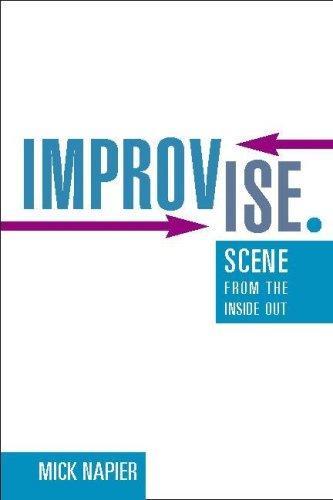
Improvise
Scene from the Inside Out
Mick Napier

The Young Actor's Book of Improvisation
Dramatic Situations
Sandra Caruso; Susan Kosoff
Theater Games for Rehearsal
Viola Spolin

Semiotics and Pragmatics of Stage Improvisation
Domenico Pietropaolo; Paul Bouissac

Improvisation Starters
A Collection of 900 Improvisation Situations for the Theater
Philip Bernardi

Spontaneous Performance
Acting Through Improv
Marsh Cassady
Related Exercises
Scene to Music
Scene to Music is an exercise in which performers improvise a scene while a musician or recorded soundtrack plays underneath, allowing the music to influence the emotional tone, pacing, and genre of the scene. The exercise trains performers to listen beyond their scene partners and respond to an external atmospheric element.
Pivot
Pivot is a scene exercise in which performers identify the moment when a scene needs to shift direction and make a deliberate choice to change it. The facilitator may call "Pivot" to signal the moment, or players practice identifying pivot points themselves. The exercise develops editorial awareness and trains the skill of knowing when a scene needs to evolve rather than repeat.
Scene Replay
Scene Replay is a short-form game in which a scene is performed once, then replayed with a significant modification such as a new genre, emotional shift, or physical constraint. The replay preserves the original scene's structure and relationship while the imposed change reveals how a single variable transforms meaning, comedy, and dynamics.
Change
Change is a short-form game in which a caller says "change" at any point during a scene, forcing the last speaker to replace their most recent line with a new one. Repeated calls on the same line demand increasingly creative alternatives. The game trains verbal agility and the ability to generate multiple options for any moment.
I Love You
This exercise takes its name from the three-word declaration at the heart of every scene it generates. Performers say the title phrase to each other in as many contexts, relationships, and emotional registers as possible, discovering the vast range of meaning the words carry depending on delivery, history, and circumstance. The same phrase spoken between parent and child, between rivals, between strangers, or between lifelong partners produces entirely different scenes. The exercise builds emotional range, comfort with vulnerability onstage, and the ability to invest familiar words with specific, truthful feeling.
Scene Carousel
Scene Carousel is an exercise in which multiple pairs or small groups perform short scenes simultaneously across the rehearsal space, with the facilitator periodically calling focus to one scene at a time for the entire group to watch. The exercise builds comfort with performing, provides high-volume scene repetitions, and teaches performers to maintain a scene even when not being watched.
How to Reference This Page
The Improv Archive. (2026). Adjective Scene. Retrieved September 28, 2026, from https://improvarchive.org/exercises/adjective-scene
The Improv Archive. "Adjective Scene." The Improv Archive, 2026. https://improvarchive.org/exercises/adjective-scene.
The Improv Archive. "Adjective Scene." The Improv Archive, 2026, https://improvarchive.org/exercises/adjective-scene. Accessed September 28, 2026.
The Improv Archive is a systemically maintained repository. The archive itself acts as the corporate author.