Jargon Busting is an applied improv exercise in which participants identify, flag, and replace professional or organizational jargon in real time. Drawn from applied improv practice, the exercise trains accessible, plain-language communication by making the habitual use of insider terminology visible and subject to deliberate revision. It is used in corporate and organizational settings to improve cross-functional communication and reduce the friction that specialized language creates between departments, roles, or experience levels.
Structure
Setup
Participants work in pairs or small groups. Each participant is given a role or prompt scenario drawn from a real or fictional workplace context. The facilitator identifies a designated "jargon buster" in each group.
Progression
Participants engage in a brief conversation using the scenario. Whenever a participant uses jargon -- industry-specific terms, acronyms, buzzwords, or insider shorthand -- the jargon buster calls it out with a neutral flag: "Jargon!" or a physical signal such as raising a hand.
The speaking participant then pauses and rephrases the flagged term in plain language accessible to someone with no background in the field. The conversation continues from that point.
Roles rotate across rounds so each participant has experience as both speaker and jargon buster.
Conclusion
The exercise concludes after participants have experienced multiple rotation cycles. A facilitated debrief follows to surface which terms were flagged, how difficult rephrasing was, and what patterns emerged.
How to Teach It
Objectives
Jargon Busting targets communication clarity and the ability to translate specialized knowledge into accessible language. It trains the habit of noticing when insider vocabulary is being used and developing the reflex to rephrase without losing content.
How to Explain It
"We all have words we use automatically because everyone around us uses them. This exercise makes those words visible. When the jargon buster calls it, don't defend the word -- just find a different way to say the same thing. Pretend you're explaining it to someone smart who doesn't know your field."
Scaffolding
For groups new to the exercise, provide a short list of commonly flagged terms from their organization or industry to seed awareness. For more advanced groups, let jargon emerge organically in free conversation.
Common Pitfalls
Participants sometimes struggle to rephrase because they have never had to articulate the concept without the term. This is the productive moment -- the exercise surfaces gaps between knowledge and communication. Coach participants to sit with the difficulty rather than defaulting back to the original jargon word.
In Applied Settings
Learning Objectives
Jargon Busting trains participants to distinguish between language that communicates and language that signals group membership. The exercise reveals how much professional communication depends on shared vocabulary that excludes listeners without the same background, and it builds the deliberate skill of translating expertise into language any stakeholder can use.
Workplace Transfer
In organizations, jargon functions as both a communication shorthand and a boundary marker. When cross-functional teams, new employees, or external stakeholders are excluded by insider vocabulary, alignment and collaboration slow. The exercise directly replicates the dynamic that occurs in meetings, presentations, and written communication when a speaker or writer defaults to field-specific terms without checking whether the audience shares the reference. Participants who practice rephrasing in a low-stakes exercise develop the reflex to do it automatically in high-stakes contexts.
Facilitation Context
Jargon Busting is used in onboarding programs, cross-functional team workshops, leadership communication training, and client-facing skill development. It is particularly effective in organizations undergoing rapid change, mergers, or integration of teams from different professional backgrounds. Groups of eight to twenty work well; pairs and triads allow for the most frequent rotation and personal practice.
Debrief Framing
After the exercise, ask participants: What words were flagged most frequently? Were you surprised that they were considered jargon? How did it feel to be asked to rephrase in the moment? Where in your actual work -- meetings, emails, presentations -- do you use these terms most often? The debrief should help the group connect the flagged vocabulary to specific moments in their professional communication where clarity is most at risk.
Skills Developed
Worth Reading
See all books →
When I Say This, Do You Mean That?
Enhancing Communication
Cherie Kerr; Julia Sweeney

Business Improv
Experiential Learning Exercises to Train Employees
Val Gee

The Art of Making Sh!t Up
Using the Principles of Improv to Become an Unstoppable Powerhouse
Norm LaViolette; Bob Melley

The Applied Improvisation Mindset
Tools for Transforming Individuals, Organizations, and Communities
Theresa Robbins Dudeck; Caitlin McClure

The Improv Handbook
The Ultimate Guide to Improvising in Comedy, Theatre, and Beyond
Tom Salinsky; Deborah Frances-White
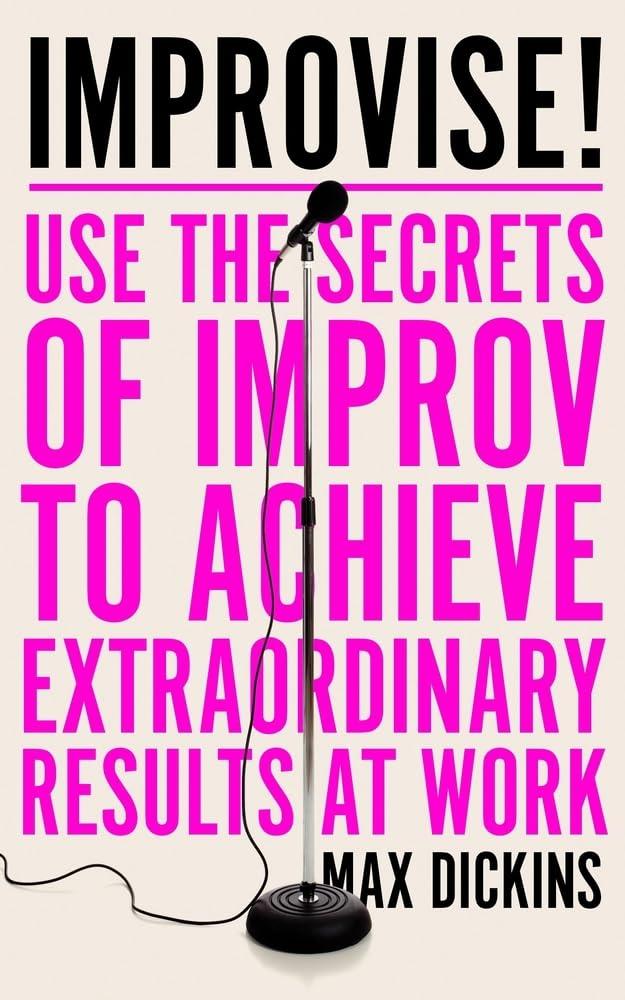
Improvise!
Use the Secrets of Improv to Achieve Extraordinary Results at Work
Max Dickins
Related Exercises
Buzzwords, Acronyms, and Jargon
Participants identify and replace workplace jargon with clear language, improving accessibility and understanding in communication.
Silo-Busting Exercise
Silo-Busting Exercise is an applied improvisation exercise in which a team facing a real challenge invites people from a completely separate department to join their brainstorming session. The outside participants bring fresh perspectives, unfamiliar frameworks, and no institutional assumptions, breaking the echo-chamber dynamic that limits innovation within isolated teams.
Question Storming
Question Storming is an applied improvisation exercise from Max Dickins' Improvise! in which participants brainstorm questions rather than answers about a challenge. By reframing the creative process away from solutions and toward inquiry, the exercise reveals hidden assumptions, opens new angles of exploration, and demonstrates that asking the right question is often more valuable than generating quick answers.
Gibberish Games
Gibberish Games is an applied exercise in which two participants hold a conversation entirely in made-up, invented language -- gibberish -- while a third person translates for the rest of the group. The exercise trains attention to nonverbal cues: tone, rhythm, gesture, facial expression, and physical presence carry the meaning that words normally would. Participants learn to read and respond to a speaker's full communicative body rather than filtering attention through vocabulary alone.
Gibberish
Gibberish is a foundational improv exercise in which performers communicate using invented nonsense language while relying on vocal tone, facial expression, gesture, and physical action to convey meaning. The exercise demonstrates that communication transcends words and that audiences read emotional truth through nonverbal channels. Gibberish builds confidence in physical and vocal expression, frees performers from dependence on clever dialogue, and reveals how much information the body communicates before language enters the picture. It is one of the most widely used exercises across all improv traditions and appears in the training curricula of Viola Spolin, Keith Johnstone, and nearly every major improv school.
New Object Name and Application
New Object Name and Application is an applied improvisation exercise in which participants are given an ordinary everyday object, assign it a completely new name, and then pitch a convincing use case for it under its new identity. The exercise trains spontaneous creative reframing, confident presentation under uncertainty, and the ability to find value in unexpected contexts.
The Lineage
Explore the schools and structures that influenced or evolved from Jargon Busting.
Improvise! (Max Dickins)
How to Reference This Page
The Improv Archive. (2026). Jargon Busting. Retrieved September 28, 2026, from https://improvarchive.org/exercises/jargon-busting
The Improv Archive. "Jargon Busting." The Improv Archive, 2026. https://improvarchive.org/exercises/jargon-busting.
The Improv Archive. "Jargon Busting." The Improv Archive, 2026, https://improvarchive.org/exercises/jargon-busting. Accessed September 28, 2026.
The Improv Archive is a systemically maintained repository. The archive itself acts as the corporate author.